Day 176: Queens’ Play

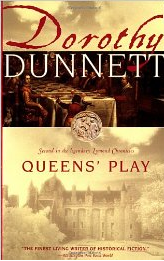
Cover for Queen's PlayBest Book of the Week!

Queens’ Play is the second book of Dorothy Dunnett’s excellent historical fiction series, the Lymond Chronicles. Although it is not absolutely necessary to read the first book, Game of Kings, you will enjoy the other books more if you do. If you decide to continue this series, it is important to read them in order after this one.

Francis Crawford of Lymond enters the scene disguised, and it is some time before we figure out which of two characters he is. Francis has been asked by Mary de Guise, Queen Dowager of Scotland and mother of Mary Queen of Scots, to travel to France and protect Mary. Although Mary is still a little girl, plots revolve around her, and her mother is afraid her life is at risk.

The Irish prince Phelim O’Liam Roe’s arrival into France is a spectacular one, as his ship almost crashes into another one when entering the harbor. This incident is perhaps not an accident, as evidence mounts that someone is trying to kill the prince. To the French court, O’Liam Roe is unbelievably provincial, and he is immediately the butt of ridicule. He is attracted to Oonagh O’Dwyer, an Irish woman living on the borders of society, but she disdains him. In fact, she is the mistress of the Irish rebel Cormac O’Connor.

O’Liam Roe has brought with him Thady Boy Ballagh, an ollav, or trained master poet. Untidy, fat Thady Boy is gaining popularity with the decadent French court through a series of reckless deeds and his brilliant musical performances.

It seems that the Queen Dowager’s fears are correct. During a hunt that employs the king’s leopards as hunting animals, someone lets Mary’s pet hare out in front of the cat near her pony. As she struggles to save her pet, the cat turns its sights on Mary.

As always, Dunnett combines heart-stopping action and suspense with a detailed knowledge of the period. This book begins some of the plot threads that will continue throughout the series.


Day 175: Death Angels

Cover for Death AngelsAlthough Death Angels is the fourth of Åke Edwardson’s books to be published in the United States, it is the first book in his Erik Winter series. I felt that this mystery flagged in the middle, although the beginning and ending were interesting.

Young men are murdered in a similar way in Sweden and London, so Erik Winter and his team get together with their London counterparts to solve the crime. When they begin to suspect that the murders may be connected with snuff films, Winter asks a childhood friend with ties to illicit porn for help. A break finally comes when a burglar reports seeing some blood-stained clothing in a house he’s broken into.

As I mentioned before, nothing much seems to happen in the middle of the book. It appears that some of the Scandinavian mystery writers are at pains to show realistically how long it takes to solve some crimes. This objective is a worthy one, but they need to also find a way to build suspense or keep the reader’s interest. The characters of the members of Winter’s team are not well developed, although an attempt is made to show other aspects of their lives. However, I especially disliked the subplot of the young cop with a pregnant wife who gets involved with a stripper.

Day 174: Pauline Bonaparte: Venus of Empire

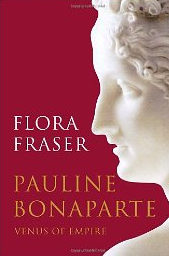
Cover for Pauline BonaparteI didn’t know anything about Pauline Bonaparte before I read Pauline Bonaparte: Venus of Empire. I picked it up because it was by Flora Fraser, a noted biographer who specializes in 19th century women. (She is also the daughter of Antonia Fraser, the famous biographer.)

Pauline Bonaparte was Napoleon Bonaparte’s youngest sister, renowned for her beauty. She lived a colorful life and is immortalized by a life-sized, nude statue by Antonio Canova that resides in the Villa Borghese in Rome.

The connection with the Borghese family is not one that they cherish. Pauline’s second husband was Prince Camillo Borghese. During their long marriage, they lived mostly apart, and Pauline entertained herself with numerous flagrant affairs.

In fact, Pauline’s reputation was dreadful. Napoleon’s enemies spread numerous rumors about her, even stooping to claim that her relations with her brother were incestuous. Not only did she not care, she encouraged that particular rumor to show how powerful she was.

Although she could be very charming, she spent most of her career manipulating infatuated men and intimidated women. Stories abound of her using generals as footstools, turning people our of their own houses, and so on. A particularly odd one was that when she was visiting an officer of the church, she made him cut a hole in the ceiling of his bathroom over the tub so that someone could stand on the floor above her and shower her with milk.

Although extremely jealous of the prerogatives granted her sisters (as they were of hers) and generally hateful to the Empress Josephine (she and her sisters held onto Josephine’s train during her coronation so that she could not move forward), Pauline’s most positive trait was her loyalty to her family. She was devoted, although not faithful, to her first husband, General Victor Emmanual Leclerc. When Napoleon fell out of power, she was persistent in trying to improve his living conditions and tried to get permission from the British to share his exile.

Fraser’s biography is interesting and well written. I found Pauline to be a fascinating subject, although not an admirable person.

Day 173: David Copperfield

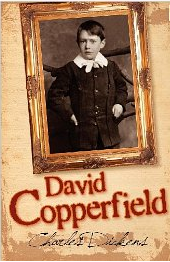
Cover for David CopperfieldBest Book of the Week!

I believe that David Copperfield was the very first book I ever received as a young girl that was not a children’s book. My dad brought it home for me one day when I was sick (beginning my collection of Modern Classics back when they were hardcover), and it transported me to another world.

People have differing opinions about which Charles Dickens book is best. For example, author Nick Hornby blogged that Great Expectations was one of the greatest books ever written. I myself have never fallen under the spell of Great Expectations, though. David Copperfield is my favorite. Tolstoy thought Dickens was the best of all English novelists and considered this book Dickens’s finest work.

David is the narrator of his own story, and he begins it on the night of his birth. David is a posthumous baby, and the novel begins with the first appearance of Aunt Betsey Trotwood, who comes to greet the appearance of her niece and terrifies David’s gentle, foolish mother. When David turns out to be a boy, Aunt Trotwood is mightily offended and departs.

Although David’s early childhood is idyllic, worshipped as he is by his mother and Peggoty the maid, it soon takes a turn for the worse. David’s mother is courted and won by the stern, apparently upright (and ultimately cruel and hypocritical) Mr. Murdstone, and the house is taken over by his cold and fault-finding sister Jane. David is a true innocent with only good intentions, but at every turn he is found to be in the wrong. He is soon shipped off to a typically horrible (if you know Dickens) boarding school.

After a bit of a rocky start, David finds himself made a pet of the popular Steerforth and also befriends Tommy Traddles. However, his mediocre education is interrupted when his mother and baby brother die. Mr. Murdstone sends him to London to lodge with the feckless Micawber family and work in a factory. When the well-meaning but impecunious Micawber is sent to debtor’s prison, David tires of his degrading life and runs off to find the only family he has left, Aunt Betsey Trotwood.

Although Aunt Trotwood is still disappointed that he isn’t a girl, she is kind, and from here, David’s life improves. The story continues with his education, marriage, and young adulthood. It is loaded with some of Dickens’s most delightful characters and a few villainous ones. Alternately turning from comedy to pathos, Dickens expertly drives the story along.

I believe one reason I find David Copperfield so touching is that David’s early life is taken from Dickens’s own. Dickens’s father was sent to debtor’s prison and Dickens went to work in a factory at an early age. This connection translates into a moving experience for the reader.

When innocent and loving David is punished by his stepfather because he is so terrified he can’t recite his lessons or when he is sent off to work in a factory, who remains untouched? When Barkis is willin’ or Mr. Micawber appears on the scene, who doesn’t laugh out loud? When steadfast and valiant Ham dies trying to rescue his rival, who isn’t tearful? When the slimy Uriah Heep finally gets his comeuppance, who isn’t delighted?

If you are not used to reading Victorian literature, you may find the writing old-fashioned, but you will almost certainly be carried along by the story.

Day 172: The Weird Sisters

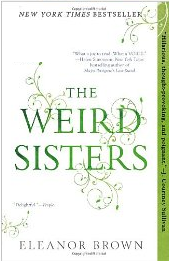
Cover for The Weird SistersRose, Bianca, and Cordelia Andreas are the daughters of a Shakespeare scholar who is obsessed with the Bard. From their earliest days they were taught to quote from Shakespeare plays, enact scenes, and use Elizabethan curses. Of course, they are named for characters from the plays. Their father’s way of communicating with them when they are away is to send them clippings from the Riverside Shakespeare. This is the setup for The Weird Sisters by Eleanor Brown. You might think such a gimmick would become tiresome, but it does not.

The three sisters have traits in common with their characters. Rose, like Rosalind, is smart and dutiful. Bianca is a flirtacious beauty. Cordelia is the much-loved youngest daughter. They are also a bit estranged from each other. Rose resents that she always has to be the responsible one, but Bean and Cordy think she takes too much upon herself. Both Rose and Bean are jealous of the unconditional love that Cordy receives from their parents. And Rose and Cordy think Bean has too great a need for attention, one that leads her to seduce men indiscriminantly.

When they receive a summons from their father because their mother has cancer (it says “Come, let us go; and pray to all the gods/For our beloved mother in her pains”), the lives of all the women are in disarray. Rose’s fiancé is about to leave for a  job in England, and he wants her to join him. She believes she is too urgently needed at home, where she is the organizer. Bean (Bianca) has been fired from her job in New York for embezzling the money she needs to perpetuate her lifestyle. Cordy has been living from man to man like a vagabond when she finds she is pregnant.

They all return to their crazy, poorly run childhood home, where piles of books are everywhere and all members of the family are perpetually reading but not, perhaps, cleaning. Slowly, the small town in Ohio that Cordy and Bean have been running away from begins to seem not so bad.

The Weird Sisters is an amusing, touching novel about how each of the women finds her path and reconciles with her sisters. It is extremely well written, and oddly enough, you do not tire of its devices.