Review 2763: The Lark Shall Sing

The other day a friend and I got on the topic of Elizabeth Cadell. She is an infallible read for a light-as-fluff experience. Most of her novels, written between the 1940’s and the 80’s, involve some kind of romance and sometimes a mild mystery. But she creates engaging characters.

This discussion reminded me that Cadell’s relatives had reprinted all her books—some not quite as good as others—so I decided to poke around and compare their list with the selection of mostly used books that I own. In poking around, I discovered that one of my favorites, Six Impossible Things, was not the second book about the Wayne family but the third! This meant, of course, that I had to buy the second and read all three. The Lark Shall Sing is the first. (Just an update: This whole discussion took place this spring, and I reread this book at the end of May. I just realized that although I read the first two, I forgot to read the third one. I’ll have to do that next.)

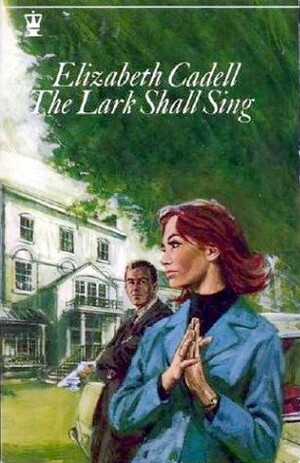
Lucille Wayne has come home to sell the family house, despite the recommendation to wait awhile by her godfather, Mr. Milward. She is from a large family now consisting of three young adult siblings and three child siblings. After their mother’s death, they stayed in the house a year, all except Nicholas, who was in the military, but Lucille convinced them to lease it for a year because they couldn’t afford it. Lucille had a job in Cornwall, and Roselle, having finished a secretarial course, was itching to get a job in London.

The year has elapsed, and the tenants, who once considered buying the house, were called back to South Africa. Lucille is engaged and plans to live with her fiancé Digby and his mother in Cornwall. Eleven- and nine-year-old Simon and Dominic are at school and live with their Aunt Mary, and ten-year-old Julia is at school and can spend the holidays with Lucille and Digby. Lucille has sent each of her siblings a letter instructing them to let her know which of their things they would like to keep.

Almost half the book is about them all coming home. Because as soon as they get Lucille’s letter, they all leave immediately for home, most of them with little money or preparation, to try to convince Lucille not to sell. On the way, the three children and Roselle are helped by three total strangers who somehow end up coming along. Roselle nearly faints when she gets off the train, and Miss Cornhill jumps off to help her, only to have her things go off in the train. Simon and Dominic arrive at the London station at rush hour, and Dominic is torn from Simon’s grasp and pushed onto the train while Simon can get nowhere near it. Simon is helped by Robert Debrett, who picks him up so he can signal to Dominic to continue, and drives him to the other end of the journey so he can meet Dominic’s train—in his limousine, because he’s a famous actor. Julia, exhausted and riding a bike too big for her, hits Italian brush salesman Pietro smack in the back and ruins his suit and brushes, but he puts her back on the bike and wheels her home. Nicholas arrives on a rickety motorcycle. Now, all everyone has to do is convince Lucille to keep the house.

This is a lovely book full of likable characters with some touching scenes, particularly the reunion between Simon and his dog, Long John. Of course, Lucille dislikes Robert on sight while Robert decides he’s sticking around to see if he can’t change her mind. What fun!

Related Posts

Money To Burn

Consider the Lilies

Death Among Friends

Review 2759: Pastel

A few months ago, I found there were several of Georgette Heyer’s books that I hadn’t heard of much less read. I managed to get ahold of a few, but so far, I’m finding there’s a reason why they haven’t been reprinted.

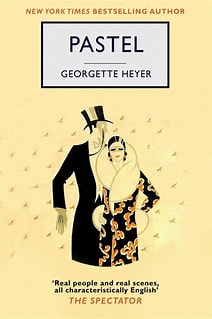
A puzzle about my copy of Pastel (not the one pictured) from Buccaneer Books is its listed copyright date. I wanted to see how old Heyer was when she wrote the book, so I looked at the copyright date, which says 1910! Heyer was only eight years old then! Her Wikipedia page says her writing career began in 1922, and a Google of the book’s publication date shows 1929, and judging by this cover, she was already well-known. So, where they got that date, I don’t know.

Now to the plot. Frances Stornaway loves her younger sister, Evelyn, but she can’t help feeling that she wants to be more like her. Frances is pretty, but Evelyn is beautiful. Evelyn does everything effortlessly, while Frances tries hard but doesn’t do as well. Evelyn is sparkling and outgoing and attracts people while Frances is shyer. Only their old friend Norman Acre doesn’t prefer Evelyn. He is in love with Frances, but Frances is too romantic to want to marry an old friend.

Frances’s godmother invites just Frances for a visit. Lady Twyford has been matchmaking, so Frances is met at the station by a man who looks to her like a Viking god, Oliver Fayre. She falls in love with him at first sight, and he seems to like her. However, when he comes to call on her, he meets Evelyn, and soon they are engaged. Frances keeps up a brave exterior so that no one knows she cares for Oliver.

Frances eventually decides she’s never going to be in love again. She is fond of Norman, so she decides to marry him.

This novel shows none of the sparkling wit of Heyer’s historical romances. I believe she was hoping to write a realistic book about a certain level of society. As in her other contemporary novels (not counting her mysteries), there are a few “intellectual” conversations meant to reflect what young people are discussing in those days. One was a pretty good satire of an avant-garde art scene, while the second was heaped with sexist assumptions made by both men and women.

But basically, the story follows Frances through very mundane scenes and conversations. The book is well written but predictable.

Related Posts

Instead of the Thorn

Helen

The Unfinished Clue

Review 2753: Woman at the Window

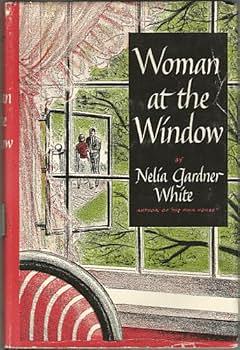
Although Elizabeth Burke leads a simple life, she enjoys it. She is looking forward to her new job in a bookstore when her brother-in-law Adrian calls. Her sister Anna has been told she won’t walk again. We’re never told what happened to her, but she has undergone two surgeries and refused a third that was supposed to either kill or cure her. Now Anna has asked Liz to come take care of her.

Liz is reluctant to go, citing a fear of losing her independence, but her issues are more complicated than that. And that’s one thing I liked about this book—everything is nuanced and complex, nothing black and white. Her friend and neighbor Lollie advises her not to go, but within a few pages, she has arrived at Anna’s home in Lakeville, New York.

There she finds a disturbing setup—Adrian is exhausted and seems to dislike her, having misunderstood her reluctance. Bunce, the cook and housekeeper, also shows dislike. Johnny, Adrian and Anna’s five-year-old son, avoids Anna’s room and spends most of his time by himself. Anna, who is charming to everyone else, is cold to Johnny. Adrian’s mother stays in her room all the time and doesn’t seem to notice Johnny much.

The crux of the novel is the relationship between the two sisters and between Anna and everyone else. Anna is charming and everyone loves her. Her bedroom receives visitors constantly. She talks affectionately to Liz but calls her her pony to other people. LIz has always adored Anna but previously Anna never seemed to heed her very much. She has seen Anna tire of people and doesn’t want her to tire of herself.

Liz is self-conscious about her looks and dresses badly while Anna is described as looking like Alice in Wonderland, fragile and beautiful. But Liz doesn’t understand her own qualities. There are a few instances, for example, when her intervention or comment helps another person, but she always attributes the help to Anna.

I disliked Anna. I could see that under her much-vaunted charm she sometimes makes knowingly hurtful remarks. Liz, although sometimes abrupt, is much more attuned to other people’s feelings. The situation becomes more intense when a friend gives Anna a mirror, to be put outside her house so that from the window she can see everyone who goes by. She becomes relentless about ferreting out people’s secrets, and she doesn’t seem to understand that she has no right to know them. Twice, she makes it appear that Liz has divulged someone’s secret when she has not and causes trouble by letting people know she knows their secret or by telling it to someone else.

Liz has a secret she doesn’t want Anna to discover. It’s that she’s fallen in love on sight with Huxley Reals, an employee of Adrian’s company. But Huxley is Anna’s devoted slave, coming constantly to visit her.

As Liz gets acquainted with the community, her influence begins to help particularly the people in their house. She pays attention to Johnny and he slowly opens up. She says something to get his grandmother to spend time with him. She cautiously makes some friends. But she believes she will be leaving, even continuing to pay rent on her old room, and everything in her life is overshadowed by her complex relationship with her sister.

I liked this book, which was published in 1951, a lot. I sympathized with plain, abrupt Elizabeth and felt she underrated herself and overrated Anna. I liked several other characters in the novel as well and thought it was an interesting character study.

Related Posts

The Pink House

A House in the Country

Revolutionary Road

Review 2744: Classics Club Spin Result! Our Mutual Friend

One of the pleasures for me in rereading some of Dickens’s more massive works is the plethora of characters and plots and the author’s skill in linking them all up. Our Mutual Friend is one of those books, and it was chosen from my list by the latest Classics Club spin.

The novel begins when Jesse Hexam, a waterman, and his daughter Lizzie fish a body out of the Thames. A sequel to this incident is related by Mortimer Lightwood, a man of law, at a party. He tells the story of a man named Harmon who became fabulously wealthy dealing in dust. He had two children. He threw off his daughter for marrying a man with no money, and when his son came from school to defend his sister, he threw him off, too. When Harmon dies, he leaves the lowest mound of dust to an old family servant, Mr. Boffin, and the rest to his son, John Harmon, as long as John marries the girl his father has chosen for him. The son is located after an absence of twelve years, but then he is drowned after returning, a body of a gentleman having been found with only Harmon’s card on his person.

Brought to identify the victim is a young man named Julian Handford, but he is unable to identify the body. When next we see this mysterious young man, he is called John Rokesmith and has soon offered himself as secretary to Mr. Boffin, the residual legatee to Harmon’s estate, now wealthy.

The Boffins are honest and unsuspecting people who, we learn, were the only comfort for John Harmon in his younger years. Since they have inherited John Harmon’s estate, they decide to offer a home to Bella Wilfer, the girl that the elder Harmon had picked out to be wife for his son, reasoning that they have deprived her of wealth. Our first meeting with Bella is not the best. She is both angry at being parceled out to be a wife for a man she never met without her consent and yet determined to marry money, because she is sick of being poor. The ubiquitous Mr. Rokesmith has taken a room at her parents’ house.

The Wilfer family comprise Mr. Wilfer, described as a cherub, with a generous and pleasant disposition; Mrs. Wilfer, a grand, bitter lady who terrifies her husband; Bella, a beautiful spoiled girl; and Lavinia, a little shrew. To her credit, though, Bella likes the unsophisticated Boffins and accepts their invitation.

This is just the beginning of a complex story that features a character with a secret identity; a murder; a man consumed by jealousy; the pursuit of a beautiful but socially inferior girl by an idle member of society; an attempted murder; betrayal by an employee; a selfish brother; an unselfish sister; a kind old Jewish man who suffers many insults; a doll’s dressmaker; and much more. This novel is so complex, but it features characters that you care about, characters that you hate, passages that make you laugh, others that bring a tear. In short—everything you expect from Dickens. Although not as well known as some of his novels, this is one of my favorites—after Bleak House and maybe tied with David Copperfield.

Related Books

David Copperfield

Bleak House

Dombey and Son

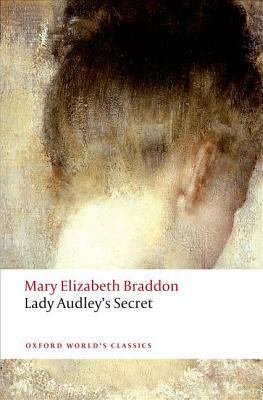
Review 2734: Review-Along! Lady Audley’s Secret

Yesterday FictionFan was hosting a Review-Along of Lady Audley’s Secret, a book I thought I read long ago but did not really remember. I wasn’t able to participate yesterday because of Literary Wives, but today I can.

As I said, I thought I had read Lady Audley’s Secret long ago, but apparently I was wrong. Nothing in this book was familiar.

Lady Audley is newly married. She is a young, beautiful, child-like woman who was working as the governess for a doctor’s children when she met the much older Lord Audley. He is enchanted by her, but his daughter Alicia thinks she is superficial.

After we meet Lady Audley in her beautiful old home, the narrative skips to a young man, George Talboys, returning to England after three years in Australia. He left his young wife and child in the care of her father, because his father disowned him when he married, and the couple has run through his money. So, he departed to seek his fortune and is returning a wealthy man, eager to see his wife. However, he is stunned after he finds a newspaper announcement that she has died.

His friend Robert Audley, Lord Audley’s nephew, takes pity on him, and the grieving Talboys moves in with him. Sometime later, Robert thinks it will enliven George to visit his family at Audley Court. The young men repair to an inn nearby. First, Lady Audley makes excuses to delay a family dinner, and then she has to travel out of town because an old friend is on her deathbed.

We think we already understand Lady Audley’s secret when George catches a glimpse of her in her carriage and becomes preoccupied. The next day the two young men are fishing when Robert falls asleep by the stream. When he awakens, George is gone, yet he is not in their room at the local inn. He was last seen walking toward the dark lime avenue where Lady Audley was supposed to be. Robert assumes George returned to London, but he is not there, and his things have not been disturbed.

When George doesn’t resurface or respond to advertisements and Robert can find no evidence that he took a boat to Australia, as Lady Audley claims, Robert begins to have dreadful thoughts. He begins trying to trace Lady Audley’s past.

I can imagine that this Sensation novel made quite an impact on Victorian society. I thought it moved along pretty well and only was frustrated by the number of times conscientious Robert tells Lady Audley what he’s found out and what his next move will be, hoping she will go away and not wanting to give his uncle a shock. But Lady Audley thinks her husband will believe anything she tells him.

There are a few little perplexing complaints against women in general in the book, but otherwise, I thought the story was quite entertaining, gaining most of its impetus from a contest of wits. It also has an interesting secondary character in Robert’s cousin, Alicia.

Related Posts

The Dead Secret

The Moonstone

Red Pottage

Review 2716: #1961Club! Revolutionary Road

Nineteen sixty-one must have seemed like a year of great let-down across the world. At least it would seem so based on the books I chose for the 1961 Club, which were uniformly depressing—except for The Prime of Miss Jean Brodie, which has its own sting.

Frank and April are a young couple who have moved out to the suburbs in Connecticut for the sake of their two young children. There, they speak almost unceasingly about the dreary lives and people around them, implying their superiority as cultured ex-New Yorkers.

We meet them at the performance of an amateur play—clearly an attempt to bring a little culture to the drab lives of their neighbors. April has the lead, and at first everything goes well even though the leading man called in sick. But the pathetic attempts of his substitute throw her off. The play is a disaster. What was striking to me was that April doesn’t want to talk about it, but Frank talks and talks.

Frank is a talker. He’s developed a reputation as a thinker because of his talking. But as the book progresses, he continually uses this type of badgering to get his way.

April seems to be trying to find her way back to something more than being a wife and mother. At one point, she suggests that they all move to France in the fall. She can take secretarial work at an embassy, and he can use the time to discover what he really wants to do, because it’s certainly not the job he has.

Frank has taken a position in the most boring job he can think of as a sort of elaborate joke and assurance that he won’t want to stay there more than a few years. He spends his days shoveling paperwork around and pretending to be working. But it’s a little brochure he throws together to get someone off his back that changes the possibilities of work.

I felt as if Frank was never really serious about going to France while April is steadily working toward that goal, but then a hitch appears.

I really disliked these characters and their superior attitudes until I began to feel a little sorry for April. Certainly, the novel evokes the sterility of suburban living, but it made me dislike Frank especially, as he turns his arguments against even April’s mental well-being.

Related Posts

Mrs. Bridge

Recipe for a Perfect Wife

The Amateur Marriage

Review 2715: #1961 Club! Sunlight on a Broken Column

Here’s another book for the 1961 Club!

When this novel begins, Laila is a 15-year-old orphaned girl from a Muslim family that is part of the elite Taluqdars, equivalent to England’s landed gentry, in Lucknow during the 1930s. She has grown up in the house of her grandfather, a large household of aunts, cousins, and servants. In the beginning of the novel, though, her grandfather is dying, and it’s not difficult to guess that changes are in store.

The changes in this household are not the only ones coming, as evidenced by the arguments between Laila’s two teenage cousins. One of them sees his future as a government employee while the other wants independence from the British.

After her grandfather’s death, the head-of-household becomes her Uncle Hamid, who prefers a more English lifestyle than the traditional one her grandfather followed. Laila had been allowed an education with a governess in deference to her own father’s ideas, but this had ended before her grandfather’s death. Now her home is totally different, her aunts gone to be married or live elsewhere, the familiar servants replaced or sent to the country estate, the visitors most often Hamid’s political friends and acquaintances. Laila is allowed to go to university, but she knows her aunt dislikes her, and her home life is cold and isolated.

Uncle Hamid believes that the move toward democracy is a threat to the entire class of Taluqdars, so he is working politically to protect it. But some of his younger relatives feel that the dissolution of the system would be better for ordinary people. Laila tends to observe and have sympathies but no impulse to action.

This novel is a compelling record of a way of life that is completely gone less than 20 years after the beginning of the story—the family broken apart by the partition of India. It is interesting to see Laila move from the life in purdah to the more social existence required by her uncle’s lifestyle. The novel is very much also about how class distinctions affect people’s lives.

Related Posts

The Covenant of Water

The Widows of Malabar Hill

Nectar in a Sieve

Review 2706: Classics Club Spin Result! Love’s Labour’s Lost

Love’s Labour’s Lost is the work I drew for the Classics Club spin, and it seems like a bit of a curiosity. Despite having taken several Shakespeare courses during my academic days and having attended quite a few performances, I have never read this play or seen it performed.

My Riverside edition says that the play is Shakespeare’s most Elizabethan, with lots of wordplay and references to current events and people. It also has hardly any plot. It is certain that it is meant to be a romp and that lots of things went over my head.

The King of Navarre intends to found a learned Academe in his court. To kick it off, he has got three noblemen of his court to join, and part of this is a vow to only study and fast, and to stay away from women for three years. This silly idea is already threatened, because the King has forgotten he is to receive a state visit from the Princess of France.

There is a lot of tomfoolery with the Clown and a boastful Spaniard, but the thrust of the story is that of course as soon as the young men see the Princess and her ladies in waiting, they all fall in love. But they have already made a bad impression by receiving the Princess in a field (so as not to have broken the vow to have no women at court) and the ladies are not disposed to take them seriously.

In general, I tend to get along a little better with Shakespeare’s tragedies than comedies, except that I love Much Ado about Nothing. I also think the comedies are much more effective when played than read. Sections of this play are almost all punning and wordplay, but Shakespeare has been able to introduce some beautiful lines in the form of love billets. In any case, this wasn’t my favorite of his plays.

Related Posts

All’s Well That Ends Well

Antony and Cleopatra

Othello

Review 2702: Pontoppidan Review-along! A Fortunate Man

Yes, here it is, time for the Pontoppidan Review-along. Join me and FictionFan and post your own review or leave comments! FictionFan and I decided to read A Fortunate Man, but others of you may have chosen some other work by Pontoppidan.

A Fortunate Man is considered the most important work by Danish Nobelist Henrik Pontoppidan. It is an ambitious work that attempts to capture all the ideas and events affecting Danish life in the mid to late 19th century, and it is also considered to be quite autobiographical. The tensions between the new industrialism and accompanying modern ideas and traditional views of religion is one of the many themes of this novel.

Per Sidenius grows up in rural Jutland in a household dominated by a strict and self-righteous father—a Lutheran vicar. Per is a high-spirited boy, and his father and entire family treat him as if his boyish antics are paving the way to hell. His mother has been bedridden as long as he can remember. Per does not feel as if he belongs there.

This upbringing results in a young man who can’t wait to leave his home and deny all of his father’s religious beliefs. He wants to be an engineer, so his father finds the money—they are poor—to send him to technical school in Copenhagen. But Per is an arrogant youth determined to make his way, and he finds school a waste of time. Instead, he reads voluminously and starts working on a massive project. The growth of Denmark has been stunted since the country lost territory to Germany in the war of 1864. Per feels that Denmark has become a backwater, especially technologically, with its prominent citizens only protecting the status quo. He conceives of a plan to reopen the many waterways that used to cross the Jutland Peninsula, beginning with a freeport in the East, with the idea of revitalizing the entire area. (His dream of lining this waterway with warehouses and factories doesn’t exactly suit our modern sensibilities, but this was the Industrial Revolution.) But he is an unknown very young man with no backing or credentials. Once he finishes his plans, he finds he’s not getting anywhere. And he needs money just to live.

Per falls in with the Salomons, a family of wealthy Jews. He thinks perhaps his problems will be solved by marriage to one of their daughters and is extremely attracted to the younger one, Nanny. However, as he gets to know them, he realizes he cares for the older sister, Jakobe, a much more intelligent and cultured girl. He is also attracted at first by the family’s relaxed and hospitable approach to life. (Later, though, he starts being embarrassed by their outgoing manners and love of show, so beware, this novel contains lots of anti-Semitism. Even Per, engaged to a Jewish girl, tends to stereotype them, as in general, there is a lot of stereotyping of people of various nationalities and groups like Danish farmers, too.)

At first, Jakobe doesn’t like Per, but he is persistent and wins her over so that eventually her parents reluctantly betroth her to Per. Although Jakobe’s brother Ivan works hard to promote Per’s plan and try to line up backers, Per himself is condescending and rude to the money men (they’re a bunch of money-grubbers, he thinks!) and seems to lose interest in the project. Instead, he goes off traveling, supposedly to study but seeming to do little of that (all the while being supported by Mr. Salomon).

Per feels he is never at home anywhere. His father dies, and this death affects him by having him begin to obsess about and eventually re-embrace Christianity, just not the bleak one his father represented. And frankly, he treats Jakobe shamelessly, just before they are supposed to be married.

Pontoppidan is a Realist writer, and I often think that the Realists spend too much time on the negatives of human behavior. Almost up to here, I was rooting for Per, but when he starts delving into religion and we have to read excerpts from religious philosophies and endless ruminations by Per, I lost most of my interest (religion is a black hole to me), and frankly I felt that his behavior from there to the end was even more self-serving than before. In a quest for self-realization, which sounds laudable, I felt as if he would decide what he wanted to do and then find self-justifications for his actions.

Spoilers ahead! There is a scene where he’s basically unloading his family (he feels it would be “best” for them), and first he tells his religious wife that he doesn’t believe in God (is he lying?) and then lies to her that on a business trip to Copenhagen he met another woman, so it will be “easier” for her to split from him. She’ll understand that. (Of course, she’s a simpleton who doesn’t understand anything, at least not according to him.) When she leaves in anger, he looks up to heaven and asks if that was the right sacrifice. Doesn’t believe in God? His sacrifice? He just wants to be free and has found a way to do it. I ended up hating this guy. And then there’s the letter he gets from her years later thanking him for doing the right thing. Sure. I totally buy that.

I really enjoyed Pontoppidan’s The White Bear and about a half to three quarters of this novel. But at some point, I began to feel as if I had been reading it forever. The rest of the novel made me at first bored and then angry. I suspect from reading Pontoppidan’s Wikipedia page that this novel is at least partly biographical. If it is, he wasn’t a very nice man.

A very slight issue. I’m not sure how New York Review Books prepares its reprints and whether machine reading is involved, but usually their editions are immaculate. In this one, though, I spotted three confusions of homonyms in the first 100 or so pages. Interestingly, two of them were the reverse confusion of “bear” and “bare.” That is, in one instance “bare” should have been used but “bear” was, and in the other, the reverse. (One might have been “bear-faced.” I can’t remember.) I couldn’t tell if this was a machine-reading error not detected by an editor, an editing error, or a translation error.

Check out other reviews of Pontoppidan’s books for this event here. I’ll add them as I become aware of them:

Related Posts

The White Bear

We, The Drowned

The Unseen

Review 2700: World of Wonders

World of Wonders is the third book of Robertson Davies’ Deptford Trilogy and the one I least got along with. All three books deal with the repercussions of a malicious act—a snowball with a rock in it that Boy Staunton threw at Dunstan Ramsay when they were boys.

To make any sense of the plot of this one, I have to recap the action of the first book, so if you are planning to read it, you might do better to just read my review of it, Fifth Business. Boy’s snowball hits, not its intended target because Ramsay ducks, but the pregnant wife of the vicar, Mrs. Dempster. Her son Paul is born prematurely, and Mrs. Dempster is not quite right thereafter. Paul disappears as a boy and reappears after years and years as Magnus Eisengrim, the world-famous magician. Fifth Business ends with Boy Staunton’s possible suicide/possible murder with the selfsame stone in his mouth just after Boy meets Magnus. Did Magnus somehow murder Boy?

In World of Wonders, Dunstan Ramsay, now an old man, is living with Magnus and his friend Liesl. Magnus is starring in a film about another magician, French illusionist Robert-Houdin, and three of the film makers are visiting. Magnus has published a largely imaginary biography through Dunstan and now he agrees to tell the true story of his life from the time he disappeared as a boy. It’s quite harrowing at first, because he was kidnapped by a small-time magician in the World of Wonders carnival, held captive, and repeatedly sodomized. That’s just the beginning of an unusual and varied life.

I thought the story of Magnus’s life was interesting, but after each segment, his friends sit around and philosophize about it, maybe the sort of discussion that is exciting and interesting when you’re engaged in it but frankly not very interesting to read, at least not to me. I thought we were leading up to some surprising exploration of Boy Stanton’s death, but that wasn’t exactly how it ended, or at least what was revealed was not surprising.

Of the three books, I really enjoyed Fifth Business. The Manticore, from the point of view of Boy’s son David, was less interesting because of its emphasis on Jungian therapy. And I found this book the least interesting. In fact, I kept putting it down and reading other things, which is not usual for me.

Related Posts

Fifth Business

The Manticore

The Bird Artist