
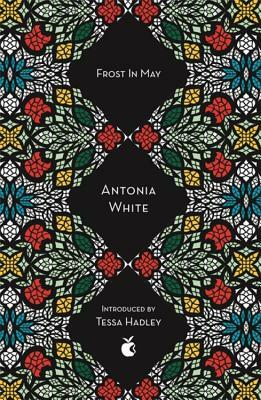
I am not at all religious, in fact, have always felt little interest in what bits of religion I encountered as a child. And I have no opinion about Catholicism. So, it’s going to be hard to write this review without sounding anti-Catholic. I promise I am not. But anti the way this school is run—yes.
Nanda Grey’s father is a recent convert to Catholicism, and Nanda also is eager to embrace it. So, her father has enrolled her in school at the Convent of the Five Wounds. It is a very strict school. Letters in and out are read, even to and from parents, censored and sometimes confiscated. Girls are not allowed to be in pairs. Pictures and text are cut out of storybooks, which in fact are only occasionally available. All the students’ reading seems to be on religious topics. Not much time is spent in the novel discussing school subjects, but a lot is spent on religious matters. In fact, for a while I wondered what else the children might be learning, if anything (but apparently some Latin is included, big surprise).
Nevertheless, Nanda is fervently involved in all this, even though she is periodically checked by Mother Radcliffe, who seems to find her willful. (The idea is to break the will, which I think is awful.)
It took me longer to read this short book than it should have because I got really tired of the religious bent to it. In fact, there are about six pages of Nanda’s meditations that she wrote during a retreat, and I completely skipped them. But I was appalled by some of the ideas of the school. For example, when Nanda is still quite young, she talks about how every child should be prepared and happy to die at any moment. It’s in a sermon by a priest, but it’s obviously part of the girls’ consciousness—and embraced. I found it shocking.
Throughout, there are events and incidents that show constant attempts to work against the girls’ natural likes and interests. Parts are assigned in a play not based on the girls’ interests or abilities but counter to them. And the lead, Nanda’s best friend Léonie, who is very good at her part, is removed from it because she’s enjoying it.
Nanda’s enthusiasm and devotion begin to encounter setbacks as she approaches the age of fourteen. Then she runs into a major obstacle, one that even affects her relationship with her beloved father.
The novel doesn’t have much of a plot but is more involved with the daily details of school life.


I read that it’s based on the author’s own experience in a pre First World War convent school.
I think that’s true.
I’m not religious either so this doesn’t really appeal to me. That school does sound horrible!
I guess the title says her ultimate opinion of it.
Not for me – the school sounds terrible, and the religious stuff would bore me, I’m afraid!
Moi aussi!
It does sound awful, but I bet most schools for girls were pretty awful at that time, as were schools for boys. Certainly the choice of reading materials was skewed towards Christian moralising no matter where it came from. I studied children’s lit including its history so I had to read examples of the ‘improving’ stories for children’ of the C18th and C19th, and they were always more ‘improving’ for the girls, who delivered charity baskets on Sundays as part of their evangelical duties, and Felt Joy as they did it. (Boys learned to be manly, of course, and laughed at little ‘dandies’ depicted grotesquely in illustrations. But they were (inevitably) always kind to ‘poor boys’ who could not read middle-class books like they could).
Then we progressed to the C20th, and we read stories of jolly girls playing hockey and spurning anyone who sooked over being sent away from home or breached the (children’s) moral code of the boarding school. They were always fiercely patriotic and deeply suspicious of anyone from Europe, plus anti-German by default. It was such a relief when we reached the post war period and the stories for children were interesting in their own right rather than as curiosity pieces.
The text we read as a source was Childhood’s Pattern, a study of the heroes and heroines of children’s fiction 1770-1950 by Gillian Avery (1975) and it was really interesting. But since then I bet (I hope) someone’s written something more up to date, to include the postwar period, feminism in the 70s, and globalisation.
I read this a few years ago and was actually riveted because so much of it I related to! That horrible seen where she has to wait outside the office for her father to speak to her had me physically catching my breath. It was protestant not catholic but it’s all the same when it comes to fanatics! Thank goodness I’m an adult now
Wow! I don’t envy you!