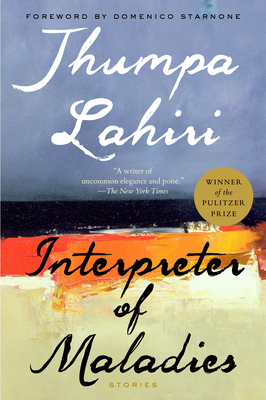
Review 2733: Literary Wives! Interpreter of Maladies

Today is another review for the Literary Wives blogging club, in which we discuss the depiction of wives in fiction. If you have read the book, please participate by leaving comments on any of our blogs.

Be sure to read the reviews and comments of the other wives!

This month we’re saying goodbye to Naomi of Consumed By Ink, who has been a member of the club for a long time. Good luck, Naomi!

My Review

Interpreter of Maladies is a collection of short stories mostly about Indian or Pakistani immigrants but a few about residents in India. Only a few of the stories seem suitable for our discussion purposes in Literary Wives.

In “A Temporary Matter,” married couple Shoba and Shukumar deal with the consequences to their marriage of the death of their baby in a premature birth. During a Boston winter, the city announces planned power outages in their neighborhood. They find that they are able to talk in the darkness lit by candlelight.

In “When Mr. Pirzada Came to Dinner” a woman remembers a man from Dacca who lost everything in the war for Bangladesh. He has had no contact for some time with his wife and daughters. Ten-year-old Lilia’s parents invite him to dinner every night, and then they watch the news.

The “Interpreter of Maladies” is an English-speaking tour guide taking Mr. and Mrs. Das and their children around an area of India. Although they look Indian, they act and dress like American tourists, and Mr. Kapasi learns they were born in America. When Mrs. Das learns Mr. Kapasi also works as an interpreter of Gujarati in a doctor’s office, she seems to misunderstand his function.

“A Real Durwan” is the story of Boori Ma, who lives in a storage room on the roof of an apartment building and sweeps the stairs. She speaks of a better life before the Partition, but disaster strikes when her quilts are ruined in a storm. This story seems to be about the incomprehension of the better off for the difficulties of the very poor.

Back in the States again, Laxmi tells her friend Miranda about her cousin’s problems in “Sexy.” Her cousin’s husband has met another woman and is leaving her. Miranda has kept secret her affair with a married Indian man named Dev, but her encounter with Laxmi’s cousin’s young son makes her re-evaluate her affair.

In “Mrs. Sen’s,” young Eliot stays with Mrs. Sen after school every day. She is having a hard time adjusting to life in the U. S., especially the isolation and difficulties shopping because she doesn’t drive.

Twinkle keeps discovering gaudy religious artifacts in the house she and Sanjeev have bought—statues and large pictures of Jesus and shrines in the yard in “This Blessed House.” `She thinks they’re hilarious and puts them on display. He thinks they should dispose of them because they’re not Christians and worries about what people will think. Sanjeev is a very successful management type who has married after short acquaintance because it’s time. But he is disturbed by Twinkle’s outgoing personality. A house-warming party helps him look at her another way.

Another roof dweller in India is the subject of “The Treatment of Bibi Haldar,” a woman who suffers from seizures. After charms and homeopathic remedies fail to heal her, one practitioner recommends marriage. But her brother and sister-in-law don’t want to spend the money to marry her off and she is eventually forced to live in the rooftop shed because her sister-in-law is afraid her condition is contagious.

In “The Third and Final Continent,” an Indian man marries before taking a job in an MIT library in 1964. The summer before his wife arrives, he takes a room in the house of a 100-year-old woman.

What does this book say about wives or about the experience of being a wife?

Actually, when the story is about marriage, it is more often from the point of view of the husband. Only a few of these stories lend themselves to our usual discussion, and anyway in Lahiri’s stories, more things are implied than stated. But certainly the isolation immigrants experience in the States is a common theme of much of her work, and that isolation often reflects itself in the characters’ marriages.

In “A Temporary Matter,” the marriage of Shukumar and Shoba was apparently a love match, and now it is foundering because of the death of their baby in a premature birth. When the two begin talking by candlelight, Shukumar seems to be hoping they can become closer again, but Shuba is leading up to something else. Noticeable in this story is Shukumar’s incomprehension.

The glimpse that Mr. Kapasi gets into the Das’s marriage in “Interpreter of Maladies” isn’t one he wants, but why does Mrs. Das confide in him in the first place? This story is more, though, about Mr. Kapasi’s lack of understanding of the type of person Mrs. Das is.

“This Blessed House” is about a newly married couple trying to understand each other, or more particularly, Sanjeev’s lack of understanding of Twinkle. I have noticed that Lahiri often works from the man’s point of view when observing marriage, and she does so again here. Sanjeev is so worried about what other people think that it takes a party at his house, in which his guests clearly like and admire his wife, for him to start to appreciate her qualities.

Literary Wives logo

In “The Third and Final Continent,” the unnamed narrator has married Mala, a woman he hardly knows. When she arrives from India, it is his relationship with old Mrs. Croft that brings out her first smile.

Culture shock and isolation are big themes in Lahiri’s literature, and many of the marriages she examines seem to be filled with incomprehension and more isolation. But not all. In her looks at marriage, she seems to be saying we’re all strangers to each other and some of us can bridge the gap while others cannot.

Related Posts

Unaccustomed Earth

The Lowland

The Namesake

Review 2715: #1961 Club! Sunlight on a Broken Column

Here’s another book for the 1961 Club!

When this novel begins, Laila is a 15-year-old orphaned girl from a Muslim family that is part of the elite Taluqdars, equivalent to England’s landed gentry, in Lucknow during the 1930s. She has grown up in the house of her grandfather, a large household of aunts, cousins, and servants. In the beginning of the novel, though, her grandfather is dying, and it’s not difficult to guess that changes are in store.

The changes in this household are not the only ones coming, as evidenced by the arguments between Laila’s two teenage cousins. One of them sees his future as a government employee while the other wants independence from the British.

After her grandfather’s death, the head-of-household becomes her Uncle Hamid, who prefers a more English lifestyle than the traditional one her grandfather followed. Laila had been allowed an education with a governess in deference to her own father’s ideas, but this had ended before her grandfather’s death. Now her home is totally different, her aunts gone to be married or live elsewhere, the familiar servants replaced or sent to the country estate, the visitors most often Hamid’s political friends and acquaintances. Laila is allowed to go to university, but she knows her aunt dislikes her, and her home life is cold and isolated.

Uncle Hamid believes that the move toward democracy is a threat to the entire class of Taluqdars, so he is working politically to protect it. But some of his younger relatives feel that the dissolution of the system would be better for ordinary people. Laila tends to observe and have sympathies but no impulse to action.

This novel is a compelling record of a way of life that is completely gone less than 20 years after the beginning of the story—the family broken apart by the partition of India. It is interesting to see Laila move from the life in purdah to the more social existence required by her uncle’s lifestyle. The novel is very much also about how class distinctions affect people’s lives.

Related Posts

The Covenant of Water

The Widows of Malabar Hill

Nectar in a Sieve

Review 2496: The Covenant of Water

In 1900, a 12-year-old girl, later known as Big Ammachi, travels to meet her future husband and marry him. Almost immediately after her father died, her uncle married her off. She is lucky, though, because her thirty-some husband makes no effort to consummate the marriage until she is 19. In the meantime, she acts as a mother to his little son Jo Jo and takes care of the house.

Although they live in southwestern India, on the Malabar Coast, an area where people are constantly in boats or on the water, she notices that her husband and Jo Jo avoid the water. It is not until Jo Jo dies in a tragic accident that she learns some members of her husband’s family suffer from the condition of disorientation in water that often results in drowning.

In 1933 Madras, Digby Kilgour, a Scottish surgeon, arrives to take up a position at the hospital. Although he was at the top of his class, he has found that his origins as a poor Glaswegian have kept him out of the positions where he can work with a more experienced surgeon. At the urging of one of his professors, he has applied for a position in India.

He finds fairly quickly that his superior, Claude Arnold, is incompetent, so he begins spending time at another hospital, working with an Indian surgeon. He falls in love, however, and this ultimately results in tragedy, turning his life toward a different direction.

Verghese takes his time, introducing many characters and stories and taking the reader through two more generations to the 1970s. He moves between these stories, eventually linking them.

Verghese is an enthralling story teller. Although on occasion he gets a little too deep into medical topics, for the most part, he gets us involved, depicts vivid sights and smells, and carries us along with his tale. Like those of some other writers of Indian descent that I’ve read, his tales loop and branch, but they eventually converge and resolve.

Related Posts

Cutting for Stone

Sea of Poppies

The Glass Palace

Review 2087: Burnt Sugar

When Antara was three, her mother Tara took her and left her home out of boredom to join an ashram, becoming the guru’s lover. In the ashram, Antara hardly ever saw her mother, and when she did, Tara alternated between effusive love and abuse.

Now Antara notices her mother is losing her memory. Although she tries to help her with diet and memory exercises, she still bears her a lot of resentment for events in the past. But this novel reveals its secrets slowly, and its secrets include betrayal. This novel, which I read for my Booker project, is mostly a character study about a woman who felt unloved as a child and is still suffering.

Antara is an artist, good enough to have her own show in a gallery, so I found it disturbing how slighting her family was about her art. When her mother burns some of her drawings, no one is upset, and later someone refers to her art as a hobby.

Antara is not a reliable narrator, nor is she a likeable person, but I found this novel fascinating.

Related Posts

The Blazing World

Suzanne

Black & White

Review 2034: The Year of the Runaways

The Year of the Runaways is another book I read for my Booker Prize project. It follows the fortunes of a group of young Indian men who are living illegally in England looking for work.

Tochi is a young man from a low-caste family who in India had been finally getting his head above water since he had bargained for an auto so that he could work as a taxi driver. But after an election where one party rabbled-roused on the slogan of “racial purity,” his entire family was murdered. He travels illegally to England to start again.

Alvar’s father’s shawl business isn’t doing well and his younger brother will soon have school fees to pay. He also wants to marry Lakhpreet, his friend Randeep’s sister. He is able to get a student visa for England with no intention of studying, because he has had to borrow money from a moneylender for his fare.

Randeep comes from a wealthier family, but his father, a government official, loses his job after a mental breakdown. Randeep is kicked out of college in India and attacked for sexually assaulting a girl because he is constantly misreading people’s reactions. To get to London, he enters into a visa marriage with Narinder, a devout Sikh.

All of these young men travel to England with completely unrealistic ideas of how much money they can make or how easy it will be to even find work. They end up living together in a house packed with illegal immigrants working for low wages at menial work, most often employed by their own countrymen. Those with families receive constant demands from them for more money. And things get worse.

This novel is a throw-back to the 19th century social realism genre. The story is compellingly told and illuminates the dilemma of the illegal immigrant. I didn’t feel particularly attached to any of the characters, but I felt sorry for all of them.

Related Posts

The Lives of Others

Nectar in a Sieve

The Lowland

Review 1881: Death in Kashmir

A quote on the cover of Death in Kashmir compares M. M. Kaye to Agatha Christie. A more accurate comparison in terms of the type of novel it is—romantic suspense rather than mystery—is to Mary Stewart, although there is just something about a Mary Stewart book that this novel doesn’t quite have. Still, Death in Kashmir is entertaining enough.

The novel is set in 1947, the year before the British left India, and it provides an interesting look at the life of British upper-class people living there at the time, although the natives are mostly only in the book as servants.

Sarah Parrish goes to Kashmir to attend the last meeting of the India Ski Club at Gulmarg in a primitive hotel that is usually only open in the summer. The outing has already been shadowed by the death that day of Mrs. Matthews in an apparent skiing accident. In the middle of the night, Sarah awakens to a scraping noise and realizes someone is trying to break into the room next door, that of another young woman, Janet Rushton. Sarah quietly hurries to Janet’s door to warn her and is shocked to be greeted by a drawn gun. However, when Janet sees someone has tried to enter by the bathroom window, she confides in Sarah that she is an agent for the government. She and Mrs. Matthews discovered an important secret and were waiting for help from their superiors when Mrs. Matthews was murdered.

A few nights later, Sarah and Janet have joined an expedition farther up the mountain to ski and spend the night in a ski hut. Sarah catches Janet ready to ski off in the middle of the night because she has finally been contacted by her people. The next day, she too is found dead.

Returning to Peshawar after the trip, Sarah tries to forget what she has learned, but she receives a letter from Janet’s attorney enclosing the receipt for her houseboat in Srinagar and telling her the secret can be found there. So, she finds herself returning to Kashmir with her friends Hugo and Fudge Creed. There she encounters all of the people who were on the ski trip, with a few extras, like the attractive Captain Charles Mallory.

The Cold War plot seems a little silly when compared to those of some of the masters, like Le Carré (and may more fairly earn the comparison to Christie, who also has some silly Cold War plots), but it leads to plenty of suspense and an unguessable villain. A small criticism is that both sides seem to have so many helpers that it’s no wonder there was a leak. A bigger caveat is that the explanations at the end go on for quite a while longer than seemed necessary.

Related Posts

This Rough Magic

The Spy Who Came in from the Cold

Code to Zero

Review 1869: The Widows of Malabar Hill

In 1920’s Bombay, Perveen Mistry is the only female lawyer in the city. She is working with her father at the Mistry law office when a question comes up about the trust for the three widows of Omar Farid. First, the family’s agent Mr. Mukri says the widows want to change the purpose of the trust from support of veterans to the establishment of a madrassa. Further, the wives are giving up their mahr (sort of a dowry) to the trust. That may not be allowed by law. But Perveen also notices that the signatures of two of the women appear to be the same. Since the women are living in purdah, Purveen talks her father into allowing her to interview the wives.

When Perveen visits the wives, she finds Mr. Mukri rude and uncooperative and only Sakina, the second wife, understands and agrees with the requested changes. Sakina is shocked to find out that Razia, the first wife, is the administrator of the trust. Razia is unaware that Mr. Mukri has filed for a change in the purpose of the trust, but she is clearly afraid of him. Perveen also finds out that the agent has not been paying the household’s bills and that the third wife, Mumtaz, is trying to hide a pregnancy from the rest of the household. Perveen believes Mukri is mishandling the estate’s funds.

This novel is being marketed as a mystery, but it is about 80 pages before Perveen goes to see the women and 120 before a murder is committed. That is mostly because Massey devotes about half the novel to Perveen’s personal life, particularly her brief marriage. It seems to me that she could have accomplished what she needed to do in a few paragraphs or a chapter, because we don’t invest much in this relationship. Perveen is afraid of her ex-husband at the beginning of the novel, but the reasons could be explained in a lot less space.

Massey does a good job of giving the feel of the indoor spaces and food and costume, but I didn’t get a good sense of what Bombay was like at this time, something that I look for in a novel set in an exotic location or other time. And, in fact, Perveen’s visit to Calcutta for the first time is an excellent opportunity to describe that city, but there is no description.

At first, too, I thought I was going to object to Perveen being too much out of her time, for I really dislike historical novels where the heroines behave more like they live in the present. This particularly bothered me in the section about Perveen’s romance, but as the novel continued, it stopped being an issue.

This is not a mystery, however. Perveen pokes around a bit, but the solution just depends on her being in the right place at the right time. It is her father who actually finds the most important clues. So, overall I was disappointed in this novel.

Related Posts

Murder in Old Bombay

Cromartie vs. the God Shiva

Nectar in a Sieve

Review 1842: #1954 Club! Nectar in a Sieve

I don’t usually post on Saturdays, but I had one more book that I read for the 1954 Club.

When I saw that Nectar in a Sieve qualified for the 1954 Club, I was excited to read this landmark novel. It depicts the life of poor Indian peasants, and as the Afterword of my Signet Classics edition states, nothing much has changed for them in the 80 years since it was written.

As the daughter of the village headman, Rukmani might have expected a more memorable wedding, but she is the youngest daughter, so no dowry was forthcoming and she is plain. So, Rukmani is married at the age of twelve to a poor rice farmer, Nathan, who does not even own his own land. But, she thinks as an old woman recollecting her life, her parents made a good choice, for Nathan was good and kind.

Rukmani remembers her life, a precarious one where they were never able to afford to buy the land, where one misfortune could mean disaster—and they had several.

Rukmani thinks things start to go wrong with the arrival of the tannery, which turns their village into a town and brings in many strangers. But one year of flood followed by one of drought cause starvation and worse problems when Rukmani and Nathan are middle-aged.

By coincidence, just before I read this novel, I read The Year of the Runaways by Sunjeev Sahota, about the life of Indian illegal immigrants in London. In all these years, nothing much seems to have changed except the ultimate outcome.

In some ways, Nectar in a Sieve is more like social reporting than a character- or plot-driven novel. The only character we really get to know is Rukmani herself. However, the novel is poetically written and tells a powerful story.

Related Posts

The Lowland

Sea of Poppies

The Lives of Others

Review 1823: Murder in Old Bombay

Nev March says she was inspired to write Murder in Old Bombay by Sherlock Holmes and Kipling’s Kim. Certainly I can see the influence of the Holmes novels, if not in the hero’s deductive processes then in the complicated plot and disguises. From Kim, I hoped for a more atmospheric novel.

Captain Jim Agnihotri has retired from the army and is in the hospital recovering from serious wounds when he reads about a murder case. Two Parsee women fell or were pushed from the university bell tower, and the man charged got off because it wasn’t clear whether it was suicide or murder. Also, two other men present on the scene could not be found. Jim decides to offer himself as a journalist and investigate the case.

Having been hired, Jim goes to interview Adi Framji, whose wife and cousin were the victims of the crime. As a Eurasian, Jim is not usually accepted into either British or Indian society, but the Framjis soon accept him as a friend. Although Parsee families don’t marry outside the Zoroastrian religion, he finds himself smitten by Diana, Adi’s sister returned from London.

Jim’s investigation at first doesn’t turn up much, but even though the break in continuity seemed odd, the novel gets more interesting when he takes on a mission for the army. Indeed, he gets the opportunity to travel a bit and don several disguises.

As far as the mystery goes, this novel seems to stumble along. Jim also makes some cognitive leaps that don’t seem warranted by what has come before. For example, early on Jim concludes that the two girls who fell from the tower were being blackmailed. This turns out to be true, but where did it come from? There is nothing that comes before it to lead him to that conclusion.

The adventure portion makes the novel perk up, but otherwise I felt the effort was a little lackluster for a historical novel. March doesn’t supply much background for the historical events, nor does the reader get much sense of the sights, sounds, and smells of Victorian India, which is one of the things that makes Kim so wonderful.

Finally, although Jim is a likable character and I also liked the Framjis, I wasn’t interested in the romantic plot.

Maybe I’m making this review sound a bit too negative. I enjoyed parts of the novel, but the mystery seemed all over the place and I wanted more descriptions—of rooms, the city, the dress, the food. I wanted to feel the atmosphere of 19th century India, as a historical novel should make me do.

Kim

Dark Road to Darjeeling

Arctic Summer

Review 1754: Narcopolis

The narrator of Narcopolis arrives in Bombay in the 1970’s or early 80’s after he’s been thrown out of the United States. He finds Rashid’s opium den, where he meets such characters as Dimple, a hijra, or transsexual woman, who prepares the opium and works in a nearby brothel; Rashid, who has the best opium in Bombay; and Rumi, a low-level criminal. The novel is made up of linked short stories that follow the various characters until returning to the narrator many years later.

Pimps, pushers, and junkies are not my favorite subject matter, and I would not normally choose this book to read, but it is part of my Booker prize project. By around page 50, when the narrator attends a ridiculous lecture by a poet/artist named Xavier, I realized I had no idea what was going on and almost quit reading. However, soon I was taken up by the much more interesting stories of Dimple and Mr. Lee.

I was jarred to find one Goodreads reviewer referring to this gritty book as nostalgia, considering it mostly deals with drug addiction and sexual exploitation. Still, by the end of the novel, which takes place closer to the present, things are so much worse that I got his point.

I felt that the characters’ speech, when philosophical, sounds like it comes out of a textbook, and in other moods is unrealistic in other ways. I also thought that there was no reason to subject readers to such things as Xavier’s speech, the entire plot of the book written by Mr. Lee’s father, most of the characters’ dreams (I hate reading about dreams in fiction), the long description of a new form of poetry, and so on.

Did I like this novel? Not very much.

The Ministry of Utmost Happiness

Sea of Poppies

Arctic Summer