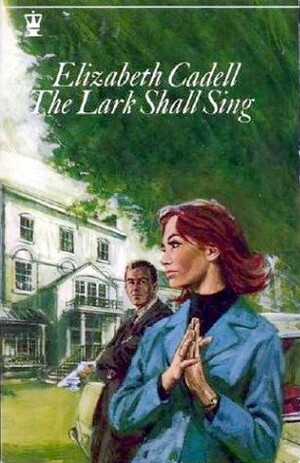
Review 2763: The Lark Shall Sing

The other day a friend and I got on the topic of Elizabeth Cadell. She is an infallible read for a light-as-fluff experience. Most of her novels, written between the 1940’s and the 80’s, involve some kind of romance and sometimes a mild mystery. But she creates engaging characters.

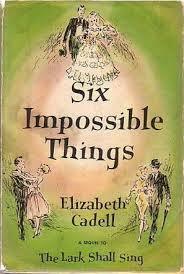
This discussion reminded me that Cadell’s relatives had reprinted all her books—some not quite as good as others—so I decided to poke around and compare their list with the selection of mostly used books that I own. In poking around, I discovered that one of my favorites, Six Impossible Things, was not the second book about the Wayne family but the third! This meant, of course, that I had to buy the second and read all three. The Lark Shall Sing is the first. (Just an update: This whole discussion took place this spring, and I reread this book at the end of May. I just realized that although I read the first two, I forgot to read the third one. I’ll have to do that next.)

Lucille Wayne has come home to sell the family house, despite the recommendation to wait awhile by her godfather, Mr. Milward. She is from a large family now consisting of three young adult siblings and three child siblings. After their mother’s death, they stayed in the house a year, all except Nicholas, who was in the military, but Lucille convinced them to lease it for a year because they couldn’t afford it. Lucille had a job in Cornwall, and Roselle, having finished a secretarial course, was itching to get a job in London.

The year has elapsed, and the tenants, who once considered buying the house, were called back to South Africa. Lucille is engaged and plans to live with her fiancé Digby and his mother in Cornwall. Eleven- and nine-year-old Simon and Dominic are at school and live with their Aunt Mary, and ten-year-old Julia is at school and can spend the holidays with Lucille and Digby. Lucille has sent each of her siblings a letter instructing them to let her know which of their things they would like to keep.

Almost half the book is about them all coming home. Because as soon as they get Lucille’s letter, they all leave immediately for home, most of them with little money or preparation, to try to convince Lucille not to sell. On the way, the three children and Roselle are helped by three total strangers who somehow end up coming along. Roselle nearly faints when she gets off the train, and Miss Cornhill jumps off to help her, only to have her things go off in the train. Simon and Dominic arrive at the London station at rush hour, and Dominic is torn from Simon’s grasp and pushed onto the train while Simon can get nowhere near it. Simon is helped by Robert Debrett, who picks him up so he can signal to Dominic to continue, and drives him to the other end of the journey so he can meet Dominic’s train—in his limousine, because he’s a famous actor. Julia, exhausted and riding a bike too big for her, hits Italian brush salesman Pietro smack in the back and ruins his suit and brushes, but he puts her back on the bike and wheels her home. Nicholas arrives on a rickety motorcycle. Now, all everyone has to do is convince Lucille to keep the house.

This is a lovely book full of likable characters with some touching scenes, particularly the reunion between Simon and his dog, Long John. Of course, Lucille dislikes Robert on sight while Robert decides he’s sticking around to see if he can’t change her mind. What fun!

Related Posts

Money To Burn

Consider the Lilies

Death Among Friends

Review 2751: The Netanyahus: An Account of a Minor and Ultimately Even Negligible Episode in the History of a Very Famous Family

When I realized that the family in this novel was the Netanyahus—I mean, the Netanyahus, as in the prime minister of Israel, I was not looking forward to this book. However, it is part of my Pulitzer Prize project, and in fact won it, although I have never heard anyone talking about it.

Before I start my review, I’m beginning to find the quotes and book blurbs ridiculous, I have to say. Maybe some people actually read the quotes to select a book, but I avoid them then and only sometimes read them later when I am perplexed about a book’s reception. Here are some of the words on the back of this book—“genre-bending,” “exuberant,” “funny beyond belief.”

First, let me address “genre-bending,” which apparently applies to this novel because it combines nonfiction and fiction. Excuse me, but isn’t that what any historical fiction book based on real events does? Isn’t that the definition of historical fiction except perhaps in the case of some light romances or maybe gothic novels?

The novel is set at a small college in upper New York state, where Ruben Blum is the only Jewish faculty member—an American History professor—in 1959-60. Blum is asked to serve on the hiring committee when it interviews Ben-Zion Netanyahu, a scholar of the Spanish Inquisition and its treatment of Jews. Although Netanyahu is living in the U. S., he is from the new nation of Israel. Blum doesn’t know how he’s supposed to judge the applicant’s knowledge since he knows very little about Medieval Europe, and he finally realizes he’s been chosen because he’s Jewish and he is mostly needed to provide hospitality.

For about the first half of the book, there was a lot of standard campus satire. My husband, whose first wife is an academic, always says that politics on campus are so brutal because the stakes are so low. I started wondering where the exuberance lay or when the book was going to become funny beyond belief as it made stereotypical humor out of two holidays with the in-laws, examined the different beliefs Jews have about Zionism, and explained Netanyahu’s beliefs.

I suffered through a ridiculously long, glowing letter of recommendation, which was countered by an even longer letter telling Blum that the reason Israeli scholars were gushing so much about Netanyahu was because they wanted him out of the country. Okay, that was kind of funny, but not funny beyond belief.

Finally, more than halfway through the novel, the Netanyahus show up for the interview and lecture—not just Ben-Zion but all of them: his wife Tzila and his three young sons—Jonathan, Benjamin (yes, him), and Iddo, ages 13, 10, and 7. And their behavior is outrageous. The book picked right up, and I can only assume that the critics who are gushing about it can only remember the second half.

I won’t say what they do—that’s the fun—only that in essence if not in detail, this part is based on a true story told to Cohen by Harold Bloom—although Cohen hastens to assure us that his character Ruben Blum is not meant to be Harold Bloom (right).

All I can say is, tearing things down seems to be more the style of these characters than building them up, and I guess that has continued up to today.

Related Posts

Moo

Straight Man

Lucky Jim

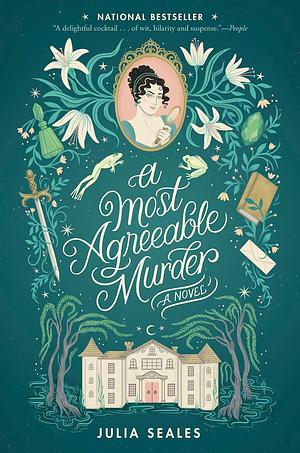
Review 2750: A Most Agreeable Murder

Julia Seales clearly had a good time writing this novel, which is absolutely silly and apparently a spoof of 19th century novels. It’s too bad, then, that she bothered so little to get the details right. It’s the second novel I’ve read recently that doesn’t bother with that, so why, I ask, place it in a historical context? Is this kind of laziness a trend?

Beatrice Steele has a secret. She is fascinated by crime and follows the exploits of Sir Huxley and his assistant, Inspector Vivek Drake, by stealing her father’s newspaper. She must hide this activity, because she lives in Swampshire, which has stern rules for the behavior of females.

The Steele family is preparing for a ball that evening at Stabmort Park, hereditary home of the Ashworths. A guest of honor is Edmund Croaksworth, a wealthy gentleman who was friends with Beatrice’s best friend Daniel Ashworth before the Croaksworths broke off the connection. Edmund’s father has died, and he is ready to resume the connection.

The Steele family is not only broke, but if they don’t produce a male heir before Mr. Steele dies, their property will go to their hated cousin, Martin Grub. So, Mrs. Steele’s hopes rest with her beautiful second daughter Louisa, who she thinks will fascinate Edmund Croaksworth into an immediate proposal. Beatrice herself assumes she will marry Daniel, but neither of them seems to be in a hurry.

I guess you can tell from the names that Seale’s sense of humor is not exactly subtle. She finally gets us to the ball while managing to get just about every detail of a 19th century ball wrong, including when soup would be available and how many guests a ball generally entails (hint—more than 16). There, Beatrice is surprised to recognize among the guests Inspector Vivek Drake—a person whom I had already guessed is to Sir Huxley as Laura Holt was to Remington Steele (that is, if you’re not old enough to remember, the real solver of the crimes), but Beatrice doesn’t believe that.

During the dance, Beatrice finds out Grub’s dastardly plan to have her father declared incompetent so that he can take the estate earlier, and since Mr. Steele is an idiot who is constantly playing practical jokes on people, this is a possibility.

Then Edmund Croaksworth is murdered, poisoned apparently during a card game that no one will admit playing. Inspector Drake is asked to solve the murder because the entire party is stranded in the house by a terrible storm. Beatrice is deputized to help him stay within the bounds of propriety.

I definitely didn’t share the author’s sense of humor here, although I might have had more patience with the novel if she could have been a little up on her subject. To successfully make fun of Victorian customs and manners, I think you have to know what they are first.

The mystery itself was all over the place, designed to get as many ridiculous details in as possible. Still, I at least finished the book.

Related Posts

Murder After Christmas

Beginning with a Bash

Babel: An Arcane History

Review 2736: Venetia

I’ve already reviewed Venetia for this blog, but my purchase of a new Folio Society copy seemed like a good excuse to reread it.

Venetia Lanyon has lived an isolated life, mostly with only her brother Aubrey for company. Her late father having refused her a London season when her aunt offered one, she has only attended a few local dances. However, she has two suitors—Edward Yardley, a worthy neighbor, and Oswald Denny, a quite young man who emulates Lord Byron in his careless dress and sulky manner. Venetia is interested in neither of them and plans to make a home for Aubrey, a studious teen with a bad hip, after her older brother Conway returns from the wars to take up his position as head of household.

But two incidents complicate this plan. One is her encounter with Lord Damerel, a neighbor she and her brothers called the Wicked Baron when they were children because of his unnamed crimes that made his family disown him when he was young.

Although Demerel, mistaking her for a village girl, offers her an insult, he is taken aback by her reaction, and she soon finds him to be a companion who shares her sense of humor. When he rescues Aubrey from a bad fall, the three of them begin a comfortable friendship.

Then strangers arrive. Without so much as a letter of warning, Conway has married a shy, biddable girl and sent her before him with her extremely unpleasant mother to establish his household.

Now, we’re set up for Heyer’s usual romance with lots of striking characters, a good deal of lively, funny dialogue, and an engaging, sparkling heroine with an unconventional mind.

Related Posts

The Grand Sophy

Sylvester, Or the Wicked Uncle

Frederica

Review 2706: Classics Club Spin Result! Love’s Labour’s Lost

Love’s Labour’s Lost is the work I drew for the Classics Club spin, and it seems like a bit of a curiosity. Despite having taken several Shakespeare courses during my academic days and having attended quite a few performances, I have never read this play or seen it performed.

My Riverside edition says that the play is Shakespeare’s most Elizabethan, with lots of wordplay and references to current events and people. It also has hardly any plot. It is certain that it is meant to be a romp and that lots of things went over my head.

The King of Navarre intends to found a learned Academe in his court. To kick it off, he has got three noblemen of his court to join, and part of this is a vow to only study and fast, and to stay away from women for three years. This silly idea is already threatened, because the King has forgotten he is to receive a state visit from the Princess of France.

There is a lot of tomfoolery with the Clown and a boastful Spaniard, but the thrust of the story is that of course as soon as the young men see the Princess and her ladies in waiting, they all fall in love. But they have already made a bad impression by receiving the Princess in a field (so as not to have broken the vow to have no women at court) and the ladies are not disposed to take them seriously.

In general, I tend to get along a little better with Shakespeare’s tragedies than comedies, except that I love Much Ado about Nothing. I also think the comedies are much more effective when played than read. Sections of this play are almost all punning and wordplay, but Shakespeare has been able to introduce some beautiful lines in the form of love billets. In any case, this wasn’t my favorite of his plays.

Related Posts

All’s Well That Ends Well

Antony and Cleopatra

Othello

Review 2585: Literary Wives! The Constant Wife

Today is another review for the Literary Wives blogging club, in which we discuss the depiction of wives in fiction. If you have read the book, please participate by leaving comments on any of our blogs.

We also welcome another member to our group! Becky Chapman is a new member from Australia. You can see her bio on my Literary Wives page. Welcome, Becky!

Be sure to read the reviews and comments of the other wives!

My Review

The Constant Wife is a play by Maugham, a social comedy that is reminiscent of one of Wilde’s. It is witty and reflects some interesting attitudes about marriage and faithfulness. It is set completely in Constance Middleton’s drawing room.

The play begins with the revelation that most of Constance’s friends and relatives think her husband John is being unfaithful with her best friend, Marie-Louise Durham. Constance’s sister Martha wants to tell her, but her mother, Mrs. Culver, does not. In any case, once the matter is hinted at, Constance refuses to hear and says she is sure John is faithful to her.

John and Marie-Louise are having an affair, though, and it turns out Constance knows. She has been maintaining the status quo, but when the truth comes out, it turns out she has some unusual ideas about marriage, especially for the time. At the same time, Bernard, a former suitor of Constance’s, returns from years in China.

The play is meant as a light diversion, I think, but its ending was probably considered pleasantly shocking at the time.

I try hard not to judge works out of their time, but although the script is undoubtedly witty, it reflects some attitudes that made me wince. Here’s one that seemed so strange it was funny. I’m not sure what early 20th century British people of a certain class thought feminism was, but in an early speech Mrs. Culver says she told a friend whose husband was unfaithful that it was her fault because she wasn’t attractive enough. (Ouch! But that idea was still around when I was growing up.) What made me laugh, although I don’t think it was meant to be funny, was that Constance in response asks her if she’s not “what they call a feminist.” Maybe it was meant to be funny. Hmm.

What does this book say about wives or about the experience of being a wife?

I think a discussion of this topic probably involves spoilers, which I try to avoid. But here goes.

This play comments in several ways about marriage and fidelity. First, there is the idea that it’s okay and expected for a man to cheat, expressed by Mrs. Culver. The corollary to that is that it is not okay for the wife. Martha does not agree. She thinks both should be faithful. Constance’s attitudes are more complex.

At first, Constance wants to maintain the status quo of her marriage by ignoring the situation. Then when she is forced to acknowledge her husband’s infidelity, she does and says some surprising things. She is very matter of fact about it and expresses the idea that they were lucky because they both fell out of love at the same time. John, more conventionally, affects to love her still.

Constance has been offered a place with a successful decorating business by her friend Barbara, which she originally turned down. Now, she decides to take it, eventually explaining that John’s rights over her have to do with him supporting her, so she wants to be independent. And a year later, there is more to come.

I’m not sure whether Maugham was making serious points about marriage and the relationships between the sexes or just trying to shock and be funny. The upshot of the play is what’s good for the goose is good for the gander—or the other way around.

There are still lots of implicit messages in the play:

  • That women are still property, based on their being supported by men. And Constance discounts running a house and caring for children as if it were nothing
  • That once love has calmed, marriage is basically a financial arrangement
  • That women are more interesting when they’re unobtainable than when they are present and faithful

These are the women’s attitudes, mind you (although I keep reminding myself that this play is written by a man). John isn’t that much heard from, except his cowardly request for Constance to break up with Marie-Louise for him and his conventional assertions that he still loves Constance.

Related Posts

All’s Well That Ends Well

The World’s Wife

Excellent Women

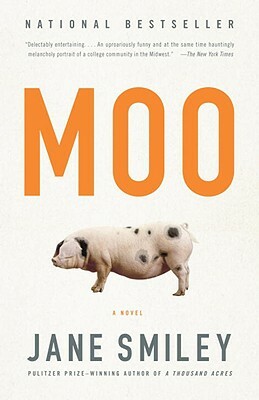
Review 2576: Moo

I have an uneven relationship with Jane Smiley. I have by no means read all her books, but I found some of them to be entertaining (The All-True Travels and Adventures of Lidie Newton and Horse Heaven) but her trilogy beginning with Some Luck to be over-rated. However, The Greenlanders was excellent, and I thought A Thousand Acres was one of the best books I ever read. Checking her oeuvre, I see now that I haven’t read any of her more recent books. This book is not one of the more recent.

Moo is set in the 1980s in Iowa in what used to be called an agricultural university (nicknamed “Moo U”). I believe the novel is supposed to be a satire. It starts with students, a boy named Bob whose job is to feed a pig as much as it can eat and take measurements, a project that seems only to be known about by the faculty member who is paying him, and four freshman girls, roommates.

But we don’t really get to know them, because then we meet a bunch of faculty members, administrators, and staff. The Spanish professor begins sleeping with the English professor. The Dean has decided, on almost no acquaintance, to marry the lunch lady. The provost seems to be entranced by money and about to make some sort of shady deal with the rich Texan who almost ruined the university’s reputation years ago. He’s seeing dollar signs in his eyes at a time when the college is cutting costs to the bone.

At page 120, I felt like I’d been introduced to about 50 people I only knew one or two things about and didn’t care. I assumed it was a satire, but nothing was funny, and it didn’t seem to be getting anywhere. So, sadly, this was a DNF for me.

Related Posts

A Thousand Acres

Horse Heaven

The Greenlanders

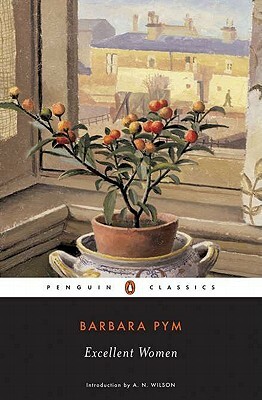
Review 2570: #1952 Club! Excellent Women

Entry #2 for the 1952 Club!

By “excellent women,” Pym seems to mean a type of English spinsters who occupy themselves with charity events and helping others, dress drably, and are taken for granted by men. That’s what Mildred Lathbury seems to think she is. She’s a clergyman’s daughter of limited means, mild-mannered and religious but observant of others’ characters while not wishing them any harm. In Excellent Women, she gets a surprising amount of attention from men, but then she’s always picking up after them.

Mildred lives upstairs of a vacant flat, and she’s curious about what her new neighbors will be like. She knows they’re named the Napiers by the sign at the doorbell. She meets Helena Napier on page 2, a young, stylish woman, and sees her around with a man, whom she assumes is her husband, Rockingham (known as Rocky). But he is not. He is Everard Bone, an anthropologist, and he and Helena, also an anthropologist, are writing a paper together. Rocky is off serving in Italy.

Mildred is good friends with Julian Malory, the vicar of her rather high church, and his sister Winifred. It is the expectation of several characters in the book that Julian will marry Mildred, but she doesn’t seem to expect it. Or does she? It’s hard to tell. Certainly, he is very friendly with her, but she thinks he is not the marrying kind.

Mildred meets Everard before she meets Rocky. Although he seems not to notice her at first, after a while he begins seeking her out. He is abrupt and serious, and she doesn’t think she likes him. Or does she? It’s hard to tell.

Once he shows up, Rocky is utterly charming and handsome. He is very friendly to Mildred and keeps popping up for tea. Mildred senses friction in the Napier home—well, she can hear them arguing. Rocky does all the cooking and cleaning in their home, because Helena is completely undomesticated. (She sounds like my kind of gal, even though she isn’t depicted particularly positively.) Mildred distrusts Rocky’s charm. She understands from Everard that Helena thinks she’s in love with him (Everard).

It being post-war London, it is still hard to find a place to live, so the Malorys decide to lease their upper floor. Soon, it is taken by Mrs. Gray, a beautiful clergyman’s widow. Mildred finds both Julian and Winifred transfixed by her, so she steers clear. It’s pretty evident what Mrs. Gray thinks Julian’s fate should be.

Mildred isn’t at all liberated. She is constantly cleaning up after men or doing ridiculously involved favors for Rocky and Helena, and all take her for granted. Yet, this is a lively, amusing social comedy. It is also a tale of the rapidly disappearing lives of upper- and middle-class English people.

Related Posts

The Camomile

Alice

My Brilliant Career

Review 2559: What Sheep Do in Iceland When Nobody’s Around

A friend of mine has family in Denmark, and she brought back this little novelty book that came from Iceland. It has great illustrations and is silly and funny, and very imaginative.

The tone of the book is set right away by the cover and title page. I took a photo of the title page, and here is its caption, in case it’s unreadable in the photo, “Because of their herding instinct, they find it very hard to resist a conga line.”

The book starts out with a more-or-less straightforward history of how sheep got to Iceland and of Icelandic sheep-keeping details, but then it just becomes silly and full of puns, with great illustrations. Perfect for a lighthearted quarter hour of reading.

I jumped into this book from a great pile of tomes I accumulated for my A Century of Books project. In fact, I interrupted my reading of Angle of Repose because I was so behind in my number of books read (I usually am reading at least 20 books ahead of my blog, and I was only in at about 13) that I wanted to dash something off and also relax. Angle of Repose is good but for some reason I kept getting distracted from it, so it took me more than a week—an unheard-of rate for fiction, even at 600+ pages.

The bad news about this book is that from the U. S. I ended up ordering it from Iceland! I assume my friend got it in Denmark, so maybe European readers will be able to find it. Anyway, it’s a hoot! I’m categorizing it as children’s literature, because I have no other suitable place for it, but I think it is probably just as funny for adults. Maybe even more so.

Related Posts

Moominsummer Madness

Summer Lightning

The Flying Books of Mr. Morris Lessmore

Review 2524: I Capture the Castle

It was with delight that I noticed I Capture the Castle would help me with my Century of Books project, because I liked it so much when I read it years ago. It had an ending that was completely different from what I remembered, though, my memory having possibly been polluted by seeing a couple of TV versions of it.

Cassandra lives with her family in a house attached to a ruined castle. The house, which was purchased during the heights of her father’s success as a writer, is now woefully decrepit. Her father has not produced anything since his initial success, and the money ran out long ago. Now their clothes are shabby, and they can barely afford to eat. Rent hasn’t been paid for months, and they’ve sold all the good furniture.

There is exciting news, though. Their landlord having died, new occupants of the estate, which includes their home, have arrived. They are American brothers, Simon and Neil Cotton.

The brothers arrive when Cassandra is taking a bath in the kitchen. She keeps quiet and they go away, but they return so she has to announce herself. They take her for a child. Her sister Rose, who is beautiful, decides that she will marry Simon, the heir, no matter what, even though she hates his beard.

Cassandra likes both men at first but then overhears them talking about Rose, who has been behaving affectedly. With a little advice, Rose begins to act naturally, though, and soon she has accomplished her goal. She is engaged to Simon, although Neil seems to hate her. The only trouble is, Cassandra is in love with Simon.

This sounds like a straight love story, but it isn’t. There are lots of terrifically eccentric characters and subplots to go with them. There is the issue of whether their father will write again. And will Topaz, their stepmother, who sees herself as an artist’s muse, leave him for someone who is working? What can Cassandra do about Stephen Colley, a devastatingly handsome young man who lives with and basically supports the family and copies out poems to give to her?

This novel is charming. Its narrator mixes wit with naiveté and wisdom, and the novel is written in a sprightly, entertaining manner. It’s a lovely light read.

Related Posts

It Ends with Revelations

A Pink Front Door

The Weather at Tregulla