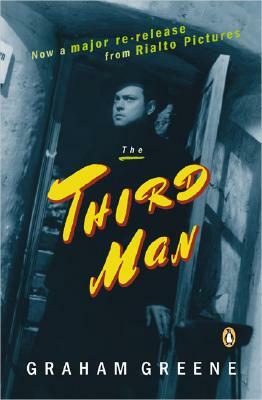
The Third Man is my first choice for the 1949 Club and also applies to RIPXXI. As usual for the club, I’ll start out by listing books written in 1949 that I have reviewed previously:
- The Sheltering Sky by Paul Bowles
- Robert Frost’s Poems by Robert Frost
- The Way West by A. B. Guthrie
- In a Dark Wood Wandering by Helle Haase
- Arabella by Georgette Heyer
- The Feast by Margaret Kennedy
- Little Boy Lost by Marghanita Laski
- Love in a Cold Climate by Nancy Mitford
- A Good Man Is Hard to Find by Flannery O’Connor
- 1984 by George Orwell
- A Town Like Alice by Nevil Shute
- Vittoria Cottage by D. E. Stevenson
- A Wreath of Roses by Elizabeth Taylor
- Brat Farrar by Josephine Tey
- The Old Bank House by Angela Thirkell
- The Catherine Wheel by Patricia Wentworth
- Because of the Lockwoods by Dorothy Whipple
I think I’ve read some of the children’s horse books (Black Stallion, Chincoteague), too, but it’s too long ago for me to remember back when I was a child.
And now for my review.
For those like me who are more familiar with the movie, there are quite a few differences. However, Greene explains in the Preface to my Penguin edition that the book was written as a preliminary to the screenplay, because he found it almost impossible to write a screenplay without a book.
The narrator is British Detective Calloway, who sometimes speaks firsthand and other times secondhand from information received from the main character, Rollo Martins. Rollo is the author of several pulp Westerns who has been summoned by his friend Harry Lime to Vienna. But he arrives just in time for Harry’s funeral after he was hit by a car.
Martins is at a loss, because at the time, shortly after World War II, British citizens were only allowed to take £5 out of the country, so he’s broke. Furthermore, Calloway meets with him to discuss Harry’s illegal activities, which are serious. Rollo, who has been friends with Harry since school and hero-worships him, doesn’t believe him. At the same time, Calloway wants to try to determine how involved Rollo is in Harry’s activities. Rollo is so incensed at Calloway’s imputations that he tells him he’s going to prove him wrong.
Rollo starts with interviewing the witnesses to the accident, who apparently were both acquaintances of Harry. This seems odd, and what is odder is that another witness, Dr. Koch, who saw the accident from the window but didn’t talk to the police, tells him he saw three men at the scene of the accident rather than the two who were reported. Who was the third man? And doesn’t it seem sinister when Dr. Koch is killed shortly thereafter?
Another complication is Anna Schmidt, Harry’s girlfriend, a Hungarian actress who is hiding under a false name and papers from the Soviets. She also doesn’t believe Harry is guilty. Unfortunately, Rollo falls in love with her.
This novel is not as suspenseful as the movie, but it excels in its bleak descriptions of post-war Vienna and the complications of its subdivided governance. It’s really moody.