Review 2756: The Captain’s Daughter

Of course, Alexander Pushkin is a revered 19th century Russian poet, but I’m not much of a poetry reader. So, I was interested when perusing the offerings of NYRB Classics to see that he had written a novella.

The Captain’s Daughter is a historical novel that ends in 1774, and Pushkin’s intent was to write about Pugachev’s Rebellion in terms of a romantic adventure novel popular at the time. Perhaps not its intent is the occasional glimpse of the power of wealth and position at the time. I didn’t really find the novel comic, although some of the dialogue is clearly meant to be, but the NYRB edition includes an article by one of the translators about the difficulties of translating the wit in the novel.

The opening, though, is probably meant to be comic. Pyotr Andreich Gunyov, son of a nobleman who is extremely wealthy (he is said to own 300 souls [i. e., serfs] at a time, a note informs us, that most landowners owned less than 60), informs us he was enrolled as a sergeant in the Semyonov regiment before he was even born and considered to be on leave until he was old enough to serve. I was too taken aback by this to find it funny when reading it but now I realize it was probably an exaggeration. Maybe?

However, once Pyotr Andreich is seventeen, his father decides he needs toughening up, so instead of sending him to the Semyonov regiment to live it up in the city, his father sends him to serve in Orenburg under his old friend Andrey Karlovich. Orenburg is apparently in the middle of nowhere at the time, protected by a small outpost.

On the way there, Pyotr Andreich, accompanied by his servant Savelich, is caught in a snowstorm with their guide. The guide not being suitably dressed, Pyotr Andreich gives him a hare-skin coat and some vodka. This encounter will prove to be significant.

At Orenburg, Pyotr Andreich finds a pleasant commander and not much to do at Fort Belogorsk. He almost immediately falls afoul of another officer, Shvabrin, who has been transferred there because of dueling. Pyotr Andreich also falls in love with Masha, the captain’s daughter, and wants to become engaged to her. Unfortunately, his father doesn’t agree.

Then they all begin hearing about a revolt of Cossacks and peasants supporting Pugachev, who claims to be the Tsar. When the fort is eventually surrounded by a huge number of insurgents, they defend themselves as best they can but are overrun. Pyotr Andreich would have been hung with the rest of the officers (except the rotten Shvabrin, who has gone over to the other side), but it turns out that Pugachev is the guide that Pyotr gave his coat to, so Pyotr is set free, but he has to leave the now orphaned Masha, in disguise as the priest’s daughter. Pytor is determined to rescue her somehow.

Although a sort of adventure novel, it isn’t really exciting, and Pushkin misses some opportunities to make it more so and to build suspense. It also makes an assumption that readers already know about the rebellion, so that the short novel has quite a few annotations. Of course, a 19th century Russian audience would probably know all about it.

The short novel is very readable and entertaining. I was just surprised at the omissions.
Related Posts

Devils

A Double Life

Effi Briest

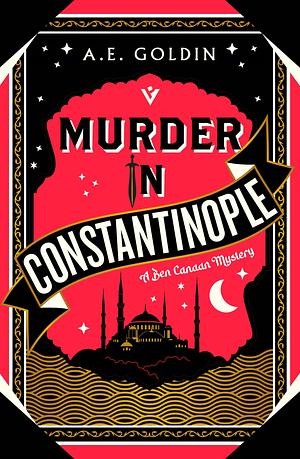
Review 2696: Murder in Constantinople

If you want a historical novel that reflects careful research and knowledge of the period, this isn’t it. If you want a novel with a believable plot, this isn’t it. If you want an old-fashioned adventure story, this might be closer.

In 1854 London, Ben Canaan is a Jewish tailor’s son on his way to becoming a nogoodnik. He was a scholar who wanted an academic career, but his father took him out of school to work in the family shop. On the day we meet him, he takes some clothes he is supposed to be delivering, and he and his friends wear them to an elite ball, where he pretends to be a Duke’s son. But he is discovered by the Duke’s son, and in the resulting struggle, a gun he is carrying goes off. He becomes a wanted man.

Before that, though, he helped his father measure Lord Palmerston for a suit. In his pocket, he found a photograph with a familiar face—his lover, who he believed dead, in front of Hagia Sofia in Constantinople with a cryptic message beneath. Since he has to leave town anyway, he persuades the criminal kingpin he does errands for to send him to Constantinople. He departs on a military ship on its way to the Crimean War, serving as a common sailor.

I had immediate problems with historical accuracy when he sashays up to a beautiful girl at the ball and introduces himself under his assumed name, then asks her to dance and she does. At this time, she wouldn’t have spoken or danced with him without an introduction. And where, exactly, is he supposed to have carried on his affair with his lover? He’s a very young man, basically just jerked out of college.

I have to tell myself just to judge the novel on its own terms, as an adventure. In that respect, it certainly shows some flights of fancy with its brash, very young man managing to work his way into the upper echelons of society and get involved in political intrigue.

I was very interested to find that in 19th century Turkey, almost everyone speaks English, including Kurdish street urchins and women who live in the Sultan’s harem. (You can see I’m being facetious here.)

The dialogue is supposed to be witty, but I found it cumbersome.

Judged purely as an adventure story, I still found it a bit meh.

Related Posts

The Prisoner of Zenda

Murder in Old Bombay

The Sea-Hawk

Review 2658: Rum Affair

The famous coloratura opera singer Tina Rossi has made a rendezvous with her lover, Kenneth Holmes, at the flat of one of his friends. When she arrives, though, Kenneth is not there, but a body is in the wardrobe. She has just discovered it when Johnson Johnson, the famous portrait painter, arrives with two policemen, saying there’d been a complaint. Reader of this series know that Johnson is a lot more than an artist. (Although I guess they don’t know at this point.)

Tina puts them off, but after they go outside, a man with a gold tooth bursts out of the wardrobe. Tina screams, but they miss him and he escapes.

Tina is now afraid for Kenneth, but acknowledging the affair could destroy her career. She decides to go to the island of Rum, where his laboratory is located. But she must do it without anyone suspecting, especially her agent, Michael Twiss, who has been trying to keep them apart. Later, she hears that Kenneth is suspected in the explosion aboard a nuclear submarine that was developed under his management. That makes her more eager to get to Rum.

Luckily, Johnson offers to paint her portrait if she will join him for a yacht race in Western Scotland that ends near Rum. Shortly after they leave, it becomes clear that someone is trying to kill Tina.

Dunnett’s Dolly series (Dolly is the name of the yacht) poses as mysteries but the books are really adventure novels with espionage at their core. They are fast moving with entertaining dialogue. All of them are narrated by a different woman, vividly drawn. The 60s yachting life seems to be pretty wild. These books make entertaining reads, even though it is generally impossible to guess what’s going on.

These books have not been republished in order, and I have not been reading them in order. This one, original name Dolly and the Singing Bird, was actually the first one in the series.

Related Posts

Ibiza Surprise

Tropical Issue

The Scottish Highlands

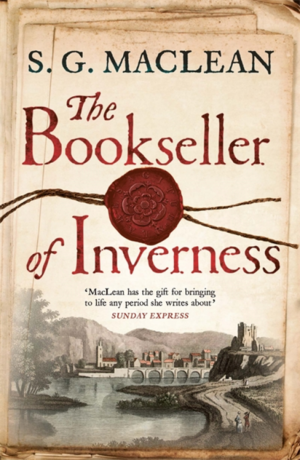
Review 2635: #RIPXX: The Bookseller of Inverness

Iain MacGillivray was badly injured at Culloden and shipped off to work in indentured servitude in the Americas. In 1752, six years later, he is back and running a bookshop in Inverness. The town is full of British soldiers.

One evening he sees a grubby man who looks vaguely familiar looking through some books that came from Lord Lovat’s estate. It’s closing time, so he forces him out.

Iain hasn’t seen his father, Hector MacGillivray, for years. Hector has been serving King James in France and Italy. He is proscribed, but Iain has believed his father is dead. Now he finds he is in town.

Hector is searching for a book that has been rumored to exist, one that contains a list of traitors to the Jacobite cause. King James is planning another attempt to take back the throne from the Hanoverian king, and they want to make sure they know it’s not going to be betrayed.

By looking through the remaining books from Lord Lovat, they figure out which book it was. Hearing that there is a copy, Iain goes to Lovat’s castle, now occupied by British soldiers, on the pretext of buying some of the books. There he has an unpleasant encounter with the cruel Captain Dunne, who burns part of the book, but Iain is able to get away with the rest.

Hector starts trying to decode the text for names, but before he figures out each of six names, that person is murdered. The killer could be someone getting revenge, or it could be a traitor trying to cover his back.

I found this to be an interesting, fast-moving adventure that seems well researched and steeped in its time. I enjoyed it quite a bit.

Related Posts

Kidnapped

Corrag

Waverley

Review 2062: The Prisoner of Zenda

When I was making up my Classics Club list, I thought it might be fun to read The Prisoner of Zenda, a book I’ve heard of for years. I was surprised to find it was really good!

Rudolf Rassendyll is the younger brother of a British nobleman whose family has a tradition that an ancestress had an affair with a Ruritanian prince, bestowing on some of the family a pointed nose and red hair that Rudolph has himself. The family also stays away from Ruritania, but when Rudolf hears there is to be a coronation of the new king, he decides to attend.

Since Strelsau, the city where the coronation is to be held, is going to be crowded, he decides to stay in the village of Zenda and travel in for the ceremony. He lands in Zenda the day before and, while wandering in the woods, encounters the King, who looks exactly like him except for a beard. Amused, the King invites him to Zenda Castle, where he is staying as a guest of his brother, Duke Michael.

When the King drinks a bottle of wine gifted by Michael, his attendants can’t wake him. Duke Michael has drugged him so he’ll miss his coronation. The King’s attendants, Fritz and Sapt, talk Rudolf into impersonating the King just for the coronation. But things don’t go exactly as planned.

This adventure story is fast moving with interesting characters and lots of action. A fun read!

Related Posts

Kidnapped

The Sea-Hawk

The Queen of the Caribbean

Review 1861: Great Circle

After getting fired from a hit TV series with a cult following for damaging the brand, Hadley Baxter thinks her career might be over. However, she is approached about starring in an independent film about the life of Marian Graves, an early aviator who disappeared in 1950 while attempting to circumnavigate the earth via the poles.

Although the novel sometimes follows Hadley as she tries to figure herself out, its main focus is on Marian and her twin brother, Jamie. As babies, they are on their father’s ship when it sinks, and because he chooses to save them rather than go down with his ship, he serves time in jail. They are raised in Missoula, Montana, by their alcoholic artist uncle, who lets them run wild.

When a pair of barnstormers stop over, Marian is bit by the flying bug. She is already doing men’s work, so she begins working harder to earn enough for flying lessons. But no one will teach her until she meets Barclay Macqueen, a bootlegger.

Great Circle is a broad-ranging novel that takes us from bootlegging in the West to serving mining camps in Alaska to ferrying planes in England before the flight around the world. I found Marian’s story more compelling than Hadley’s but still found the novel fascinating. Since I read it, it has been nominated for the Booker prize, so is part of my project.

Related Posts

West with the Night

Circling the Sun

Straight on Till Morning

Review 1823: Murder in Old Bombay

Nev March says she was inspired to write Murder in Old Bombay by Sherlock Holmes and Kipling’s Kim. Certainly I can see the influence of the Holmes novels, if not in the hero’s deductive processes then in the complicated plot and disguises. From Kim, I hoped for a more atmospheric novel.

Captain Jim Agnihotri has retired from the army and is in the hospital recovering from serious wounds when he reads about a murder case. Two Parsee women fell or were pushed from the university bell tower, and the man charged got off because it wasn’t clear whether it was suicide or murder. Also, two other men present on the scene could not be found. Jim decides to offer himself as a journalist and investigate the case.

Having been hired, Jim goes to interview Adi Framji, whose wife and cousin were the victims of the crime. As a Eurasian, Jim is not usually accepted into either British or Indian society, but the Framjis soon accept him as a friend. Although Parsee families don’t marry outside the Zoroastrian religion, he finds himself smitten by Diana, Adi’s sister returned from London.

Jim’s investigation at first doesn’t turn up much, but even though the break in continuity seemed odd, the novel gets more interesting when he takes on a mission for the army. Indeed, he gets the opportunity to travel a bit and don several disguises.

As far as the mystery goes, this novel seems to stumble along. Jim also makes some cognitive leaps that don’t seem warranted by what has come before. For example, early on Jim concludes that the two girls who fell from the tower were being blackmailed. This turns out to be true, but where did it come from? There is nothing that comes before it to lead him to that conclusion.

The adventure portion makes the novel perk up, but otherwise I felt the effort was a little lackluster for a historical novel. March doesn’t supply much background for the historical events, nor does the reader get much sense of the sights, sounds, and smells of Victorian India, which is one of the things that makes Kim so wonderful.

Finally, although Jim is a likable character and I also liked the Framjis, I wasn’t interested in the romantic plot.

Maybe I’m making this review sound a bit too negative. I enjoyed parts of the novel, but the mystery seemed all over the place and I wanted more descriptions—of rooms, the city, the dress, the food. I wanted to feel the atmosphere of 19th century India, as a historical novel should make me do.

Kim

Dark Road to Darjeeling

Arctic Summer

Review 1767: Classics Club Spin! A Town Like Alice

Best of Ten!

I haven’t ever read anything by Nevil Shute, so I decided to put A Town Like Alice on my Classics Club list, and then it was chosen for the latest spin. I’m glad I chose it for my list, because it’s a really good book, hard to categorize—part war story, part love story, part adventure story, about brave and resourceful people and challenges faced. I loved it.

The novel is narrated by Noel Strachan, an elderly solicitor, who finds himself the trustee for a young woman named Jean Paget. After they befriend each other, Jean confides to him that during World War II she was in Malaya when she and a group of women and children were taken prisoner by the Japanese. Since the Japanese didn’t know what to do with them, they were marched hundreds of miles back and forth over the Malay peninsula. Half of them died until Jean made a deal with a village headman that he would allow them to stay there if they helped with the rice harvest. During the time they were wandering, an Australian POW who was driving trucks for the Japanese tried to steal food for them and was crucified by the Japanese. Jean decides to use part of her legacy to dig a well in the Malayan village to thank them for helping.

While in Malaya, Jean learns that the Australian man, Joe Harman, did not die as she thought. She decides to go to Australia to try to find him. As fate would have it, however, he comes to Strachan’s office in London looking for Jean, having learned that she was single after thinking all this time that she was married.

About half the novel is about the couple finding each other, but then Jean sees the nearby town to the remote station where Joe works. She learns that the girls won’t stay in town because there is nothing there for them, and Joe can’t keep men on the station because there are no girls. The resourceful Jean decides that if she can’t bear to live in the town, something must be done to improve it.

It’s easy to see why this novel is so beloved, although caution—there is incidental racism that reflects the times. That being said, I found this novel deeply satisfying—engrossing, touching, full of life and spirit.

The Narrow Road to the Deep North

My Brilliant Career

Salt Creek

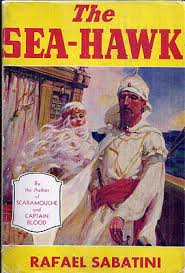
Review 1687: The Sea-Hawk

Sir Oliver Tressilian is in a good place. As one of Elizabeth I’s privateers, he has made a fortune and gained the Queen’s favor. He is also engaged to marry the woman he loves, Rosamund Godolphin, or at least she has promised herself to him. When he calls on her brother Peter to ask for her hand, though, Peter refuses it, determined to keep up the feud begun between their parents. Indeed, he is insulting to the proud Sir Tressilian, so much so that Oliver would have killed him had he not promised Rosamund he would not.

Peter’s refusal seems of little moment to Oliver, because Rosamund will soon be of age. When Oliver’s brother Lionel returns home, however, he has fought with Peter without witnesses and killed him. Oliver promises to protect him but later learns that the wounded Lionel left a trail of blood to his door and everyone thinks Oliver murdered Peter. When Oliver tries to speak to Rosamund, she refuses to hear him. He is able to prove he is innocent to a magistrate and a minister because he has no wounds, but Rosamund will not listen.

Lionel becomes frightened that Oliver will tell the truth, so he arranges with a shady sea captain, Jasper Leigh, to kidnap Oliver and sell him into slavery. Jasper Leigh actually intends to let Oliver buy himself back, but their ship is taken by Spain and both Oliver and Jasper end up as galley slaves.

When next we meet him, Oliver is named Sakr El-Bahr, the Sea-Hawk, for his famous acts of piracy. He has adopted Islam and is a chief of Asad-ed-Din, Basha of Algiers. He learns that his brother and Sir John Killigrew have had him declared dead and Lionel has taken over his property and his former fiancée. Upon hearing this, Sir Oliver sends a messenger to Rosamund with the proof of his innocence in her brother’s death, but she throws it unread into the fire. Oliver is overcome with anger against both Lionel and Rosamund. How will it end?

I thought this was a very interesting swashbuckler, mainly because both the hero and heroine have more dimensions than in the usual adventure tale. There are times when both of them behave very badly, and I especially disliked Rosamund for much of the book because she was so quick to distrust Oliver. However she is also more brave and self-possessed than the majority of adventure story heroines. They get into some seriously exciting situations.

This is my last book from my second Classics Club list, which I have finished a couple of weeks late, so I’ll be publishing another list tomorrow.

Related Posts

The Lovers of Yvonne

Blood & Sand

Treasure Island

Review 1612: Abigail

Gina is a fourteen-year-old girl who is adored by her father, General Vitaly, and has led a carefree life in Budapest. Then some changes occur. Her adored governess, Marcelle, must leave home because she is French and thus on the opposite side of World War II. Then, her father enters her into Matula, a school for girls in the provinces. He does this with no warning, and Gina is at a loss to understand why he has chosen a cheerless, strict Calvinist school.

Upon arrival, Gina is stripped of her possessions and given charmless garments to wear. Her hair is cut off. The other girls in her class seem friendly at first, but after a horrible first day, she has a melt-down and blurts out a class secret. After that, no one will speak to her.

One of the school traditions, at least among the girls, is that if you write a note asking for help and put it in the vase held by a statue named Abigail in the garden, she will help you. This tradition is one of the things Gina finds ridiculous in her first days, but after a while, she comes to believe that someone, perhaps one of the staff, probably is helping.

When Gina becomes so miserable at school that she can’t take it, she plots to run away. She is prevented by one of the teachers, König, whom she despises. Soon, her father comes to see her and tells her a secret, something that requires her to stay in the school. She realizes she must try to make peace with her classmates.

This may sound like a standard novel about life in school, but it is an adventure novel that actually becomes quite suspenseful. The identity of Abigail wasn’t very hard to guess. It is Gina who is oblivious to all the clues until the last sentence of the novel. There is certainly a cast to pick from, including Susanna, the beautiful and strict prefect; Mr. Kalmár, the handsome young teacher who is in love with her; and Gedeon Torma, the director, the source of the cheerlessness and strictness. This is also Mitsi Horn, a former student who is a legend at the school.

Despite knowing who Abigail was almost from minute one, I really enjoyed this novel. Gina, headstrong and oblivious, is still appealing, and the plot is an interesting one.

Related Posts

Salt to the Sea

The Book Thief

The Nightingale