Review 2130: The Cartographers

Seven years ago, Nell Young was on her way to her dream job after interning in the Cartography Department at the New York Public Library. Her father, the head of the department, had hinted that a position was hers. In her excitement, she went down into the archives hoping to make a big discovery. This action initiated the Junk Box incident, after which she found herself fired and unemployable. Eventually, she got a job finding and copying maps for decorative purposes. She hasn’t spoken to her father since.

Suddenly, she receives a call from Swann, a former co-worker, telling her that her father was found dead in his office. She goes there to talk to the police. The death appears natural, but they are looking into it. When she is sitting at her father’s desk, she surreptitiously presses a button for a secret drawer and finds a portfolio. Returning home, she finds a map in the portfolio—not just a map but the one that appeared to be worthless when she originally found it in the Junk Box seven years ago, an ordinary road map from 1930.

When Nell looks the map up, she finds that every other copy of it has either been destroyed or stolen. It appears to be valuable on the dark web, but prospective searchers are warned to beware of a mysterious group called The Cartographers.

If you read my blog, you probably know I have a tricky relationship with magical realism. Suffice it to say that I found this novel most interesting before the magic came in, which it did in a obvious way at about page 150.

But I even had some problems with the realistic parts—in particular, that scholars of cartography would take seriously the idea of the Dream Atlas, not to mention the subsequent project.

Another problem was the shift in narration. Most of the book is in third person, but several chapters revealing secrets from the past are narrated by various friends of Nell’s parents. First, multiple narrators need to sound like different people. Shepherd’s do not. Second, the style of third-person narration is different from speaking. Shepherd’s is not.

I guess readers who go into this novel just as an adventure story and don’t look at it too closely will enjoy it most.

Related Posts

A Tale for the Time Being

Galore

Little, Big

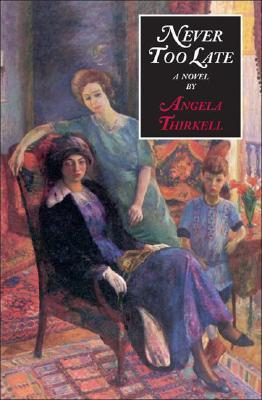
Reading Thirkell’s Barsetshire Series in Order: #22 Jutland Cottage + #21 Happy Returns Wrap-Up!

Rereading Happy Returns in the context of the rest of the Barsetshire series proved to be much more rewarding than reading it as a one-off as I did years ago. My thanks to the people who are sticking with the project and made comments or read along with this book:

  • Liz Dexter of Adventures in Reading
  • Penelope Gough
  • Gypsi

The next book is Jutland Cottage, and I will be posting my review on Friday, March 31! I hope some of you can read along with me. Including Jutland Cottage, there are only eight more books to go in the series!

And here’s our badge.

Review 2129: #ThirkellBar! Happy Returns

Cover for Happy Returns

When I originally reviewed Happy Returns, I remarked that I thought it would be easier to keep track of its many characters if you had read the series from the beginning. That certainly proved to be the case when I revisited the novel this time. I provided an adequate summary in my original review, so I’ll use this post to write about my observations second time around.

I didn’t mention that much of the point of view of this novel is from Eric Swan, whom we met way back when he was a school friend of Tony Morland’s and used to infuriate Philip Winter, then his schoolmaster, by looking at him through his glasses. (I believe this was in Summer Half.) Swan is now working for Philip, and at thirty, has not found the woman for him. However, he is immediately struck by Grace Grantly.

Much of the novel concerns whether the engagement of Clarissa Graham and Charles Belton will actually end in marriage, but I was also interested in the growing friendship between the older Lady Lufton and her very nice tenant, Mr. Macfayden. Lady Lufton was exceedingly irritating in the preceding book because of her helplessness after her husband’s death, but in this one a few choice words from a friend make her pull herself together. This takes some of the pressure off the burdened young Lord Lufton, her son. He has been attracted to Clarissa, but another instance of rudeness toward Charles breaks the spell. Unfortunately, he also notices Grace Grantly.

I enjoyed this novel in its context within the series much more than I did as a stand-alone. I knew most of the characters already, although I sometimes wish I had drawn up tables for each character when I read the first book and continued with it as I went on.

I haven’t commented on this before, but I also enjoy the references to Trollope’s Palliser and Barsetshire series. I have probably missed some, but I am noticing them more often because lately I’ve been reading the Palliser series.

Related Posts

Summer Half

The Duke’s Daughter

County Chronicle

Review 2128: Phineas Redux

In summarizing Phineas Redux, the fourth of Trollope’s Palliser novels, I can’t help giving away some of what happened in the previous books, so if you’re planning to read them, beware. All of the books so far in the series have shared characters but been reasonably independent. In fact, it didn’t much matter that I read the first two out of order. Although you could probably read this one by itself, it begins to tie the events and characters from the previous novels more closely.

Phineas Finn has been working at a government job in Ireland since we last saw him two books ago. However, after a short marriage, his wife Mary has died, and his friends, who think there will be a change in government, ask him to run for a seat in Parliament. He does and loses by only a few votes, but there are indications of bribery on the other side, so the election is challenged and Phineas must wait until January for the result.

Phineas has not seen his friend Laura Kennedy since she left her husband and went to Dresden to live with her father. However, she begs him to visit her. Before he leaves for Dresden, he is summoned by Kennedy, he believes to take a message to Laura. But all Kennedy does is berate Laura, tell Phineas it is her duty to return, and allege that she and Phineas are having an affair. They are not, but Phineas feels he owes Laura friendship. Unfortunately, Laura has learned too late that she married the wrong man.

Phineas gets his seat in Parliament, but he has managed to offend the editor of the equivalent of a tabloid newspaper, who brings him a libelous letter from Kennedy that he intends to print. Phineas goes to Kennedy about it, but Kennedy tries to shoot him. The editor is compelled not to print the letter but begins attacking Phineas in print, making suggestions about his relations with Laura and referring to the attack as if Phineas is to blame. The result is that he doesn’t receive a paid position in government as he expected, and he is still very poor.

In the meantime, Phineas’s friend Mrs. Max Goesler has befriended the failing Duke of Omnium. She has refused his proposal of marriage but continued to visit him. When he dies, she finds he has left her a large sum of money and his jewels, none of which she wants. As a result of his death, Plantagenet Palliser becomes the Duke of Omnium and Lady Glencora the Duchess. Plantagenet is mostly upset because his new position forces him into the House of Lords and out of the House of Commons, where he feels he has been doing important work.

Things are not going well for Phineas, and they are about to get worse, even to threaten his life.

In this book, I found the parliamentary issues a little harder to follow, but I was not expecting what is essentially a murder mystery. Once that plot got started, I was rivetted.

Related Posts

The Eustace Diamonds

Phineas Finn

Can You Forgive Her?

Review 2127: The Mystery of a Butcher’s Shop

The Mystery of a Butcher’s Shop is the second Mrs. Bradley mystery, published in 1930. It is written in a flippant, comic style and depicts Mrs. Bradley, a psychoanalyst (very 30s), as all-knowing.

When Rupert Sethleigh’s solicitor appears at his house about a will, his cousin, Jim Redsey, says he left unexpectedly for America. No one else in the household seems to be aware of Sethleigh’s departure, and Jim Redsey behaves in a suspicious manner. Then human remains are discovered, dismembered in the local butcher’s shop but lacking a head. Inspector Grindy soon assumes that the body belongs to Sethleigh, but they have no way of proving it.

So much confusing activity goes on in this novel that, after a while, I stopped paying attention. The head appears and disappears, someone in a Robin Hood outfit almost kills Mrs. Bradley with an arrow. A suitcase disappears and reappears. Clothing of the dead man is worn by several people. Some curtains are burned.

One of the events is impossible. The skull is found and taken to an artist, Cleaver Wright, for reconstruction. It returns looking like Sethleigh but constructed on a coconut. The skull is lost again. But you can’t do facial construction on a coconut. Nor, if you’ve finished it on a skull, could you remove it and put it on a coconut. It’s just silly.

The next-to-last chapter is Mrs. Bradley’s notebook, with which we are expected to correlate her comments with the appropriate chapter of the book. I didn’t bother.

Related Posts

Seven Keys to Baldpate

The Mayor’s Wife

The Iron Clew

Review 2126: The Flight Portfolio

As soon as I finished reading Julie Orringer’s The Invisible Bridge, I looked to see what else she had written, and that’s how I found The Flight Portfolio. This novel is based on true events with real historical characters except for Elliott Grant and some main invented characters.

It’s 1940, and American journalist Varian Fry is working in Marseille as the head of a charitable organization. Its mission is to help as many European artists, writers, and other intellectuals as it can to leave Europe and escape the Nazis. This mission is supposed to be legal but of course Fry has to use illegal means to evacuate people sought by the Nazis or by the Vichy government. The book begins with him trying to persuade the Chagalls to leave, but they think they are unassailable.

Into the chaos of the office work, including the eviction of the charity, comes a request for a meeting. It is from Varian’s old schoolmate at Harvard, in fact his ex-lover, Elliott Grant, who disappeared when Varian decided to pursue marriage and a normal life. Grant has come to ask Varian’s help in finding the son of his own lover, Professor Gregor Katznelson, a brilliant nuclear physicist who is somewhere in Europe trying to evade the Nazis.

While Varian works hard trying to get exit papers and arrange routes of escape, his relationship with Grant rekindles. He is forced to face his old decision and determine whether he wants to continue hiding his real self. His office faces searches and arrests, closures of escape routes, arrangements made only for clients to refuse to leave, blockages by government officials, and other obstacles.

The novel is riveting. Orringer is not only an excellent writer but a great story teller. I love it when I discover someone who is this good.

Related Posts

The Invisible Bridge

Down Below

Dark Palace

Review 2125: N or M?

Agatha Christie said she liked Tommy and Tuppence best of her protagonists, so I decided to read them all in order. N or M? is the third. Unfortunately, they tend to be espionage novels, which are not her best even though Tommy and Tuppence are fun.

It’s 1940, and both Tommy and Tuppence are frustrated because no one wants them to help in the war effort. Tommy at 49 is considered too old for intelligence work. However, shortly after he makes another attempt, he’s called on by a Mr. Grant who has an independent operation for Tommy only.

England has become infiltrated by Nazi sympathizers in all levels of government, which is why Mr. Grant wants someone from the outside. He has information that either N or M—both German spies, one male and one female—is at the San Souci rooming house in Leamington. Tommy is to pretend to have got a boring job in Scotland then go to Leamington and check into the San Souci. He does so, only to find one of the guests is Tuppence, who has eavesdropped on his meeting with Mr. Grant. So, pretending they don’t know each other, the two begin investigating the household.

I thought that Tommy and Tuppence were a little dense about the identities of the spies. I knew who one was almost immediately. However, this was the usual romp with some adventure and risk to our hero.

Related Posts

The Secret Adversary

Partners in Crime

The Man in the Brown Suit

Review 2124: A Train to Moscow

A Train to Moscow is Elena Gorokhova’s first novel, coming after two memoirs. Although its story is similar to that of A Mountain of Crumbs, including where it ends (which I found frustrating both times), I still found it affecting.

Sasha grows up in a small Russian village with a nose and disdain for mendacity, which, as it is the Stalin years, is dangerous for her. Her best friends are boys—Marik, who is her same age and shares her interests, and Andrei, who is two years older and disapproved of by her mother. When she is a pre-teen, she discovers her Uncle Kolya’s diary hidden away in the attic. Her uncle never returned from World War II, and the family has heard nothing from him, but his diary describes a war unlike the patriotic and courageous venture she learned about in school. Periodically, the novel includes excerpts from this diary.

When Sasha hears a play on the radio, she realizes she wants to become an actress. As she nears graduation from secondary school, she knows her family won’t approve her decision to try out for drama school in Moscow. Nor will Andrei, who is now her boyfriend and has just lost his parents and home in a fire.

This is a strong novel about family and hidden secrets, about being true to oneself, and about an abiding love.

Related Posts

A Mountain of Crumbs

Mastering the Art of Soviet Cooking

Sofia Petrovna

Review 2123: The Murder Rule

Hannah has left her alcoholic, dependent mother in Maine for the University of Virginia. There she uses deceit and some dirty tricks to get onto the Innocence Project. In particular, she gets herself onto the case of Michael Dandridge.

Dandridge has been in jail for 11 years, found guilty of rape and murder. However, his sentence has recently been vacated. The original prosecutor is determined to retry him.

Hannah’s goal is to interfere with the project’s defense of Dandridge. We learn why slowly as passages from her mother’s diary are revealed, dated 25 years before.

I wasn’t sure what I thought about McTiernan’s change of locale, her other novels being set in Ireland, but her storytelling took over, and I found myself reading another page-turner. Although I was not sure that things could turn out the way they did, I found the novel thrilling.

Related Posts

The Ruin

The Scholar

The Good Turn

Review 2122: The Mysterious Mr. Badman

The Mysterious Mr. Badman starts out with an intriguing premise. Athelstan Digby is on holiday in Keldstone waiting for his nephew, Jim Pickering, to be free for a walking trip through Yorkshire. His landlords have to attend a funeral, so Digby offers to watch their bookstore. During the afternoon, three men come in at separate times looking for John Bunyan’s Life and Death of Mr. Badman—the rather shifty looking Reverend Percival Offord, a foxy looking man, and a genial chauffeur. Shortly after Digby has disappointed them, a boy comes in with books to sell, including Life and Death of Mr. Badman.

Naturally, Digby takes the book home. Later that night, someone breaks into the bookstore. Digby confides in his landlord, Mr. Lavender, who suggests they put a note in the bookstore window asking the person who accidentally took the book to return it. That will prevent further break-ins.

The boy who brought the books in says they were given to him by Miss Diane Conyers. Before Digby and Jim have a chance to talk to her, Digby finds a letter in the book that brings to mind a recent crime. A man named Neville Monkbarns was to be hung for murder but he was reprieved and sent to a mental hospital. However, the letter shows that Neville Monkbarns is actually the estranged son of the Home Secretary, Sir Richard Mottram. Sir Richard is Diane’s father, and it’s clear that the letter was going to be used to blackmail him.

Then, the body of the foxy looking man is found on the moor.

If you ignore the unlikelihood that any of the unsavory characters would know about the letter, this situation kicks off a lively and adventurous investigation, with Digby and Jim trying to help Diane protect her father. The main characters are likable and interesting, the dialogue is often amusing, and the book is light and fast-moving. I would like to read more of Digby’s adventures.

The cover explains that the original novel has been exceedingly rare, so I’m glad British Library Crime Classics chose to reprint it.

I received this book from the publishers in exchange for a free and fair review.
Related Posts

Death of a Bookseller

The Murder of My Aunt

The Iron Clew