
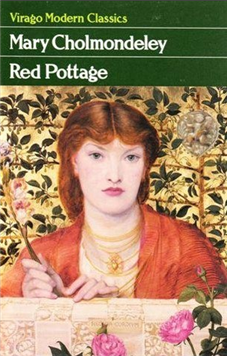
 This week’s Best Book is Red Pottage by Mary Cholmondeley! Recommended reading: Girl Waits with Gun by Amy Stewart!
Category: books
Day 895: Red Pottage
Best Book of the Week!
Red Pottage is another find for me this year of a novel by a terrific classic author. I can include Mrs. Oliphant, Dorothy Whipple, and Julia Strachey in this list of classic authors I have not read before that I really enjoyed. My Doughty Library edition says the novel contains “every ingredient for a Victorian bestseller” and mentions wickedness and greed.
Hugh Scarlett has been having an affair with a married woman, Lady Newhaven. At first he thought he was in love with her, but now he has recognized her for who she is—a shallow and stupid beauty. He has already decided to break with her when he meets Rachel West at a party. At one glance he decides that Rachel is the woman to make a better man of him.
Rachel has also attracted the attention of Dick Vernon, a wine grower from Australia who is visiting his friends and family. Rachel likes him, but she is thinking of others.
Rachel has an unhappy past. Once the daughter of a wealthy man, she lost her fortune with her father’s death. For seven years she struggled to support herself, living in London’s East End and working as a typist. At that time, she fell deeply in love with an artist, Mr. Tristram, and was devastated when she realized he had no intention of marrying her. At the beginning of the novel, she has inherited another fortune and still believes herself in love with Mr. Tristram. Now that she has a fortune, though, she is looking like a much better prospect to him.
Another important character is Hester Gresley, an author who has been Rachel’s friend since childhood. Although Hester is better born than Rachel, her fortunes have suffered as Rachel’s have improved. She lives with her brother James, a rector who disregards her talent as a novelist and can only see his own point of view. James’s wife is jealous of Hester, and the children lovable but noisy. Hester finds herself unable to work during the daytime, so she stays up into the morning working, only to be accused by her sister-in-law of laziness.
Red Pottage is a story about morals and manners. That sounds boring, but it is quite satirical at times, while at other times it brought me to tears. The central conflict begins shortly after Hugh meets Rachel, when Lord Newhaven confronts him about Hugh’s affair with his wife. He makes Hugh a challenge, that they draw “lighters” (matches? straws?) and whoever draws the short one must take his own life within four months.
To complicate matters, Lady Newhaven eavesdrops on this conversation but does not learn who drew the short lighter. Then foolish, self-centered Lady Newhaven confides in Rachel, along with her assumption that if her husband dies, she will marry Hugh.
The story turned out just about how I thought it would, but I found the journey completely gripping. Another success from my Classics Club list!
Related Posts
Day 894: Everyone Brave Is Forgiven
 Just before I read Everyone Brave Is Forgiven, I began a couple of advance reading copies that were varying degrees of bad. I did not finish either one, but the characteristic that stood out most for me was that both were written without a shred of humor. That is not to imply that all books should be humorous, but humor certainly helps me enjoy a book.
So, as I seemed to be on a run of bad fiction, my hopes for Everyone Brave Is Forgiven were not high, even though I enjoyed Cleave’s previous Little Bee. Although I’ll sometimes read one delightful book after another, this was not one of those periods. Thank goodness, I found Cleave’s book not only interesting, but at times funny, at other times touching.
Cleave starts out with some information about his grandfather, who was stationed during World War II in Malta. He has used the relationship between his grandparents as a jumping-off point for his novel.
Mary North is a young socialite who wants to do something for the war. She envisions the war office sending her on some important mission, but she finds she has been assigned to be a school teacher. She enjoys teaching, but her methods are unorthodox. When her school is evacuated to the countryside, her headmistress decides they can do without her.
Tom Shaw isn’t really interested in going to war, but when the children in the school district he administers are evacuated, he starts wondering about his role. After his good friend Alistair Heath enlists, he tries to sign up but is found to be performing an essential job.
By then he has already met Mary, who comes to him asking for a class to teach. Although most of the children are gone, there are still some about, mostly kids who weren’t wanted by the people in the country. Finally, Tom lets her conduct a small class of children, mostly handicapped, and the American negro boy from her old class, Zachary.
Tom falls madly for Mary, who is bright, beautiful, and funny. Mary also cares for Tom, who although older and more steady is also more naive. When Alistair returns, already a bit damaged from the war, Tom and Mary arrange a double date with her friend Hilda. But it is clearly Mary that Alistair is struck by, and she with him. Still, she stays true to Tom.
Alistair is stationed on Malta, which was Britain’s sole air base in the Mediterranean for much of the war. Nothing much grows on it, though, and after it is blockaded, the soldiers starve.
 We like Tom, but it is clear from the first that Mary and Alistair are meant for each other. How they will end up together is one thread of this story, but it has others. It’s about racism in World War II, about how Mary comes to reassess some of her values, about the horrors of war.
The conversations and exchanges of letters in this novel are light and amusing. The themes of the novel are more serious, but it still fits in the category of light fiction. I really enjoyed this novel. Mary is a determined character, light in approach but trying to do the right thing, even if it seems eccentric to others. Alistair is fairly shattered by his war experiences but still amusing.
Related Posts
Day 893: Classics Club Spin! A Wreath of Roses
 Today is another Classics Club Spin, and the book that was chosen for me from my Classics Club list is A Wreath of Roses by Elizabeth Taylor. Compared to the other two books I’ve read by Elizabeth Taylor, this novel seems less blighted in its setting. It takes place in a countryside that is lushly described. But before we get there, a shocking event occurs in the railway station that foreshadows the atmosphere and events to come.
Camilla is on her way for her annual holiday, which she has spent for years with her closest friend Liz and Liz’s former governess, Frances. Frances has become a famous painter, and they stay with her in her home. But this year things are different. First, Camilla has met a man, Richard Elton, on the train. Although she ordinarily wouldn’t have even spoken to him, categorizing him as a certain type, the incident at the train station has shocked them both. Then, Liz has brought along her baby Henry. Liz’s marriage to Arthur, whom Camilla dislikes, has created distance between the two women, and Camilla isn’t interested in the baby. Finally, Frances is looking like an old woman. She has difficulty painting, and has radically changed her style.
But the focus of the novel is on Camilla’s relationship with Richard Elton. When we see him on his own, we realize he is a liar who has difficulty telling his own lies from the truth. He may also be dangerous. He has told Camilla stories about violent activities during the war, but they seem unlikely. And he keeps reading in the paper about the murder of a woman.
Camilla is both repelled by and attracted to Richard. At first, she agrees to see him only to irritate Liz, but then she begins to feel sorry for him. Also, she sees herself drawing ever closer to a sort of dried-up spinsterhood, while Liz is positively blooming in her fecundity.
Although some of Taylor’s other novels are depressing in their realism, A Wreath of Roses is much darker. It juxtaposes the heat and lushness of its country setting with Camilla’s feelings of sterility and the themes of murder and suicide. The novel is disturbing yet compelling.
Related Posts
Day 892: Wild Strawberries
 This title does not refer to the Ingmar Bergman film but to the second (or third, depending on where you look) Barsetshire novel by Angela Thirkell. Unlike the others I’ve reviewed lately, Wild Strawberries was written before World War II. It is a delightful and gentle comedy with a romantic triangle.
Wild Strawberries is about a summer with the Leslies. Lady Emily is universally adored, a vague woman always leaving a trail of her possessions behind. She is also a managing type whose attempts to arrange things that are already decided repeatedly throw the family into chaos. The novel opens with a hilarious scene in which the family is late for service and disrupts the sermon while Lady Emily tries to tell everyone where to sit. Lady Emily is the mother whose passing is much lamented in Enter Sir Robert, which I reviewed a few months ago.
And if I am not mistaken, Agnes, a daughter of the house, is the same Lady Graham who is a major character in Enter Sir Robert, and as in that novel, Robert is continually referred to but not present. Agnes is a young mother with three children, kind but silly, and entirely obsessed with the children.
Other members of the household are Mr. Leslie, gruff but kind, sons John and David, and grandson Martin. Martin is the son of the Leslies’ deceased oldest son. John is a widower who has been mourning his wife Gay. David is a charming but selfish playboy.
The Leslies have invited Mary Preston to spend the summer with them while her mother recuperates at a spa on the Continent. Mary is Agnes’s niece by marriage, and her affections play a major part in the plot. She is a young, naive girl who is immediately charmed by David. John, on the other hand, falls in love with her when he hears her singing. We find ourselves rooting for John, but in Thirkell’s novels, the characters we like best are not always successful in love.
Providing humor are a visit from Mr. Holt, a toady to the upper class and expert on gardens, who invites himself to visit the Leslies, and the establishment at the vicarage of a French family. Seventeen-year-old Martin gets himself embroiled in a demonstration to restore the French monarchy, and Mr. Holt finds himself rewarded for his gate-crashing by being entertained by Agnes and her children.
This is a delightful novel with sympathetic and engaging characters and a great deal of humor. I enjoyed it very much.
I have to say that my Moyer Bell edition (not the one pictured above) was riddled with typographical errors, including a chapter that literally ended in the middle of a word, to be completed after the next chapter title. I just picked this up at a used bookstore, but next time I buy Thirkell, I will look for a Virago edition.
Related Posts
Day 891: Girl Waits with Gun
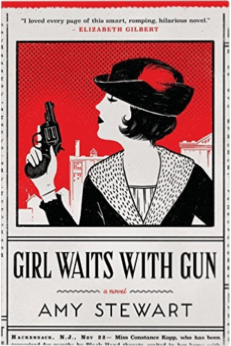 Constance, Norma, and Fleurette Kopp are driving their carriage into Paterson, New Jersey, one day when they are broadsided by an automobile driven by a wealthy man accompanied by a bunch of thugs. The men try to drive away but are stopped by the townspeople. The man turns out to be Henry Kaufman of Kaufman Silk Dying Company.
When Constance tries to collect $50 from him for repairs to their buggy, she and her family find themselves the victims of harassment. They receive threatening letters, bricks are thrown through the windows of their farmhouse at night, and men invade their property. Constance’s trip to the police gets no help from the prosecutor’s office, but Sheriff Heath teaches Constance and Norma how to shoot and sends deputies out to patrol the house.
The threats don’t stop, though. Instead, the attacks escalate and the women receive kidnapping threats against Fleurette, who is only 16.
In the meantime, Constance has met Lucy, a young dyer, who says she had a child by Kaufman. She said she sent the baby away with other children during a recent strike, and he is the only one who didn’t come back. She is sure Kaufman kidnapped him.
This novel is fun, exciting, and well written, with interesting characters, placed during a period when there was a lot of labor unrest in the Northeast. Constance is an engaging heroine. Although the plot involving Lucy is made up, the rest is based on a true case of the time, taken from newspaper articles from 1914. This novel makes truly enjoyable reading.
Related Posts
Best Book of the Week!
 This week’s Best Book is Fair Helen by Andrew Greig!
Day 890: Charlotte and Emily
 I have read two of Jude Morgan’s literary biographical novels but never felt I was really seeing the true character of the subjects. However, with Charlotte and Emily, Morgan seems to have found his subject.
Charlotte and Emily covers most of the Brontës’ lives, from the time they were children until Charlotte marries Arthur Bell Nicholls. By that time, all the other Brontë siblings have died.
Charlotte is the main character of the novel, although it is occasionally told from the point of view of Anne. Emily remains distant from the reader, harder to know.
Much of the novel is concerned with the focus of the entire family on the future of brilliant Branwell, the only son. The girls are sent for schooling so that they can be teachers and earn money to help educate Branwell. Although Charlotte wonders if she can become a writer and even tries sending poetry to Southey, the poet laureate, she is discouraged by both Southey and her father.
Of course, Branwell never finds a vocation and instead becomes a wastrel. Charlotte and Anne work doggedly as teachers, although they hate it. Emily gets herself sent home both from school and work.
I have read biographies of the Brontës, but this novel is the first I’ve read that gave me a sense of what their lives may have been like. I found it completely absorbing. If you are a Brontë lover, this is a book for you.
Related Posts
Day 889: An Inquiry into Love and Death
 For light reading with a supernatural twist, I’m developing an affection for the novels of Simone St. James. Her romantic suspense novels are set in post-World War I England and feature spunky heroines who get embroiled in mystery, always with a supernatural element.
Jillian Leigh is an Oxford student in one of the few colleges for women. She is summoned away from her studies with news that her Uncle Toby has died. Her parents expect her to take care of his affairs, saying that her father is unable to leave his work in Paris.
Jillian hasn’t actually seen her uncle since her parents broke with him when she was 14, for reasons she does not know. The one thing she knows about him is embarrassing, that he worked as a ghost hunter. Other than that, she remembers him as a shy, quiet person who was kind to her.
She is appalled, however, to find she is expected to identify his body. He was staying in the seaside village of Rothewell, thought to be haunted by the ghost of a smuggler, when early one morning he fell off a cliff.
Jillian stays in the house where Toby lived, an isolated cottage nearest the activities of the purported ghost. Almost immediately, odd things begin happening. She finds things in odd places, a book in the stove, for example. At night she hears what she thinks is a tree scratching her window, but in the daytime she sees there is no tree anywhere near it. Then Scotland Yard Inspector Drew Merriken arrives and tells her that Toby may have been murdered.
After reading a few of St. James’s novels, I have no doubt there will be a romance with the inspector, but her combination of ghost story and mystery is truly suspenseful. I found this to be another enjoyable romantic suspense novel.
Related Posts
Day 888: Tinkers
 George Crosby lies dying. He is an old man who retired and then became a clock repairman for 30 years. As he dies, he remembers the life of his father, who was a tinker—a traveling salesman of household items in the rural wilds of Maine—and an epileptic. In a way, of course, George also tinkers, with clocks.
This novel’s writing is truly astounding. Harding has a way of examining ideas and objects down to the bone. At other times, musings seem almost hallucinogenic. I wasn’t sure I understood the point of view, though. If all of the novel is from the point of view of George, as most reviews of the book seem to imply, how does he know what happened to Howard, his father—or is he imagining a life for his father?
To me, the novel seems to be about both men, in particular, about the circumstances that led to George being raised without his father. In the hard primitive life of backwoods Maine, George’s mother is resentful and cold. It is his father who is more considering and thoughtful, but a poor provider who might stop to weave pallets of grass instead of selling his goods. After a particularly bad epileptic attack, the only one witnessed by the Crosby children, George’s mother decides to have their father committed.
This novel was difficult for me to read, because I was so interested in some aspects of the plot that I glanced over some of the gorgeous prose or couldn’t concentrate on it (not my usual approach). The prose is the point of this book, however, and the meditations it evokes.
I believe this book is related to another book that also bought. I can’t remember if it is the sequel to the other book, or the other book is a sequel to it. I’ll be interested to see if reading both books enlightens me more.

