
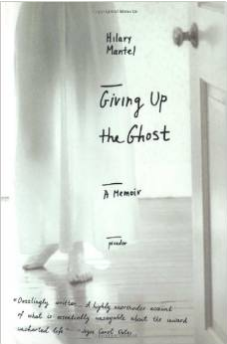
 This week, there is a tie for Best Book, between fiction and nonfiction! The fiction Best Book is Mercy Snow by Tiffany Baker, and the nonfiction is Giving Up the Ghost by Hilary Mantel!
Category: books
Day 630: Amherst
 Amherst combines the tale of two love stories, one actual and one fictional. The historical actual affair was between Emily Dickinson’s brother Austin and the much younger Mabel Loomis Todd. The modern fictional affair is between Alice Dickinson, working on a screenplay about the affair, and Nick Crocker, an older academic who gives her a place to stay in Amherst while she does her research. All of these people are married to others except Alice.
Emily Dickinson herself is a minor character in the 19th century story. Her brother and Todd used her house for their trysts—a known fact—and there is some debate about how much exposure Emily herself had to sex. Nicholson theorizes a woman listening at doors and a sort of free love attitude by everyone except Sue, Austin’s wife. I found it all a little sordid and probably unlikely.
All of this might be interesting to a reader of literature if Nicholson had spent any time with these characters before thrusting them into their love affairs. We don’t know any of them, so we don’t care about them (alas, too often my complaint lately).
Worse, to me, are the liberties or omissions at the end of the novel. Nicholson gives Todd full credit for her efforts to publish Dickinson’s poetry after her death, even having her spend hours convincing Thomas Wentworth Higginson of the value of Emily’s work. He doesn’t mention that Higginson was already very familiar with Dickinson’s poetry, having been in correspondence with her for 20 years before her death, as related in the excellent biography White Heat. (Although on the surface Nicholson seems unfamiliar with or ignores some of the content of the biography, he interestingly uses the phrase “white heat” to refer to the affair between Todd and Austin Dickinson.) Higginson was already convinced of the worth of Dickinson’s poetry—he just had doubts about how publishable it was. In fact, he almost certainly met Dickinson, which Todd never did.
The other historical fact Nicholson completely glosses over is the one the world of literature finds most shocking—that Todd and Higginson edited Dickinson’s poetry, changing capitalization and spelling but even rewriting some of the passages.
 The lovers are not really likable, in fact or fiction. Austin Dickinson actually consummated his affair with Todd while his wife was grieving the recent death of their young son. Mabel comes off everywhere as self-centered, and she fought with the Dickinson’s over Emily’s legacy as much as she ensured it.
The two modern lovers are just not interesting, really more of a footnote to the historical section, and I found Nick to be extremely manipulative. The novel also employs that overused trope of having Alice find out immediately in a way that is too crass to be believable that Nick has a reputation as a seducer. Note to minor characters: these warnings never work.
It’s hard to tell whether Nicholson meant these stories to be romantic, although he states in an interview that he is interested in exploring love. I did not find the stories romantic, either one of them. I also did not feel they particularly explored the theme of love. I was not at all drawn in by this novel, neither by the historical nor by the modern story.
Day 629: Giving Up the Ghost
Best Book of the Week!
In this gripping memoir, ghosts haunt author Hilary Mantel—the spectres of her past, her stepfather’s shade stumbling around the upper reaches of her holiday cottage, the spirit of her unborn daughter, the wisps of her yet unwritten books, and most confoundingly, the black smudge of an apparition that invaded her body when she was seven. Mantel’s is a memoir of wit, anger, and poetic truth.
It also meanders. It begins with the sale of Owl Cottage—where Hilary senses the ghost of her stepfather even though he never lived there—but then returns to the earliest memories of her childhood.
Of Irish Catholic parents, she grew up in the grim north England town of Hadfield, near Manchester. Although her family was poor, her earliest memories are the rich ones of her grandparents and aunts, who lived all along the lane, indulging the imagination of a child who was a knight of the round table, a red Indian, a priest, and was due to turn into a boy when she was four. To me, this last detail is one of the most charming. I can see this little girl.
Then a serious illness struck, changing her from a sturdy tough child with long black hair to a wispy, frail blonde girl, no longer due to change to a boy. From then on it seemed she was robbed of her true self.
The memoir details her rigid Catholic school education, where she developed an intolerance for ridiculous questions, from those asked by her teachers. It also tells of the more profound loss of her childhood, when her mother moved the family out of that lane of relatives so that she could take up life with her lover, Jack. Hilary’s father Henry was relegated to the status of a lodger and then left behind when Hilary won a place at a better school, never to be seen again.
The most debilitating events of her life began when she was a young married woman studying law. The extreme pains in her legs were diagnosed by patronizing and sexist doctors as mental rather than physical problems, caused by the stress of her studies on her feeble female brain, and she was treated first with Valium and later with anti-psychotics. What she actually had was endometriosis, which she finally diagnosed herself. It was left untreated so long that she ended up having a hysterectomy at age 29. She had put off having a child, and it was too late. The effects on her health continue to this day.
Mantel’s memoir is vividly and beautifully written. She strips herself bare, and it is unforgettable.
Day 628: Anne of Green Gables
 I have not read Anne of Green Gables since I was about ten, and I’m delighted to report that it is a book that offers as much enjoyment to an adult reader as to a child. As a child, I threw myself wholeheartedly into Anne’s delights and misfortunes, but as an adult, I am more able to appreciate the abundant humor of the novel.
Matthew and Marilla Cuthbert are an elderly brother and sister with a farm in Avonlea on Prince Edward Island. They have taken a momentous decision to adopt an orphan boy to help Matthew on the farm. They sent word to an acquaintance who went to adopt a girl, and she has brought an orphan back for them on the train.
But when Matthew arrives at the station, he finds not an orphan boy but a girl, a funny looking, skinny, red-headed girl. Matthew is a shy and reticent man, and he sees nothing to do but take the girl home and let Marilla break the news that there’s been a mistake. So, they set off home for Green Gables, the excitable Anne Shirley prattling all the way back.
When Anne learns she isn’t wanted after all, she is devastated. But when Marilla takes her to see another woman who might want an orphan girl, she can’t quite bring herself to leave Anne with the mean-mouthed woman with a reputation for mistreating the help (as an orphan would often be regarded at that time, not as a member of the family). Despite her better judgment, Marilla decides to keep Anne.
Thus begins this delightful novel about a young, imaginative girl who is always running into trouble. For Anne is romantic and dreamy and full of big ideas that often go wrong. The delight for me as an adult in reading this sentimental tale is the dry humor of Marilla, as she learns to love Anne and all her mischief. This is a lovely and fun book to read, particularly if you love any other volatile little red-headed girls.
Day 627: Mercy Snow
 Best Book of the Week!
On an icy Thanksgiving eve outside Titan Falls, New Hampshire, a school bus with children who had been to the movies in the nearby town plummets off the road, killing one girl and incapacitating the bus driver. Readers know that a car passed the bus at a dangerous place, causing the driver to lose control. Up the road from the bus, the sheriff finds the wrecked truck of Zeke Snow, a young man from a backwoods family of ill repute. No one knows exactly what happened, but the sheriff decides it must have been Zeke’s fault.
June McAllister, the mill owner’s wife, soon finds evidence that her husband Cal may know more about the accident than he’s admitting. Her reaction is to close family ranks. After all, the Snows have never been anything but trouble.
Zeke is hiding in the woods, but he has told his sister Mercy that he did not see the bus the night that he wrecked his truck. He ran when the police arrived because he’s known nothing but trouble from them.
Mercy knows that her brother occasionally shows poor judgment, but his main instinct has always been to protect her and their little sister Hannah. While eking out an existence for herself and Hannah and living in a battered old trailer, she decides she must somehow prove Zeke innocent. For her part, June is trying to drive the Snows out of the area, where they have returned to their grandmother’s property after years of a rough and nomadic existence.
This novel may sound like a mystery, but it is not. We know fairly early on what happened to the bus. Instead, the novel is an examination of themes like discrimination against the poor, the exercise of power, the complexity of people’s reactions to tragedy, and the close-mindedness of small, closely knit communities. It also includes a hint of the supernatural. The novel is disturbing and well written. Although I thought I knew where it was going, the novel turned out to be unpredictable.
Day 626: River Thieves
 Reading River Thieves did not leave me with the same impression of wild originality as did Galore, the other Michael Crummey novel I read. Still, it is an interesting historical novel about the interactions between Europeans and the Beothuk Indians in early 19th century Newfoundland.
This novel is based on a true incident. It concerns an investigation into the killing of a Beothuk man by trappers after they went looking for redress for some thefts. This expedition brought back a Beothuk woman, later called Mary, who is captured at the beginning of the novel. But the narration of this story is far from straightforward, and we do not learn exactly what happened until the end of the novel.
Further, the characters’ actions are affected by a long history of their personal interactions. John Peyton is a young man at the beginning of the novel. He is in love with Cassie, his tutor and his father’s housekeeper, but she is somewhat mysterious and keeps aloof from him. John Sr. hired Cassie thinking that she and John Peyton might marry, but a misunderstanding interferes.
Lieutenant David Buchan encounters most of those figuring in the incident when he makes an earlier attempt to establish more cordial relations with the Beothuk than the violent ones currently existing. This expedition, which includes John Peyton, John Sr., and some of John Sr.’s employees, ends in disaster. It is the seemingly upright Buchan, later a captain, who is put in charge of the subsequent investigation.
This story is told at a remove from the characters. Although we learn the thoughts of several of them, Crummey never reveals everything, forcing us to view his characters more as an ensemble rather than to consider one a central character. In Galore, Crummey used this technique to depict the occupants of an entire village. Here, it is not quite as satisfying.
Best Book of the Week!
 This week’s Best Book is Under the Harrow by Mark Dunn!
Day 625: Another Time, Another Life
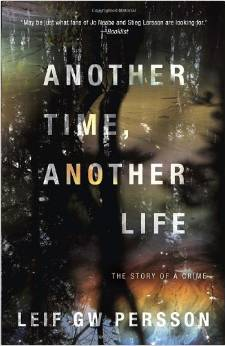 Another Time, Another Life is the second book in a trilogy of complex political police procedurals by Leif GW Persson. I reviewed the first book last spring.
At first, it is difficult to see the connection between the two books, but eventually some of the names and events from the previous book re-emerge. Another Time, Another Life begins with two crimes 14 years apart. Like Between Summer’s Longing and Winter’s End, one of the crimes is based on an actual event, in this case the bombing of the West German embassy in Stockholm in 1975 by German terrorists. Although the Swedish authorities are certain that the Germans must have had help from Swedish citizens, the case is wound up fairly quickly without any indication of who those Swedes might be.
Inspector Bo Jarnebring was on the scene right after the bombing, and 14 years later he is the first to respond to a call for help. A little old lady has overheard an argument in a neighboring apartment and called to report that someone is attacking her neighbor. When Jarnebring and his partner Anna Holt arrive, they find Kjell Göran Eriksson stabbed to death in his living room.
Eriksson turns out to be an unpopular man—no one at his workplace liked him and he had only two friends, both of whom have not seen him in awhile and have alibis. Bäckström, the inspector in charge of the investigation, gets it into his head that the crime involves homosexuality, based solely on there being no evidence that Eriksson had a girlfriend. He has no compunction in using illegal means to make the facts fit his idea of the crime. Jarnebring and Holt are suspicious of the amount of money in Eriksson’s bank account, not justified by his salary or his background. But Bäckström won’t let them pursue their leads, and no suspect is ever identified.
Ten years later, Lars Johansson has just taken a job as head of the Swedish Security Police when he finds some puzzling information in his files. The names of four Swedes suspected of helping the German terrorists in 1975 were redacted from a file, but then two were reinstated. Both men are dead, and one of them was Kjell Göran Eriksson. The other was one of his two friends. This discovery leads Johansson back to his friend Jarnebring and to an official reopening of the Eriksson case and an unofficial reopening of the embassy bombing case.
Having read the first book in this series, I was not surprised to find the case becoming very complex, with important political ramifications. Persson’s work is reminiscent of some of John Le Carré’s political thrillers, although not as exciting and probably not as well written (hard to tell with a translation). The novels are intended more as complex procedurals, though, than thrillers, and they succeed in keeping my attention. As with the first book, Persson seems to delight in depicting incompetence and idiocy in the police and government. Jarnebring and Johansson’s teams are capable and intelligent, though, and for once we meet detectives who are happy with their wives.
Day 624: Men Against the Sea
 Men Against the Sea is the sequel to Mutiny on the Bounty, and it accomplishes an interesting feat. While Mutiny on the Bounty depicts Captain Bligh as an enraged and irrational task-master, Men Against the Sea shows him as a consummate navigator and an able leader.
The novel takes up where the mutineers put the more loyal men adrift in a small boat. They have very little food and water and only a small tool box and a few weapons. Nineteen men are crowded into the 23-foot-long open launch.
Although the men make their way at first to one of the nearby Friendly Islands (present-day Tonga), they come close to being killed there by hostile natives. In fact, one of their number is murdered while they make their escape. They realize they will have to travel 3600 miles to the nearest European-occupied territory, in the Dutch East Indies (Indonesia).
Narrated by Thomas Ledward, the ship’s surgeon, the novel tells the story of this incredible journey. The men fend off hostile natives, battle storms, and survive on scanty rations and little fresh water, lead on by Captain Bligh.
This novel is well written and engrossing, although it lacks the suspense of the trial in Mutiny on the Bounty. I am looking forward to the final book in the series.
Day 623: The Goblin Market and Selected Poems
 I don’t know much about the life of Christina Rosetti. I know a little more about her brother, the artist Dante Gabriel Rosetti. The introduction to this book of her poems says that something happened to her when she was 15 that changed her from a mercurial child into a controlled, careful young woman. Certainly, her poetry shows a preoccupation with religion and death. It is also brimming with life, full of nature and love.
In “The Goblin Market,” for example, her descriptions of the goblin’s fruit are luscious. But though I understand the introductory comments about the poems being too sexually explicit for Victorian tastes, I see this poem as more about the pleasures and temptations of life versus spiritual values.
Some of the poetry in this collection dwells on themes I am not that fond of, but there is no doubt that the language is vivid and gorgeous. I don’t know if the poems are arranged sequentially, but some of the earlier ones remind me somewhat of traditional folk songs. Her sonnets employ an unusual rhyme scheme, close to Petrarchian, but with the last six lines using a different scheme.
One of my favorite poems was “In an Artist’s Studio,” about how the artist paints and repaints his model:

He feeds upon her face by day and night,
And she with true kind eyes looks back on him
Fair as the moon and joyfull as the light:
Not wan with waiting, not with sorrow dim;
Not as she is, but was when hope shone bright;
Not as she is, but as she fills his dream.
I know that Dante Gabriel occasionally painted Christina when she was young, but this poem made me think of how he obsessively painted his mistress, Lizzie Siddal.

