Day 664: Miss Marjoribanks

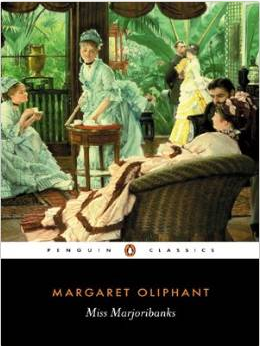
Cover for Miss MarjoribanksBest Book of the Week!
It’s not often that I discover a delightful novel by a classic author whose works I am unfamiliar with. But that’s the case with Miss Marjoribanks. It is a wonderfully ironic comic novel about middle class mores with an exasperating and ultimately lovable heroine.

We first meet Lucilla Marjoribanks at the age of 15. Her long-ailing mother has died, and Lucilla rushes home vowing to be a comfort to her father. Dr. Marjoribanks, who has been looking forward to a comfortable bachelor existence, wastes no time in sending her back to school.

Four years pass, and Miss Marjoribanks returns from her tour on the continent determined to devote herself to her father for the next ten years, suggesting that by then she may have “gone off” a little and will start looking for a husband. Lucilla is a young woman of energy and complete self-confidence who is determined to be a force in Carlingford society. But first she must deal with a proposal from her cousin, Tom Marjoribanks. She loses no time in dispatching him to India.

Dr. Marjoribanks watches in amusement as Lucilla calmly removes the reins of his household from his redoubtable cook Nancy and begins to take control of Carlingford society. Her first project is to begin a series of “evenings” every Thursday.

As Lucilla deftly and with dauntless good humor manages the affairs of her friends, somehow none of a series of eligible men ever come up to scratch with a marriage proposal when her friends expect them to. But Lucilla insists she will dedicate herself to her father’s happiness at least until she is 29.

Although Lucilla, with her managing ways, could easily be a figure of satire, I grew to admire her and like her friends and neighbors, who are fully realized even though  this book is the fifth in a series and I have not read the others. We even feel sympathy for Barbara Lake, the contralto whose voice goes so well with Lucilla’s that Lucilla invites her to her evenings. Barbara, from a lower strata of society, sees Lucilla’s actions as condescension and rewards Lucilla’s impulse with spite.

I was hugely entertained by Lucilla’s career and have already started looking for more books by Oliphant. Margaret Oliphant, I find, was once one of the most popular authors of the mid-19th century, and she deserves to be remembered.

Related Posts

Anderby Wold

Good Behaviour

Mrs. Dalloway


Day 662: The Mermaid’s Child

Cover for The Mermaid's ChildI was really delighted with Longbourn, Jo Baker’s twist on Pride and Prejudice. I have more mixed feelings about The Mermaid’s Child, Baker’s latest.

Malin Reed is raised by her father, who tells her she is the daughter of a mermaid. Her father, the ferry operator, is affectionate, but everyone else in town treats her with disdain. Malin herself is an odd mixture, a girl naive enough to believe in mermaids but hard schooled, bullied by the village boys and by her teacher. But she has seen a mermaid herself, when the circus was in town.

When her father dies, her grandmother tells her she can’t control her (although we see little evidence that she is uncontrollable) and sends her to “Uncle George” to be a skivvy and bar maid. There she is mistreated and learns to service more than the bar.

Then one night she walks off with a stranger, a man who has given her a smile. He has promised to deliver a rain machine to the village, which is in a terrible drought. With her myopic naivety, she hasn’t even realized he is a con artist.

So begins a picaresque journey for Malin that eventually becomes a search for her mermaid mother. This search takes her to many unlikely places.

I wasn’t sure how I felt about this novel. Were it not for the realism of Malin’s situation, I would take it more for a fantasy, and that is how it is being marketed. But it isn’t really a fantasy except possibly in the narrator’s mind, nor is it magical realism. Unlikely is the word to apply to her adventures but then again, I’m not sure we’re supposed to take Malin’s story that literally. She tips us off in the first few pages that she may be an unreliable narrator.

Still, there is not much to anchor this book except Malin’s character. Most of the other characters are one-dimensional, and anyway we don’t spend much time with them.

This is just an observation, but I don’t think I’m giving away too much when I say this is the fourth historical novel I’ve read this year in which a girl is disguised as a boy. So, what’s up with that? Are historical novelists bothered by the restrictions a woman was subject to in the past?

http://www.netgalley.comI guess I would sum up by saying I found the novel mildly entertaining. It starts out fairly believably and quickly becomes rather grim but with each adventure also becomes less likely. It’s as though it wants to be closer to something like The Rathbones but doesn’t quite manage to push out the boat.

Related Posts

Longbourn

The Rathbones

Ahab’s Wife Or, the Star-Gazer


Day 661: The Bully Pulpit: Theodore Roosevelt, William Howard Taft, and the Golden Age of Journalism

Cover for The Bully PulpitNoted historian Doris Kearns Goodwin approaches her subject of the relationship between Theodore Roosevelt and William Howard Taft from several insightful angles. Although her book examines their careers separately, it is focused on the differences in their personalities and approaches that finally led to the serious rift in their friendship of many years. This rift also led to Roosevelt’s third run for president, which split the Republican ticket.

One of the major differences that Goodwin identifies is their relationships to and use of the press. The journalists particularly close to Roosevelt and involved in the fortunes of both presidents all worked for McClure’s magazine and make up an impressive list of names in journalism: Ida Tarbell, Ray Stannard Baker, William Allen White, and Lincoln Steffens.

I wanted to read more by Goodwin after I read Team of Rivals, the great history of Lincoln’s career that inspired the movie Lincoln. Although I also have her book about FDR and Eleanor Roosevelt in my queue, I was interested in this one because I know only a little bit about Teddy Roosevelt and almost nothing about Taft, just the broad outlines of their careers.

Without going into detail about the careers and personalities of either man, although I developed respect for both, after reading this book, I confess to having a lot of sympathy for Taft over their split. The fact is that Roosevelt regretted his decision not to run for a third term and so looked for excuses to find fault with Taft’s presidency. After Roosevelt’s return from Africa, he criticized Taft’s record of progressive legislation even though it was actually better than Roosevelt’s own. Taft later acknowledged that he wasn’t as good as Roosevelt in publicizing his accomplishments or explaining his policies to the press.

This book is thoroughly interesting and revealing of the characters of both men. It is carefully researched, and it is also very well written. Although quite hefty at 750 pages, it moves along at a good pace and does not get bogged down with extraneous details.

Related Posts

Team of Rivals: The Political Genius of Abraham Lincoln

The River of Doubt: Theodore Roosevelt’s Darkest Journey

The Gods of Gotham


Day 659: The Prague Cemetery

Cover for The Prague CemeteryThe Prague Cemetery opens in 1897 with a monologue that is so vile and bigoted against just about everyone—the French, the Germans, the Italians, Jesuits, Masons, women, and especially Jews—that I almost put it down at that point. That monologue is the ranting of the main character, Simonini, as learned at his grandfather’s knee. Simonini is an absolutely repellent person who makes his living forging wills and other documents but who also works for the French secret police, and the German secret police, and the Okhrana, making up lies and creating international incidents.

Simonini has a problem. He has gaps in his memory. Further, when he explores a passage in his house, it leads to the rooms of someone who wears a cassock. Following the advice of an Austrian Jew (whom he calls Froïde), he begins writing down what he can remember of his life. The next time he awakens, he finds his diary annotated by the Abbe Della Piccola, who seems to remember the time periods he cannot but doesn’t remember the others. It is soon obvious that these are two personas of the same man.

Simonini is already a forger when he begins his first employment in espionage, spying on the leadership of Garibaldi’s army for the Piedmontese secret police. He always ends up exceeding his orders, though, so when he blows up the ship containing Ippolito Nievo, who is in charge of Garibaldi’s finances, instead of simply assuring the books go to the government and nowhere else, he is shipped off to Paris.

Simonini is most concerned with the fate of what he considers his life work, a document that is supposed to be a true account of a meeting of eminent rabbis—and one Jesuit—in the Prague cemetery, where they plot against the Gentiles and scheme for world domination. Although Simonini has plagiarized some of this document from other sources, he has fabricated most of it, including the setting. Over the course of 40 years, he perfects this document, eliminating the Jesuit and changing it to a series of protocols, all the while trying to sell it to different governments. It is this document that becomes the infamous Protocols of the Elders of Zion, used by the Nazis and other hate-mongers through the years to justify anti-Semitism, even though everyone involved in its creation knew the document was apocryphal.

Although this tale is supposed to be some sort of answer to Dan Brown’s The Da Vinci Code, being based on actual instead of made-up events, and though it is told with proper postmodern irony, it left a bad taste in my mouth. As Simonini and his abettors make up more and more ridiculous stories linking, say, the Masons to Satanic rites, with the public gleefully believing everything, I felt disgusted. Almost every character in the novel except Simonini was an actual person, and all the events the novel is based on are true, which makes it even more disturbing. Eco even has Simonini responsible for framing Dreyfus. Simonini also murders people and dumps their bodies in the sewer beneath his house.

Maybe I agree with one reviewer that some readers may not understand irony. I’m not sure. The construction of a truly dark and repellent protagonist reminded me of the novel Perfume, except that I enjoyed Perfume. I just know that although I have a dark sense of humor myself, this novel made me want to take a bath.

Related Posts

Great House

In the Garden of the Beasts

The Bones of Paris

Day 655: The Night Inspector

Cover for The Night InspectorWilliam Bartholomew is a survivor of the American Civil War, but in many ways he is also a casualty. His face was destroyed, so he wears a mask, but he also bears less discernible scars from his work as a sniper for the Union army.

Bartholomew is working as a commodities trader when he meets the writer Herman Melville. He has read and admired Moby Dick, but the novel was mostly met with mockery by the critics and ignored by the public. Unable to take care of his family with his earnings as a writer, Melville takes a job as a deputy customs inspector.

Bartholomew has a relationship with a Creole prostitute that he considers deeper than the usual one of client. She asks for his help in a venture that seems laudable but is illegal. To pull it off, he must involve Melville.

At first, I wasn’t sure where this novel was going. It is dark and sometimes disturbing, and I even thought it might become a mystery. It does not, but it fully captures the consciousness of a man who is tough but has had to fight to keep from being shattered by circumstances, his own actions, and his conscience.

It is also a vehicle for depicting Melville. There, I was not so sure it was going to be successful in making Melville interesting until the denouement of the novel.

Related Posts

Moby Dick

Ahab’s Wife, or The Star-Gazer

The Invention of Wings

Day 654: Longbourn

Cover for LongbournBest Book of the Week!
There has been a plethora of Pride and Prejudice reinterpretations and sequels in the past few years, and I haven’t found the ones I’ve read to be very interesting. Longbourn, however, looks at the novel from a completely different angle, from the point of view of the servants in the Bennet household.

Sarah has been a housemaid for the Bennets since she was a child. Although she is grateful for the kindness shown to her by the housekeeper, Mrs. Hill, she chafes against the limits of her existence and the sheer hard work. She has begun to wish for more.

Mr. Bennet unexpectedly hires a servant named James Smith. There is some mystery about him, for Sarah overhears Mrs. Hill having a heated discussion with Mr. Bennet about him. At first excited to have a new member in the household, Sarah is disappointed by his unkempt appearance and the fact that he never looks at her. Besides, she soon meets the handsome and exotic Ptolemy Bingham, Mr. Bingham’s mulatto coachman.

Aside from presenting fully realized characters and an interesting story, Longbourn imagines a completely different view of the Bennet household and the action of the original novel, which here is only peripheral. We find unexpected sympathy for Mrs. Bennet through Mrs. Hill’s knowledge of her history. Mr. Bennet turns out to have a secret. Lizzie and Jane are still the most likable Bennet girls, but they think nothing of sending Sarah to walk to Meryton in the pouring rain to buy roses for the girls’ dancing shoes. The viewpoint from the kitchen is certain to be an unexpected one.

This novel is fascinating, providing its own rich story while carefully observing the events of Austen’s novel in the background. I loved this truly original re-imagining.

Related Posts

Persuasion

Jane Austen: A Life

Jack Maggs

Day 641: Remarkable Creatures

Cover for Remarkable CreaturesRemarkable Creatures is based on the true stories of Elizabeth Philpot and Mary Anning. These were two women of the early 19th century who collected fossils along the sea near Lyme Regis, beginning before fossil collections became wildly popular. Some of their finds resulted in discoveries about evolution and extinction. The novel is told in alternating chapters from the point of view of the educated upper-class Elizabeth and the uneducated working-class Mary.

Elizabeth Philpot already realizes she will be a spinster when her newly married older brother nudges her and her two sisters to look for a less expensive place to live away from the family home in London, perhaps in some genteel seaside resort. The women choose Lyme Regis, and their brother soon finds them a comfortable but small stone cottage.

Louise Philpot becomes interested in gardening and Margaret busies herself with the town’s social scene, but Elizabeth realizes she must find something to occupy herself. When visiting a carpenter’s shop, she meets Mary Anning, at the time a child, and sees the fossils Mary has collected and is trying to sell. She is fascinated particularly by the fish and decides to look for fossils herself, doing much to help label herself and her sisters as eccentric.

Mary Anning finds and sells fossils to support her family, but she is also fascinated by them. After she begins her acquaintance with Elizabeth, she starts learning more about the scientific theories behind her work. When she discovers the fossil of a previously unknown animal, she does not know that her discovery challenges the beliefs of conventional religion that every animal created by God is currently alive on Earth.

Philpot and Anning, who made significant contributions to the science, both eventually find themselves frustrated by the lack of recognition for their contributions. It is worse for Mary, for she is not only a woman and uneducated, she is considered just a fossil hunter.

I found the subject matter of this novel interesting but feel Chevalier was probably struggling with the difficulties of depicting real people in fiction. Although she depicts two distinct women, they do not seem fully formed to me. I couldn’t help contrasting this novel with the wonderful The Signature of All Things, which is a similar story although completely fictional. There I got a sense of a strong, fully realized individual. To contrast, Chevalier gives each of her main characters a few signature traits—for example, Elizabeth judges people by what part of their physique they “lead with”—and we don’t get a sense of fully formed individuals.


Day 637: The Quick

Cover for The QuickAt first, The Quick seems like a straightforward historical novel about a young writer in 19th century London. But it has a twist. To be honest, if I’d known what the twist was beforehand, I probably wouldn’t have chosen this novel to read, because frankly, I’m tired of this subject. That said, I’m glad I read the book, because it is absorbing, well written, and quite suspenseful.

James and Charlotte Norbury grow up neglected in a rambling house in Yorkshire. Their father rarely comes near them after their mother dies and seems to forget they might need attention or tutors or governesses. So, while the two children run wild, it is the older Charlotte who takes care of James and teaches him to read.

After their father’s death, James goes away to school while Charlotte stays in the care of Mrs. Chickering, an elderly relative. James eventually moves to London to try being a writer, but he is not wealthy and has difficulties finding acceptable lodgings he can afford. An acquaintance introduces him to Christopher Paige, a young aristocrat looking for someone to share his rooms. Although the more austere and shy James does not envy Paige’s life of frivolity, he slowly begins to realize that Paige is his first friend—then that he is more than a friend.

One night, though, a terrible event takes place. Christopher Paige is killed and James disappears. When James does not appear at Mrs. Chickering’s funeral, Charlotte travels to London to find him.

In London, Charlotte’s inquiries attract the attention of the members of a powerful and mysterious club, the Aegolius. There has been an unexpected event at the club, and other people are looking for James. Soon, Charlotte finds herself involved with a secret substrata of the city.

Owen depicts a wonderfully atmospheric London. Although I was at first disappointed with the direction the story took, I still was unable to put this book down.

Day 632: The All-True Travels and Adventures of Lidie Newton

Cover for The All-True Travels and Adventures of Lidie NewtonBest Book of the Week!
Just by coincidence, it seems, I have read several books in the last few years dealing with the wars in Kansas over whether it would be a free state or not. Bleeding Kansas by Sara Paretsky was the first book I read on the subject and the least well done, not providing much background for readers who don’t know a lot about the subject. The next book I read was Gilead by Marilynne Robinson, much more poetic but concerned mostly with a son’s reaction to his minister father’s participation in the bloodshed. The Good Lord Bird provides more of a comic flavor to the time, but it concentrates on a portrait of John Brown. I just finished Jane Smiley’s The All-True Travels and Adventures of Lidie Newton, which provides the most background to the issues and a more vivid picture of the times.

Lidie Harkness is a tall, plain young woman who has spent most of her time avoiding her traditional duties and instead rides, hunts, and swims with her 12-year-old cousin Frank near their home in Quincy, Illinois. She is the only child of her very old father’s second wife, and her sisters are much older. When her father dies, she knows her sisters are at a loss for what to do with her and eager to get her off their hands.

She meets Thomas Newton, a New England abolitionist on his way to join friends in Lawrence, Kansas. He seems struck by the stories Frank tells him of Lidie’s outdoor abilities, and it is not long before they are married and on their way down the Mississippi.

Flyers are plastered all over Lidie’s brother-in-law’s store promising a settled paradise in Kansas, but the reality is much more frantic and primitive. Lidie and Thomas find themselvs in a bustling but rustic town and are soon trying to build a homestead from a rough 12 x 12 cabin. Of concern, though, are all the rumors about the political situation and the outbursts of violence against the mostly free-state settlers by groups of pro-slavery Missourians who are trying to force them out.

In this tempestuous climate, Lidie tries to get to know her husband and also to understand just how committed she is to the fight against slavery. The novel depicts its time and location vividly. Lidie’s is an interesting portrait of a young woman attempting to find her own place in the world and decide what she believes about marriage and the issues of her time.

Day 630: Amherst

Cover for AmherstAmherst combines the tale of two love stories, one actual and one fictional. The historical actual affair was between Emily Dickinson’s brother Austin and the much younger Mabel Loomis Todd. The modern fictional affair is between Alice Dickinson, working on a screenplay about the affair, and Nick Crocker, an older academic who gives her a place to stay in Amherst while she does her research. All of these people are married to others except Alice.

Emily Dickinson herself is a minor character in the 19th century story. Her brother and Todd used her house for their trysts—a known fact—and there is some debate about how much exposure Emily herself had to sex. Nicholson theorizes a woman listening at doors and a sort of free love attitude by everyone except Sue, Austin’s wife. I found it all a little sordid and probably unlikely.

All of this might be interesting to a reader of literature if Nicholson had spent any time with these characters before thrusting them into their love affairs. We don’t know any of them, so we don’t care about them (alas, too often my complaint lately).

Worse, to me, are the liberties or omissions at the end of the novel. Nicholson gives Todd full credit for her efforts to publish Dickinson’s poetry after her death, even having her spend hours convincing Thomas Wentworth Higginson of the value of Emily’s work. He doesn’t mention that Higginson was already very familiar with Dickinson’s poetry, having been in correspondence with her for 20 years before her death, as related in the excellent biography White Heat. (Although on the surface Nicholson seems unfamiliar with or ignores some of the content of the biography, he interestingly uses the phrase “white heat” to refer to the affair between Todd and Austin Dickinson.) Higginson was already convinced of the worth of Dickinson’s poetry—he just had doubts about how publishable it was. In fact, he almost certainly met Dickinson, which Todd never did.

The other historical fact Nicholson completely glosses over is the one the world of literature finds most shocking—that Todd and Higginson edited Dickinson’s poetry, changing capitalization and spelling but even rewriting some of the passages.

http://www.netgalley.comThe lovers are not really likable, in fact or fiction. Austin Dickinson actually consummated his affair with Todd while his wife was grieving the recent death of their young son. Mabel comes off everywhere as self-centered, and she fought with the Dickinson’s over Emily’s legacy as much as she ensured it.

The two modern lovers are just not interesting, really more of a footnote to the historical section, and I found Nick to be extremely manipulative. The novel also employs that overused trope of having Alice find out immediately in a way that is too crass to be believable that Nick has a reputation as a seducer. Note to minor characters: these warnings never work.

It’s hard to tell whether Nicholson meant these stories to be romantic, although he states in an interview that he is interested in exploring love. I did not find the stories romantic, either one of them. I also did not feel they particularly explored the theme of love. I was not at all drawn in by this novel, neither by the historical nor by the modern story.