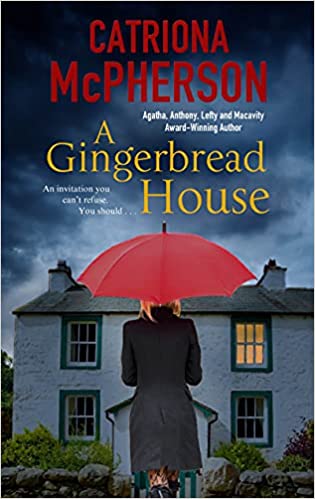
Review 2656: The Edinburgh Murders

I still prefer McPherson’s stand-alone thrillers to any of her mystery series, but Helen Crowther is starting to grow on me. This is the second book in the series.

Helen is an almoner serving the poorest neighborhoods in Edinburgh post-World War II. Her title has just been changed to welfare officer, but her job is a lot more hands on than we would expect. So, she is bathing a woman at the public baths when two things happen—first, she spots her father in a booth but it is not the family’s usual night. Then, in the next booth an attendant finds a man who has been boiled to death. Helen, trying to help, notices that although his clothes are those of an abattoir worker, his hands are not those of a working man, and someone has removed his signet ring.

No one comes to identify the body, but Helen thinks her father knows something about it.

Helen’s personal life is complicated. In the first book, she was newly married and wondering why her marriage was not consummated. (Spoiler for the first book.) She has discovered her husband Sandy is in love with a man, Gavin. Now she lives alone in an upstairs apartment with Sandy and Gavin below. Things are going to get more complicated, because Helen is attracted to Billy, a technician in the morgue. Her friend Caroline wants to visit the morgue, so they arrive there to find out that another corpse has arrived, this one forced to eat himself to death and dressed like a tanner with a signet ring missing.

Helen agrees to go ice skating with Billy, Caroline, and Billy’s coworker Tom, and another body is found frozen under the ice. Then there is a fourth.

Helen and Billy begin investigating the murders, which are being blamed on an escapee from a mental hospital. But they don’t think he did it.

In the meantime, Helen and Caroline are arranging a Halloween party for the local kids at an Adventist church. It turns out spookier than they planned.

I like the flavor of Edinburgh in these mysteries, although like her Dandy Gilver series, they are super complicated, without much of a hint about the perpetrators until the end.
Related Posts

In Place of Fear

The Reek of Red Herrings

The Turning Tide

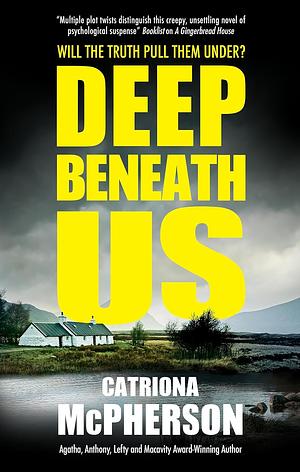
Review 2460: Deep Beneath Us

As a teenager, Tabitha had a mental breakdown and had to be hospitalized. Now her husband has left her for another woman. He has divulged her history of mental illness to her employer, who fired her for not divulging it when she was hired. This loss has resulted in the loss of her home and as a result, the custody of her son. She has returned to her family home on a remote moor because she has nowhere else to go, and at the beginning of the novel, she has decided to recede into madness. She feels a rumble and thinks she imagined it, but it is someone trying to blow up the dam.

Gordo hears the explosion and goes to the police to report it. That’s why the police are nearby when Tabitha realizes she can’t get her cousin Davey to answer his door. They find Davey inside, an apparent suicide, having taken the insulin left over after his mother’s death. At the cottage, Tabitha meets Davey’s friends Gordo and Barrett, with whom he regularly collected trash on the beach.

Tabitha, Gordo, and Barrett can’t make sense of Davey’s death nor of the police assumption that Davey tried to blow up the reservoir dam. Even though Tabitha finds a note, Davey doesn’t seem to be the type of person to commit suicide. Later, Tabitha is astonished to learn she has inherited Davey’s cottage—and delighted because it means she can offer her son a home, which he immediately agrees to accept. Then she and her new friends are astonished again to find that Davey has been hoarding all the junk the three men have picked up off the moor for the last 15 years.

Barrett is delighted to find his ex-wife wants to leave his two daughters with him, and with Tabitha’s son, the teenagers insist that Davey was murdered. As the adults and teens look into it, they end up digging into the tangled past of Tabitha’s family—the distant mother, the two brothers who were estranged for years and then apparently committed suicide on the same day (or did they?), the two cousins who eloped, one of them Davey’s brother, the other Tabitha’s sister, Tabitha’s near death as part of her father’s suicide—and why Tabitha remembers almost nothing.

This novel isn’t as much of a thriller as an extremely atmospheric and tangled mystery as Tabitha and her friends try to sort out the truth of her family’s past. Although the sequence of events around Davey’s death ended up seeming unlikely to me, my doubts didn’t interfere with my enjoyment of the novel.

Related Posts

A Gingerbread House

In Place of Fear

The Mirror Dance

Review 2166: In Place of Fear

It’s 1948 Edinburgh, and it’s Helen Downie’s first day in her job as almoner for the brand new National Health Service. Her bosses are young Dr. Strasser and Dr. Deuchar—previously the partner of Dr. Strasser’s father—who share a house and a practice. Although Dr. Deuchar is friendly and humorous, Dr. Strasser is abrupt and sometimes rude. However, Dr. Strasser unexpectedly gives Helen and her husband Sandy a place to live—a flat in a house that was used as a fever hospital during the war. That’s good, because just that morning Helen’s quarrelsome mother threw them out.

Helen completes her first busy day and is delighted with the upstairs flat, which is clean, bright, and has an inside bathroom. When she and Sandy are trying to pull together a few odds and ends to make the flat minimally habitable, Helen finds the body of a young woman out back in the Anderson shelter. She thinks the woman is Fiona Sinclair, the daughter of her benefactor, Mrs. Sinclair.

After she alerts the police, Dr. Deuchar says the woman died from poisoning herself. He and Helen go to notify Mrs. Sinclair, but Fiona is okay. Then Helen thinks the body might be her other daughter, Caroline. She and Dr. Deuchar try to find the misidentified body but are told it was sent to Glasgow because it was the body of a notorious Glasgow criminal. However, on a second visit to the morgue, Helen learns that the girl was hanged, not poisoned, and a famous criminal by the name she was given is unknown in Glasgow.

Persistent Helen begins to uncover widespread corruption involving leading citizens in the city. Something is going on very close to home.

It wasn’t clear to me whether this book marks the start to another series by McPherson, but it has hallmarks of it. Helen is a feisty and likable heroine, and although I thought she was blind to the identity of the killer, what was actually going on in the city was harder to figure out. If this is a series, I’m looking forward to seeing more of Helen.

Related Posts

The Turning Tide

Strangers at the Gate

The Mirror Dance

Review 1825: A Gingerbread House

Catriona McPherson, in her standalone novels anyway, is a master at creating creepy situations that eventually resolve into the making of warm communities. I guess that makes her the queen of gothic cozies. In A Gingerbread House, she’s hit it with another one.

Tash Dodd has discovered that her family’s transport business is involved in trafficking. She wants to take over the business and put things right, so instead of informing the police, she lodges her proof and presents her father with an ultimatum—retire or else. Then she goes into hiding to give him a week to think it over.

While she’s been away training to turn her business to greater good, she’s caught glimpses of some women just before their lives completely change. Someone is creating elaborate hoaxes to lure one lonely woman after another into a Victorian gingerbread-style house. The first is Ivy, an older woman who would like a friend but would settle for a cat. Instead, she meets Kate, who claims her twin sister looks just like Ivy. Please come to the house to meet her. Kate has a surprise in store for Ivy.

As usual, McPherson creates likable heroines—this time four of them—and there are friendly neighbors and a hint of a love interest. I enjoyed myself very much.

Related Posts

Strangers at the Gate

Go to My Grave

House. Tree. Person.

Review 1798: The Mirror Dance

It looks like Alec, Dandy Gilver’s detecting partner, is settling down at last. Dandy doesn’t like Poppy, however, and perhaps is feeling a little jealous, so she goes along with her maid Grant to meet her new client, Sandy Bissett.

Miss Bissett has explained that a Punch and Judy show in Dundee has made puppets representing characters whose copyright is owned by her magazine company. The characters are Rosy Cheeke and Freckle. She wants them to cease and desist.

Before her appointment with Miss Bissett, Dandy and Grant go along to see the puppet show. During the show, the puppets stop moving, and after a wait, Dandy goes to see what the problem is. She finds the puppeteer, Albert Mackie, murdered in his booth. Dandy can’t figure out how anyone entered or left the booth without being seen.

Returning with Alec, Dandy finds the mystery becoming more bizarre, with the puppets found in their clients’ conference room, messages in lipstick and blood, and the discovery of a similar murder 50 years ago of a man with the same name. A brother of the murdered man also appears on the scene.

Usually McPherson’s Dandy Gilver mysteries are so full of red herrings that they’re confusing. This time I figured out the murderer, although nothing else, almost immediately. However, the series is still fun.

The Turning Tide

Dandy Gilver and a Spot of Toil and Trouble

Dandy Gilver and the Unpleasantness in the Ballroom

Review 1760: The Turning Tide

I’ve started to feel as though Catriona McPherson’s approach to a mystery is to throw clues at you until you’re impossibly confused. That’s probably why I prefer her cozy thrillers. Still, I like her characters Dandy Gilver and Alec Osborne, so I keep reading.

Dandy’s daughter-in-law has given birth to twins when Dandy and Alec finally decide to respond to a third letter asking for help. One reason they decide to come is they have just heard of the death of a family friend, Peter Haslett, that seems to be connected with the case. The Reverend Hogg has asked them to find out what is wrong with Vesper, the Cramond Ferry girl, who appears to have gone mad and now blames herself for Peter’s drowning.

When they arrive in Cramond, they are confused by a meeting with three people who seem to have different agendas, Reverend Hogg, Miss Speir, who runs an uncomfortable inn, and Miss Lumley, who owns a local pub. They also hear different versions of Peter’s death. Most say he fell off the ferry and drowned, but one person says he came off the path and had his head crushed in the mill race.

He supposedly was visiting some friends, agricultural students doing an experiment with potatoes, but when Dandy and Alex meet them, the students make nothing of the fact that they have planted the potatoes upside down. When Dandy and Alec meet Vesper, she certainly seems mad, half naked and babbling about Mercury and snakes. But soon, Vesper too is dead.

I think I defy anyone to figure out McPherson’s crime novels. Still, they’re fun to read.

Dandy Gilver and a Spot of Toil and Trouble

Dandy Gilver and the Unpleasantness in the Ballroom

The Reek of Red Herrings

Review 1630: Scot & Soda

I love Catriona McPherson’s creepy psychological thrillers mostly set in small Scottish villages, and I like her Dandy McGilver mysteries set in the early 20th century, but I wasn’t that enamored with the first of her Last Ditch mysteries, set in present-day Northern California. However, I thought I’d give the second one a try before giving up.

One of the jokes of this series is a Scottish woman as fish out of water. That woman is Lexie Campbell, a therapist. She and her friends from the Last Ditch Motel are on the houseboat she inherited in the last book having a Halloween party. When Lexie tries to haul up the beer she has been cooling in the water, up comes a corpse with a wig and tam on its head. Lexie also spots a ring on his finger.

Detective Mike Rankinson is not exactly Lexie’s friend, so after Lexie has a brain wave when she reads a newspaper story about a horse having its tail cut off, Mike isn’t very receptive. Lexie thinks the events remind her of the poem “Tam O’Shanter.” In pursuit of this idea, she and some friends visit a derelict farm that has a burial mound in it, and they find some women’s clothing with blood on it.

The hallmarks of this series are Lexie’s tiffs with the police, the plethora of eccentric friends, and the confusing myriad of clues. One of the things I like about McPherson’s other books is the atmosphere of small Scottish villages, with some eccentric characters but ones that are mostly believable. In this series, McPherson has tried to create the same atmosphere with the eccentric inhabitants of the Last Ditch Motel. First, there are so many of them that I can’t keep them straight. Second, this doesn’t really work in a big city setting, even in California. Finally, I find her making mistakes about the American side of things, having her characters say things Americans wouldn’t say, for example. I think I won’t be reading more of this series.

Related Posts

Scot Free

As She Left It

Strangers at the Gate

Review 1487: Strangers at the Gate

It seems too good to be true when Paddy Lamb returns from a job interview to report that he’s been offered a partnership at a firm in Simmerton. When his wife, Finnie, raises questions about where she is going to work and how far the commute is, he comes back with an offer of a lease on a cottage belonging to the firm’s owner and the promise of a job for her as a deacon at Simmerton Parish Church.

As soon as they arrive, things begin falling apart. Finnie can see that her help isn’t really needed at the parish church. Then, Finnie and Paddy are invited by Tuft Dudgeon, the wife of Paddy’s new boss, for dinner on the night they move in. They have a pleasant evening, and the two are walking home when Finnie realizes she left her bag. Something has been spooking her all day, so when she returns to the house and can’t raise the Dudgeons, she goes back to the kitchen. There she finds Lovatt and Tuft Dudgeon in a pool of blood, apparent suicides.

She is about to call the police when Paddy stops her, because in his past he was involved in minor criminal activity. The couple decides to wait and let someone discover the bodies, thinking that will happen shortly. But when Paddy arrives at work, he finds that someone has sent a fax saying they have left on vacation to Brazil. The only problem is that the fax was sent after Finnie saw the bodies. As Finnie and Paddy try to get someone to discover the bodies, the lies begin to pile up.

My first impression of this situation was that it was a silly one for McPherson, who usually writes good modern-day cozy thrillers. It was hard for me to believe that Finnie would agree to lie. She is a deacon, albeit an unconventional one, and she seems to take this seriously although with a light touch. However, if you can buy into the situation, it’s a fairly wild ride to the conclusion.

I really love McPherson’s thrillers, because they combine a creepy plot with a community of likable characters often featuring life in a small Scottish village. This one follows that pattern while providing loads of atmosphere in this isolated, dark village.

Related Posts

Go to My Grave

Come to Harm

Quiet Neighbors

Review 1427: Dandy Gilver and a Spot of Toil and Trouble

Dandy Gilver receives a note from an old school friend, Minnie Bewer, asking for her assistance, but when she and her partner Alec Osborne arrive at Castle Bewer, what exactly the family wants is more difficult to ascertain. Whatever it is, it revolves around a missing necklace they call the Cutthroat and the disappearance 30 years ago of Bluey Bewer’s father, Richard.

Minnie Bewer wants Dandy and Alec to safeguard the castle while the Bewers put on a play. Bluey wants them to search for the Cutthroat and assure inland revenue that it is not in their possession before death taxes are assessed on his father’s 100th birthday. Ottoline Bewer, Bluey’s mother, wants them to find the necklace. To do that, Dandy reckons they must find Richard. There is a lot to do, and it must be done during the disturbance of rehearsing and performing the play Macbeth.

As usual with this series, there are lots of red herrings and a lot of confusion. That usually derails me, but this time I realized almost immediately the truth of one facet of the story, and I was right. Once I had figured it out, a lot became obvious.

Still, the Dandy Gilver mysteries are always fun cozies. The first one was set at the end of World War I, and this one in 1934, so it’s been a long-developing series.

Related Posts

Dandy Gilver and the Unpleasantness in the Ballroom

Dandy Gilver and a Deadly Measure of Brimstone

Dandy Gilver and a Bothersome Number of Corpses

Review 1359: Go to My Grave

Cover for Go to My GraveDonna Weaver and her mother have invested everything in The Breakers, a large house on the Galloway coast that they have made available as either a self-catered or fully catered vacation rental. Donna is excitedly awaiting their first guests, an anniversary party of cousins and their spouses, while her mother attends a hospitality convention.

When the guests arrive, however, it becomes clear that they have all been there before. Twenty-five years ago, they attended a 16th birthday party for Sasha, the man whose wife, Kim, has planned this trip.

The reactions of the guests when they recognize the house make it clear that they do not relish memories of this party. Then, shortly after they arrive, things begin appearing in the house that hearken back to that occasion. What is happening in the house? Is one of the guests trying to gaslight the others?

Occasionally, we see flashbacks to 1991, when a 14-year-old local girl named Carmen is invited to the party. When she arrives, she brings along her 12-year-old sister.

This novel is truly riveting, although the answer to what is happening seems a little too contrived. Although McPherson is known for her “cozy” thrillers, this one is probably more accurately described as a modern gothic thriller. The ending to it is a bizarre mixture of cozy and chilling. I didn’t know quite what to think of it, but the best term I can come up with is “morally challenged.” We are presented with an ambiguous conclusion to tone down the ending, but I know very well what I think happened.

Related Posts

The Day She Died

House. Tree. Person

As She Left It