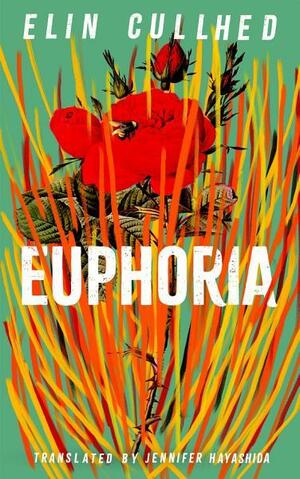
Review 2507: Literary Wives! Euphoria

Today is another review for the Literary Wives blogging club, in which we discuss the depiction of wives in fiction. If you have read the book, please participate by leaving comments on any of our blogs.

Be sure to read the reviews and comments of the other wives!

My Review

Oh, dear, Elin Cullhed and editors, morels come out in the spring. By October, it’s unlikely that any could be found, worm-eaten or not. Chanterelles are what you pick in the fall, among others.

Euphoria is about Sylvia Plath, set in the last year or so of her life. It begins when her daughter is one year old and she is pregnant with her son. It ends a few months before her death.

Before I get into my review, I want to comment on something. When I began reading this novel, I knew very little about Plath except she was a poet, she was married to Ted Hughes, and she committed suicide. Very recently, I read her novel, The Bell Jar, just by coincidence because it filled a hole in my Century of Books project. While I was reading Euphoria, I got the sense that there was a big controversy when Plath died. Some blamed her death on Hughes, who left her a few months before for another women. Certainly, there was a lot of anger against him for burning her diaries. Perhaps I’m seeing some reflection of the opposite side, but I ran across a post by All That’s Interesting, a blog produced by material collected from other sources, that states that Plath was at the nadir of her career when she died. Actually, her novel was recently published (one month before), she had been on BBC reading her poetry, and had recently finished her most famous poem, “Daddy.” So, where did this “nadir” idea come from? Maybe from Ted Hughes’s supporters?

That novel starts with the couple having moved to Devon at Hughes’s insistence. Plath liked living in London and feels lonely in the country, pregnant and left alone with her one-year-old Frieda while Ted goes up to London. Frieda wants attention all the time, and Sylvia has difficulty finding time to work or get anything done. Her marriage already seems rocky to me, alternating sometimes vicious verbal battles with voracious sex. Sylvia admits to liking being mistreated and having a fascination with death. She is extremely needy and jealous. He is always walking away.

The novel is written from Sylvia’s point of view. She is almost always either ecstatic or depressed. With her, as depicted by Cullhead, it is I, I, I. There isn’t so much a plot here as a detailed examination of her feelings as her children grow and her marriage breaks down. Jealous or not, she immediately recognizes that Aissa Wevill is after Ted.

This novel is sometimes difficult to read. Sylvia’s shifts in mood or reactions are sometimes hard to understand, and occasionally her thought processes were hard for me to follow.

What does this book say about wives or about the experience of being a wife?
Literary Wives logo

Well. Certainly Sylvia would be a difficult woman to be married to. First, she’s possibly bipolar, unsure of herself, and obsessed with Ted. But Ted, I think, is not exactly a model husband, even for his time. He helps out sometimes (which is actually unusual for his time) but he withdraws a lot because he has to write. Sylvia has to ask for time to write even though it is her fellowship that is supporting them at the beginning of the book. There are a few signs that he may be threatened by her as a writer, although other times he celebrates with her.

I know this is a time when men generally weren’t involved much with family life and childcare—and sometimes he cooks, does dishes, or takes care of the kids—but I was shocked when he left Sylvia, sick with puerperal fever but with an infant and toddler to care for, to go fishing, in winter no less.

I don’t think this book says anything about marriage in general, just something about this particular, very volatile marriage. It seems like the volatility that made it exciting at first was what did it in finally.

As so often happens when one person in a couple is attracted to someone else and wants to leave, that person begins finding fault with the person he wants to leave in order to make himself feel better about this betrayal. Often, the very things that attracted him in the first place are the things that irritate him later. You may find fault with my pronouns, but it is often these pronouns that this applies to.


Related Posts

Mrs. Hemingway

Passion

Owls Do Cry

Review 2494: #RIPXIX! The Raging Storm

Another book for RIP XIX!

On a terrible stormy night, the Greystone lifeboat crew is called out to rescue a fishing boat in danger. When they reach the boat, it is not a fishing vessel but a tender with a naked body in it. The body is that of Jem Rosco, a former local boy turned famous adventurer who has been staying in the village for a few weeks, saying he was awaiting a visitor.

Although no one knows who the visitor may be, Alan Ford, the father of lifeboat helm Mary, reports seeing a blond woman walking towards Rosco’s rented house in the early hours. However, Matthew Venn’s team can find no leads about the woman or the car that dropped her off.

Rosco’s past is proving hard to track. His apartment hasn’t been occupied for months, and no one seems to know if he has any surviving relatives.

One possible expected visitor, they find, is Eleanor Lawson, Rosco’s ex-flame who married someone else, Barty Lawson, a local magistrate and commodore of the yacht club. Eleanor claims Rosco was her true love, but Barty clearly despised Rosco from the time they were both boys. Barty doesn’t seem to be a likely murderer, though, as he is regularly driven home drunk from the yacht club.

Screenshot

Venn’s team is having difficulty penetrating the secrets of the village, which contains lots of families belonging to the Barum Bretheren, the cult Matthew grew up in but left. Then Barty Lawson is found dead, apparently having fallen off a cliff. Not only does Matthew think it’s unlikely that Barty was out strolling the cliff trail, but Barty’s body is found at Scully Head, near where the tender containing Rosco’s body was anchored.

I still don’t know what I think about the character Matthew Venn, who seems unknowable. Maybe I prefer Vera or Jimmy Perez because I first encountered them on television, where they immediately assumed distinct personalities. However, Cleeves knows how to keep her readers rivetted as far as plot is concerned.

That said, the motive for the crime in this one seemed absurd and the murders overly complicated. Still, the journey was enthralling.

Related Posts

The Long Call

The Heron’s Cry

The Rising Tide

Review 2061: The Seat of the Scornful

In the first scene of The Seat of the Scornful, we meet Justice Ireton, who really believes that an innocent man cannot be found guilty in his court. He lets a convicted man leave the court thinking he is going to be hanged when the justice intends to sentence him to life, as if that’s not punishment enough.

Later, his daughter Connie comes to see him at his seaside retreat, bringing along her fiancé, Anthony Morrell, a flashy dresser of Italian extraction whom Ireton immediately distrusts. Morrell, once alone with the justice, accepts an offer of £3000 to leave Connie alone.

The next night, the girl at the telephone exchange receives a call asking for help at the justice’s cottage followed by a gunshot. The justice is discovered seated at his desk holding a gun with Morrell’s body on the floor, shot in the head. Ireton claims to have been cooking in the kitchen when he heard a shot and came in to find the body and the gun.

Carr’s ungainly amateur detective, Gideon Fell, works with Inspector Graham to figure out what happened. Early the next morning Morrell’s lawyer explains that Morrell is actually a wealthy man with his own candy company who intended to give Ireton the £3000 as a gift for Connie to teach him a lesson.

Although the actual solution to this murder is very simple, it is followed by a series of fairly unbelievable events. However, I have a much bigger problem, without saying too much, with how Fell wraps up the case. Let’s just say that the victim, who was obviously not a nice guy but wasn’t the creep Ireton thought him, is not regarded at all. The introduction to the British Library edition says that other readers have questioned the book’s ethics. Let me say that I think the ending is extremely classist, that if Morrell had been a different type of person, the ending would have been different. Edwards states that Carr, Agatha Christie, and Anthony Berkeley were all pondering whether any murder is justified. Well, this one isn’t.

I received a copy of this book from the publishers in exchange for a free and fair review.

Related Posts

The Lost Gallows

Jumping Jenny

Murder on the Orient Express

Review 1796: The Uninvited

The movie The Uninvited has long been the Halloween movie of choice for me and my husband. It is vintage 1930’s with Ray Milland and a great ghost story. However, I had not read the book until now.

Roderick Fitzgerald and his sister Pamela have been fruitlessly looking for a house in the west country that they can afford when they come across Cliff End. Although it needs work, it is so beautiful that they are sure they can’t afford it. However, it has not been occupied for 15 years, and Commander Brook reluctantly agrees to their price. He does say, though, that there have been “occurrences.”

All is well at first, and the Fitzgeralds are happy fixing up their house, but eventually the occurrences begin—a light in a room that had been the nursery, a sighing sound, the scent of mimosa, and more terrifying, an enervating cold in the studio and the attempt of an apparition to form. The Fitzgeralds begin to learn the story behind the home—that it belonged to the Commander’s daughter, Mary Meredith, and her artist husband, that an artists model died there after attempting to kill Mary, whom most people treat like a saint, and that Mary died soon afterwards.

The Fitzgeralds soon meet Stella Meredith, the Commander’s granddaughter, and befriend her. She has yearned to visit the house, but after she does, the manifestations grow stronger. Soon, the Fitzgeralds believe they have a choice between making the manifestations disappear by understanding what they want or giving up the house.

Although this novel didn’t really make my hair stand on end, it is a good ghost story. The characters are interesting, and the descriptions of the Devon coast are striking. I enjoyed the book very much.

Dark Enchantment

The Unforeseen

The Uninhabited House

Review 1469: The Long Call

The Long Call is the first book in Ann Cleeves’s new mystery series set in North Devon. It features Matthew Venn, a detective who differs from Vera Stanhope and Jimmy Perez in that he is gay, married, and immaculately dressed, also unsure of himself.

The body of a man is discovered out on Crow Point near Matthew’s house. He has been stabbed, and he has no identification, so it takes a while for Matthew’s team to figure out who he is.

He turns out to be Simon Walden, a recently homeless man with alcohol abuse issues who volunteered at the Woodyard, a warehouse that was converted to a center offering studios for local artists, classes to the community, and a day center for mentally disabled adults. Matthew’s husband is the director of that center, so he wonders if he should take himself off the job.

link to NetgalleyIn investigating Simon, the police find more connections to the Woodyard. One of his roommates was Gaby, an artist who teaches there and disliked him. Also, a Downs Syndrome woman named Lucy who uses the center reports that he was her friend, he rode the bus with her out to Lovacott every day in the past few weeks. The police can’t figure out what he was doing there. Soon, the connections become even stronger when a Downs Syndrome woman named Chrissie goes missing from the Woodyard. Something tells Matthew that the events are related.

As usual, Cleeves presents us with a difficult mystery. I found Matthew somewhat unknowable with less of a persona than her other detectives, Vera and Jimmy, but that may be because I discovered both of those series through the television programs. I am more than willing to read another Matthew Venn book.

Related Posts

Thin Air

The Glass Room

Silent Voices

Review 1389: Murder in the Mill-Race

Murder in the Mill-Race is apparently E. C. R. Lorac’s 36th Chief Inspector Macdonald mystery, which means I have pleasure in store if only I can find others. I reported recently that I’d gotten up the nerve to request books from several publishing companies, and Poisoned Pen Press immediately sent me four books from their British Library Crime Classics. This was one of them.

When Anne Ferens, the new doctor’s wife, first meets “Sister” Monica, the warden of the children’s home in Milham in the Moor, she is taken aback by the dichotomy between the Sister’s reputation as a saint and her freakish appearance. What’s worse, Anne fears that the children are being terrorized by her. She soon learns the woman has a poison tongue, starting rumors by denying her belief in the scandal she’s trying to suggest.

Then Sister Monica’s body is found in the mill-race. The village is quick to assume the death was an accident. But Sergeant Peel is still bothered by the death a year before of Nancy Bilton, a resident of the home who was found dead in the same place. Peel finds the village just as closed as it was before. No one knows or saw anything. So, the authorities call in Chief Inspector Macdonald and Inspector Reeves. They soon ascertain that the death was no accident.

I enjoyed this mystery very much. It pays more attention to character than many of the books in this series, and the characters are believable. The mystery is not one of the over-complicated ones of the period. I guessed the identity of the killer but did not guess the motive except in general. The Ferens are a charming couple, and I liked the two detectives. This novel is a good choice for this series.

I received this book from the publishers in exchange for a fair and honest review.

Related Posts

Weekend at Thrackley

Murder at the Manor

The Sussex Downs Murder