Review 2612: Across the Common

Louise has left her husband Max for reasons that are not clear to her and gone to stay at The Hollies with her elderly aunts. Part of the problem is that she still considers The Hollies home and bears some guilt for how she left it. Maybe she resents some of the attention Max gives to his students or maybe that he realized his limitations as an artist but is happy as a teacher. (When we finally meet Max, he seems perfect, so it must be for some other reason.) In any case, she eventually realizes, she needs to grow up.

At first, she is happy to be home with her formidable Aunt Rosa and her fey-like Aunt Seraphina, although not so pleased to hear that Aunt Cissie, who has broken her hip, is coming to recuperate. And then there’s Gibby, the cook and housekeeper, who is more like family. But very soon, she learns something disturbing—that her grandfather committed suicide years ago. No one will talk about it, so she doesn’t know why.

As she listens to her aunts talk about their past, Louise begins considering what happened to all the men in the family—they all left or died. Her own father was a sort of invalid, and both he and her mother died there from the flu. Neither of her sisters ever married.

Soon, Louise begins to discover secrets in her family history and instead of retreating to her childhood, as she does at first, learns to become her own person.

I liked this book very much. The writing is gorgeous, and Berridge manages to tell the story without falling into clichés. Rooms, scenes, and emotions are minutely observed, as are perceptions about human relationships.

Related Posts

Old Filth

Heat Lightning

Family Ties

Review 2553: September

I think Rosamunde Pilcher is considered a romance novelist. Judging from this book, though, I wouldn’t call her that. Although there are some romantic situations in it, this book, in its focus on family and the beauties of Scotland, reminds me more of something by Molly Clavering’s or D. E. Stevenson’s family-oriented novels, although much more recently written.

The novel is about two families in small-town Scotland and particularly what happens when a neighbor decides to hold a ball for her daughter in September.

Violet Aird is a mother and grandmother. Her son Edmund is a businessman who spends a lot of time traveling. His daughter Alexa is a shy young woman living in a house she inherited from her other grandmother in London. His second wife, Virginia, is an American who loves being home and taking care of their eight-year-old son, Henry.

The other family is the Balmerinos. Archie Balmerino is the local laird, and although he owns a lot of land, the family isn’t as prosperous as it was, especially since Archie lost a leg in Northern Ireland. His wife Isobel has arranged to take paying guests in the summer as a result. Archie’s sister Pandora ran off with a married man when she was 18 and hasn’t returned. Archie and Isobel have children, twelve-year-old Hamish and much older Lucille, who has been living in Europe.

Lucille is traveling around Europe with her Australian friend, Jeff, when she decides to go to Majorca to visit her Aunt Pandora, whom she has never met. Pandora is beautiful, rich, and generous. Lucille hadn’t been planning to return home for the ball, but Pandora decides they should all drive back together for the party.

Trouble is brewing between Edmund and Virginia, because Edmund has signed Henry up to go to boarding school in the fall without consulting Virginia. When Virginia objects that he is too young, Edmund thinks she is babying Henry and is coldly insistent. About then, she meets a man Alexa has invited home, who turns out to be an old friend.

Alexa herself has become involved with a man for the first time. He is Noel Keeling, up to now a lady’s man who usually dates women a lot more attractive than Alexa.

I said this novel isn’t exactly a romance, but it unfortunately employs some romance conventions. One is to describe almost everything everyone wears. The other is to describe almost every room people enter. Pilcher also tells us the contents of almost every meal, no matter how commonplace. In fact, I found the book to be about two hundred pages longer than it needed to be.

Another issue I had with it was that although it was published in 1990 and gave no clear indication of its time setting, it seemed so horribly out of date for then that I wondered if it wasn’t an old manuscript that had been set aside until the success of The Shell Seekers. One example is that the American Virginia spots an American across a room and wonders why you can always tell an American. He doesn’t even wear a crew cut. What? I haven’t seen a crew cut on anyone except the military since about 1961!

And then there is Archie with his false leg made out of either tin or aluminum. In the 1970s-90s, legs were being made out of such things as polymers, and I think I can safely say that no one has ever made an artificial leg out of tin or aluminum, neither of which would support the weight. (Oh, I see now that artificial legs were made out of Duralumin, a hard, lightweight alloy of aluminum, during World War I. Well, the time setting may not be specified, but the novel is set a lot later than that, at least in the 1960s or 70s and I suspect later.)

I was interested enough in the story to finish it, even though Pandora’s big secret was pretty obvious from near the beginning of the book, but thought the novel was only a middling effort.

Related Posts

Because of Sam

Love Comes Home

Family Roundabout

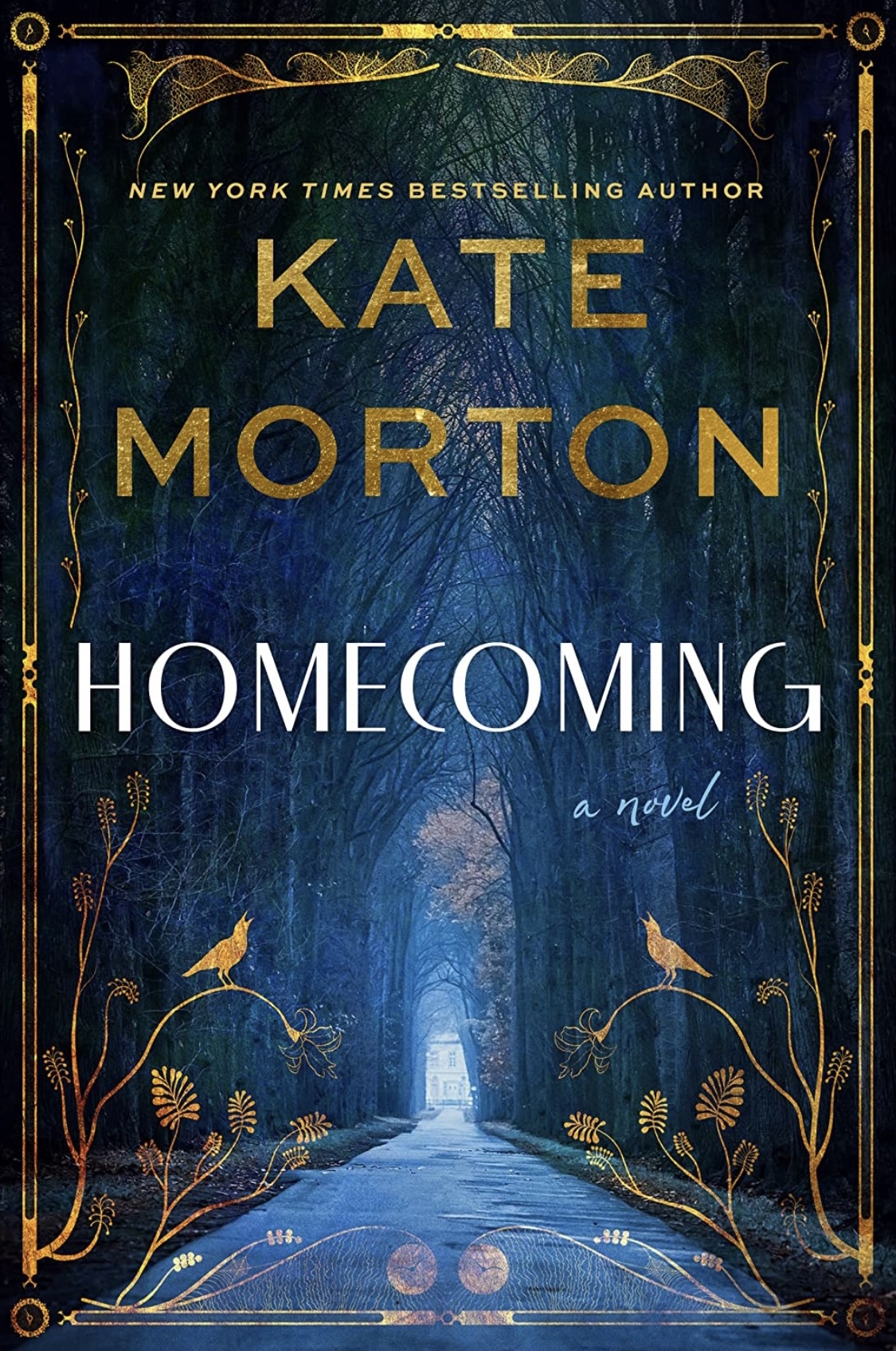
Review 2201: Homecoming

To a certain extent, you know what you’re getting with a Kate Morton novel—a split time-frame story with family secrets revealed. The storytelling is always very well done, and more often than not, the story is engrossing. Homecoming is no different.

On Christmas Eve, 1959, Percy Summers is riding past Halcyon, the estate in the Adelaide Hills recently purchased by Thomas Turner, when he trespasses to water his horse in the river. By the river, he finds Isabel Turner and her children apparently asleep near the remains of a picnic. Only they’re not asleep. In his shock, Percy fails to notice a basket hanging from a tree—where Isabel put her baby. Later, everyone realizes the baby is missing.

In 2018 London, Jess is summoned home to Sydney because her grandmother, Nora Turner-Bridges, is seriously ill, having fallen while trying to go up to her attic. Jess, a currently unemployed journalist, has not been home in 20 years, but it was her grandmother who raised her.

Nora has told Jess stories about her brother Thomas, but it is not until she begins looking through Nora’s things for a letter Nora’s caregiver said upset her that she learns Thomas had a house in the Adelaide Hills where his family was killed when he was abroad. Jess can’t believe Nora never told her about this. In fact, she finds a book about the crime in Nora’s bedroom.

While Jess investigates the old crime, we learn about it from flashes back and from the book she found, which is contained in its entirety. For me, this was an unfortunate choice that made the slow unwrapping of the plot more artificial, particularly because it is far too short to really be a book. However, I got used to it.

There were several big mysteries wrapped within this crime, but the two big ones are, what happened to the baby? and did Isabel poison her family? I was fairly sure I knew the answers to both early on, but I didn’t guess the details or complications. In all, I felt that this novel, while not my absolute favorite of Morton’s books, was right up there.

Related Posts

The Forgotten Garden

The Secret Keeper

The Lake House

Review 2094: The Book of Cold Cases

I had to read The Book of Cold Cases as soon as I received it, because there’s no one better than Simone St. James when it comes to a combination of mystery and the supernatural. It did not disappoint.

Twenty years ago, nine-year-old Shea got into a serial killer’s car. She survived, but the experience left her with several phobias and a great deal of fear. It also left her with a fascination for true crime, which she feeds by keeping a true-crime blog called The Book of Cold Cases.

At work one morning, She recognizes Beth Greer, a wealthy woman who was tried but not convicted of the murders of two men in 1973. Most people in their small Oregon town think she’s the first woman serial killer. She has never agreed to an interview, but after she catches Shea following her, she agrees to one.

Shea meets her in Greer’s parents’ home, an ugly mansion above the town with the ocean a sheer drop beneath a small lawn. Oddly, it is still decorated as her parents left it. Before the murders, her father was found dead in the kitchen, having been shot in the face by an apparent burglar. The manner of death was the same as that of two men shot several years later with the same caliber bullet, which was some of the evidence used against Beth.

Beth begins to tell Shea part of what she knows about the case, and Shea decides that although she doesn’t think Beth murdered the men, she knows more than she is telling. Then during a break, a weird thing happens. Shea goes to the kitchen and bathroom. First, all the taps turn back on after she turns them off, then all the kitchen cupboard doors open when she has her back turned to them.

When Shea tells Michael, her private investigator, what happened, he thinks Beth could have rigged up some kind of mechanism. But Shea isn’t so sure. Then when she is playing back her recording of the interview, she hears in the background the faint voice of a woman repeating, “I’m still here.” After she’s heard the voice, her phone dies and the recording disappears.

As Shea investigates the case, the novel moves back in time to events of 1973 and further back to Beth’s childhood to show what happened.

This is a great combination—mystery, thriller, and ghost story. St. James has always been good at what she does, but this book and her last were excellent.

Related Posts

The Sun Down Motel

The Broken Girls

Lost Among the Living

Review 1746: The Hand That First Held Mine

Best of Ten!

It’s the mid-1950’s, and Lexie Sinclair has already made arrangements to leave her family home in Devon when she meets Innes Kent. He is a stylish magazine editor whose car has broken down on their road. When she tells him she is coming to London, he asks her to look him up. Instead, he looks her up.

Lexie takes up an exciting life as part of the Soho art scene. She and Innes are the loves of each other’s lives even though he is married. His wife has, however, taught her daughter Margo to hate Lexie even though she and Innes have been split up for years.

In present-day London, Elina and Ted have just had a baby. The birth was difficult, and Elina is having a hard time coping with the pressures of motherhood. At the same time, Ted, whose memory is notoriously poor, has begun having flashes of memory that do not correspond to what he understands of his life. Slowly, these two stories connect.

Maggie O’Farrell is always wonderful, I find, but this novel had me sobbing. It is beautiful and tragic as it explores the themes of motherhood and family secrets.

The Vanishing Act of Esme Lennox

After You’d Gone

Instructions for a Heat Wave

Review 1376: A Harp in Lowndes Square

In a lonely attic, a neglected child sits and makes clothing for her doll out of old clothes. Everyone is out, surely, but she hears voices on the stairs. These voices belong to her two children, twenty years in the future.

Those children are twins, Vere and James, who have been taught by their mother that all time is simultaneous. The two do indeed experience flashes of visions and sounds from other times, events that occurred in the room years before.

Vere and James’s happy growing up, along with their sister, Lalage, is interrupted by the death of their father. The family is left in financial difficulties and must move from their suburban home to a small house in London. This brings their mother, Anne, back into the orbit of her own mother, the formidable Lady Vallant.

It is clear that, when she returns from visits to her mother, Anne appears to be more worn than usual. Anne’s children know that the two don’t get along and suspect that Lady Vallant harasses Anne. However, a chance remark reveals to them an aunt they didn’t know existed, Myra, who died when she was young.

Vere and James receive impressions of serious events that are not talked about. They begin trying to find out the secrets in their family’s past.

This novel is a ghost story but not in the sense of one meant to scare. It reflects Ferguson’s interest in houses and her sense that actions taken in a room stay in that room’s atmosphere. This idea also occupied A Footman for a Peacock, which I found considerably less likely than this novel, which is set during World War I.

I like a ghost story, but this novel has more going on than that. It’s a story of how family events can affect the lives of others who weren’t even alive when they happened. It’s a good character study of Vere, who cares deeply about a few people but is meticulous and reticent in nature. It is also about a chaste love affair with an older man—and his wife. I didn’t really understand the charms of that relationship, but I very much enjoyed this novel.

Related Posts

A Footman for the Peacock

Alas, Poor Lady

The Priory

Review 1346: After You’d Gone

Cover for After You'd GoneAlice Raike takes an unplanned trip from London to North Berwick to see her family. After she arrives, she sees something horrible that makes her return immediately to London. Later that evening, her mind in an uproar, she steps off a curb into oncoming traffic and ends up in the hospital in a coma.

In vignettes shifting in time and point of view, After You’d Gone tells the story of Alice’s life and of her family’s secrets. This novel is powerful, and it had me in tears by the end. O’Farrell slowly peels off layer after layer to reveal the truths of Alice’s life.

I don’t know what else I can say about this novel except I loved it.

Related Posts

Autumn

The Rehearsal

Atonement

Day 879: A Spool of Blue Thread

Cover for A Spool of Blue ThreadBest Book of the Week!
I haven’t read much Anne Tyler lately, but having just finished A Spool of Blue Thread, I think I should read more. This is one of those novels that seems to have more layers, the more you think about it.

Red and Abby Whitshank live in a lovely house in a Baltimore suburb that Red’s father Junior built for a client years ago. The house was Junior’s pride and joy, and he was constantly adding to it and refining it. Red, also a builder, has kept it in tip-tip condition. But now Red and Abby are in their 70’s. Red has recently had a heart attack, and the family gathers to decide what to do after Abby begins having gaps in her memory.

The family can sometimes be contentious, and their most troublesome member is Denny. Abby has always had a habit of inviting in strays, what her family calls her “orphans,” in an attempt to re-create the welcoming atmosphere in the house when she visited as a girl. The children have always resented these extra presences. But when Denny was four, Abby took this habit to extremes by insisting on taking in the orphaned son of one of Red’s workmen, a two-year-old boy named Stem. Denny is clearly jealous of Stem, and so is moody and unpredictable. He travels around from job to job and doesn’t tell the family about his life. He is undependable, leaving at the drop of a hat, and then can’t understand why no one asks for his help.

By the time Denny arrives, expecting to move in to help Red and Abby, Stem and his family have already rented out their house and moved in. Although there is some comic tension about who is helping whom, the family is all together again with the girls visiting frequently, and they enjoy telling their family stories.

After a tragic event, the novel moves back in time to the day when young Abby fell in love with Red. This has always been one of Abby’s favorite stories, but now we see a different side to it and to her.

Then the novel moves back farther in time to examine the relationship of Junior and his wife Linnie. At first, we’re shocked by some of its revelations, but we learn that human relationships are deep and complex.

This is a lovely novel about family stories and secrets, about how different people’s realities differ, about love and forgiveness.

Related Posts

We Are All Completely Beside Ourselves

Family Furnishings

We Are Not Ourselves


Day 852: The Lake House

Cover for The Lake HouseThe Lake House is another of Kate Morton’s enthralling novels about family secrets. It is set in two time periods, 1933 and 2003.

In 1933 Cornwall, Alice Edevane is 16. She loves her life in the woods and gardens of the family estate, Loeanneth, and she spends her time writing stories of romance and mystery. She reads her stories to Ben Munro, an itinerant gardener whom she loves. Her newest one is about a kidnapping, set in her own home.

In 2003, Sadie Sparrow is a police officer on an enforced holiday. She got over-involved in a case, in her partner’s opinion, and went to the media when she thought it was mishandled. Her partner is trying to keep her name out of the subsequent investigation, but he wants her on vacation for a month.

Sadie chooses to visit her grandfather Bertie in Cornwall, where he recently moved after her grandmother’s death. In traipsing around the woods with the dogs, she comes upon the abandoned house at Loeanneth. When she tries to find out about the house, she learns that it was deserted after the disappearance of a little boy, Theo Edevane, who was never found.

Sadie decides she would like to look into the cold case with the help of retired officer Clive Robinson. She tracks down Alice Edevane, now a famous novelist, and writes asking for permission to enter the house. But she hears nothing back.

Alice has always believed she knew what happened to Theo and thinks it is her fault. She has no desire to reopen the investigation, however unofficial. But a frank conversation with her sister Deborah reveals something she didn’t know, which leads her to re-evaluate her belief in what happened long ago. When the persistent Sadie writes again, she agrees to see her.

The story alternates between the investigation in the present and the events leading up to Theo’s disappearance. We see the past events from the points of view of several different characters but mostly from that of Eleanor, Alice’s mother.

I absolutely loved this novel, with one caveat. It is intricately plotted and beautifully written, as are Morton’s other novels. I also found it completely absorbing.

However, the coincidence of what happened to Theo I found a bit much. I can’t explain more, but read it yourself and tell me what you think.

Related Posts

The Distant Hours

The Forgotten Garden

The Secret Keeper

Day 710: The Kept

Cover for The KeptBest Book of the Week!
The Kept is a mysterious and darkly moody novel that I found compelling from the first sentences. Elspeth Howell arrives home on a snowy winter day in upstate New York near the turn of the 19th century. She has been away for months working as a midwife. But when she reaches home, she finds that her husband and all of her children that live in the house have been murdered. Only her 12-year-old son Caleb, who has taken to living in the barn, is alive, but he has been hiding in the pantry for days, and when she opens the pantry door, he shoots her in terror.

Caleb spends the next few days alternately trying to take care of his mother and dispose of the bodies of the rest of his family. He cannot bury them in the frozen earth, but in his attempt to burn them, he accidentally burns down the house. He ends up caring for his mother in the barn.

The Howell’s home is isolated and difficult to find. As a young girl, Espeth was driven from her home for having spoken to Jorah, the man she later married, because he was Native American. But there are other reasons for the family’s isolation. In any case, Elspeth thinks the murderers must have sought for their house.

When Elspeth is barely healed, she and Caleb set forth to find the three men who murdered their family, men whom Caleb watched from the barn. They stay briefly with an old couple who have been terrorized by the same three men and who point them in the direction of a town on Lake Erie with a terrible reputation. There, with Elspeth disguised as a man, they go to search for the men.

Beginning as a straightforward revenge novel, the book goes on to explore deeper themes. One of them is that of unintended consequences, as Caleb finds that their troubles result from Elspeth’s own actions years before.

This novel is well written and packed with atmosphere. It is vivid and brutal and beautiful.

Related Topics

Seven Locks

True Grit

Neverhome