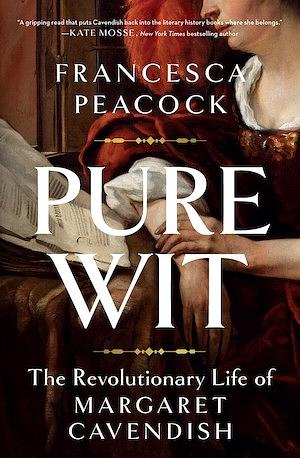
Review 2741: Pure Wit: The Revolutionary Life of Margaret Cavendish

I’m not sure what possessed me to read two biographies about Margaret Cavendish so close together. I think I moved Pure Wit up in the pile without really looking to see what it was about, just remembering I had wanted to read it.

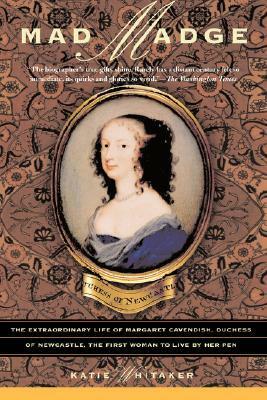
While Katie Whitaker’s Mad Madge is more of a biography for the general public, Peacock’s biography is the more scholarly and more concerned with Cavendish’s ideas and legacy.

Certainly, it traces Cavendish’s own concern with her legacy and her difficulties in being taken seriously in her own time. Although Cavendish was not the first woman writer to publish her work, she was pretty much the first to publish not only poetry and plays but her ideas on science and philosophy. Of her earlier work, some claimed that her husband, William, had written it, but by the last decade of her life, she had been invited to attend the Royal Society to see their experiments despite a reputation for eccentricity.

Peacock explores how Cavendish’s work, which made her famous during her lifetime, after her death quickly began to be denigrated and made hard to find so that scholars couldn’t make up their own minds about it. Biographers and critics began to fasten on a few contemporary remarks to claim she was unstable and to discuss only her poems about fairies and her biography of her husband, whereas she wrote widely on a multitude of subjects. For a while, she was depicted as a dutiful wife—which she probably wasn’t—and then the Mad Madge badge was pinned on her. Even Virginia Woolf made her the butt of jokes instead of trying to understand what she had done.

But actually, Cavendish was very much an early feminist and a ground-breaking writer. She was self-contradictory, but Peacock points out that other philosophers and poets of her time with the same faults—if it is a fault to change your mind about your ideas as you reconsider them—were not being criticized for them.

It’s pretty clear that the reputation Cavendish accumulated over time is a matter of misogyny.

If you want an easier-to-read biography, I’d recommend Whitaker’s, but if you are interested also in an in-depth analysis of Cavendish’s works and legacy, this is the book for you.
Related Posts

Mad Madge: The Extraordinary Life of Margaret Cavendish

Margaret the First

Georgiana, Duchess of Devonshire

Review 2567: Mad Madge: The Extraordinary Life of Margaret Cavendish, Duchess of Newcastle

Before reading Margaret the First for Novellas in November, I had never heard of Margaret Cavendish, which is interesting because I have a master’s degree in English Literature. But that all falls into place once you read Whitaker’s epilogue to this biography.

In fact, Margaret was the first woman to publish prolifically and publicly, as opposed to having writings privately printed and distributed or, more likely at the time, including a poem or two in her husband’s writings.

Margaret Lucas, according to her own writings, was determined to be famous. Unfortunately, she was very shy. She wrote even from a girl, what she called her fancies, and commented that her mind was full of ideas.

The Lucases were a prominent Royalist family. Margaret was still fairly young when she left home to be a lady in waiting for Queen Henrietta Maria at the court of Charles I. Margaret wasn’t very good at this job, because her shyness made her seem standoffish.

The English Civil War broke out, and first the court moved to Oxford, but eventually it had to move overseas. There, Margaret met William Cavendish, fully 30 years her senior, who had valiantly fought on the Royalist side but eventually left when things seemed hopeless. At the time, he was the Marquis of Newcastle. The couple married, despite having little income, William’s estates having been taken by Parliament, and most of his money gone to the Royalist cause. However, it was in William’s house that Margaret got what she had long sought, the opportunity to meet and discuss issues with men of note and with philosophers and scientists.

Margaret began writing prolifically—plays, poems, essays on philosophy and science. Once she published, many people supposed that her works were actually written by her husband.

Eventually, she became one of the first female literary celebrities, and her name was known throughout Europe. In the epilogue, though, we learn that not too long after her death, critics began to disparage her work, and she was almost lost to history. We learn that the nickname of “Mad Madge” was bestowed on her centuries after her death (and repeated by Virginia Woolf). I looked at my own 1985 Norton Anthology of Literature by Women, and despite her prolixity, they only included one page by her and perpetuated the story of her strangeness, which apparently was based only on her original clothing, designed by herself, and her odd social behavior (not speaking much).

Although this material is undoubtedly interesting, I think that Whitaker falls over the too much/not enough detail line that I find plagues a lot of biographical writing. Whitaker falls over on the “too much” side, synopsizing every section of every work Margaret wrote, quoting every person of note who respected Margaret’s work, describing details of every house she lived in, and so on. This got a little tedious when it continued for pages, although now, having read the epilogue, I see why Whitaker felt that she needed to prove that in her lifetime, Margaret was a famous and respected figure with very early feminist leanings.

Related Posts

Margaret the First

Georgiana, Duchess of Devonshire

Queen Anne: The Politics of Passion

Review 2504: Novellas in November! Margaret the First

Margaret the First is another of the short books listed on the Literary Hub’s 50 Best Contemporary Novels under 200 Pages post. I read it for Novellas in November.

This biographical novel is about Margaret Cavendish, Duchess of Newcastle, called Mad Madge in her time. She was the first woman to write for publication. And write she did—philosophy, poetry, plays, and even utopian speculative fiction. She was also very shy, tended toward agoraphobia, and wore extravagantly creative clothing.

Although some of the book is about her childhood, most of it concerns her life during her marriage. Her husband, William Cavendish, was about 30 years older than she, was a Marquess when they married, and was fighting on the King’s side of the English Civil Wars. The court was banished to France, where she had been a waiting lady to the English queen. Although she returned to England to try to reclaim some of her husband’s possessions, he was considered too big a traitor to the Parliamentary side to come back himself. It wasn’t until the Restoration that the couple was able to return and reclaim some of his fortune.

The novel is written in a telegraphic style that doesn’t seem telegraphic. That is, Dutton manages to convey a great deal of substance in a very short work (160 pages) through clever word choice and phrasing. The first half of the novel is in first person but it switches to third person, while still remaining from Margaret’s point of view.

I enjoyed this novel a lot. It is a feminist work written in a sharp, modern style, and it has inspired me to look for more to read about Cavendish. It ends with some recommendations for further reading and a few pages of bibliography.

I should note that the title of one of my favorite books, The Blazing World by Siri Hustvedt, came from the title of a utopian novel by Cavendish. I didn’t know that.

Related Posts

The Blazing World

Lark

Samuel Pepys: The Unequalled Self