Day 950: Arrowood

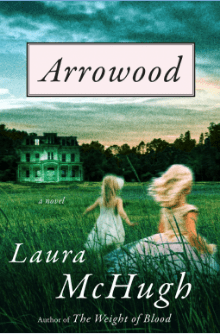
Cover for ArrowoodArden Arrowood has returned after many years to her dying home town of Keokuk, Iowa. She has inherited her grandparents’ house, a stately old home on the banks of the Mississippi. Although she has yearned for home, it is the place of her family’s greatest tragedy, the disappearance of her baby twin sisters when she was eight years old.

Arden has been a troubled young woman, and she is hoping to make a fresh start in her home town. But incidents keep pointing her back to the tragedy. She has been contacted by the site owner of Midwest Mysteries, for example, who thinks the man believed to have kidnapped the girls is innocent.

link to NetgalleyArden has also been hoping to reunite with Ben Ferris, her best friend as a child and her first boyfriend. She is surprised to find he has joined his father’s dentistry practice. But then again, she herself has failed to complete her graduate degree in history and has a secret reason for having quit school.

This novel is atmospheric and gripping. Although it is not difficult to figure out that one character is a bad guy, the solution to the mystery has a couple of twists. I was reminded when reading this book of Gillian Flynn’s Sharp Objects. Although I think Sharp Objects is the better novel, I enjoyed reading this one.

Related Posts

Sharp Objects

Dark Places

Echoes from the Dead

Day 949: Traitor’s Purse

Cover for Traitor's PurseA man awakens in a hospital to realize that he remembers nothing about who he is or what has happened to him. Then he overhears a nurse and policeman talking. Someone has killed a policeman. Thinking they are talking about him, he escapes in the outfit of a fireman.

We soon learn that the escaping man is Albert Campion. Although he is picked up outside the hospital by his fiancée Amanda, he soon realizes that something important is happening and everyone is looking to him for instruction. He must stop something from happening, but he doesn’t know what.

This mystery, which is set during World War II, has to do with a plot to destroy the foundations of the country. All Campion knows is that it involves the mysterious Institute of Bridge, an organization called the Masters, and the number 15.

In this novel, we understand a little more about Campion’s thinking, precisely because he’s not behaving in character. I believe he is normally supposed to be somewhat inscrutable, because he’s frequently described as “wooden-faced.” Because of the unique situation of the novel, it is truly suspenseful.

Related Posts

The Tiger in the Smoke

The Singing Sands

At Bertram’s Hotel

Day 945: Literary Wives! How to Be a Good Wife

Cover for How to Be a Good WifeToday is another review for the Literary Wives blogging club, in which we discuss the depiction of wives in modern fiction. If you have read the book, please participate by leaving comments on any of our blogs. Be sure to read the reviews and comments of the other wives!

Ariel of One Little Library
Emily of The Bookshelf of Emily J.
Kate of Kate Rae Davis
Lynn of Smoke and Mirrors
Naomi of Consumed By Ink

My Review

Marta has stopped taking her medication. She has been on it for years, and the only other time she stopped, she suffered symptoms of severe depression. This time she keeps glimpsing a young blond girl. Although the girl doesn’t speak to her, she seems to be trying to tell her something.

Marta has been married to Hector for many years, and they have a grown son. Marta seems inordinately upset because their son has left home to go to college. Her marriage to Hector seems almost cartoonishly old-fashioned. Her mother-in-law gave her a book about being a good wife when she married Hector, a book that was out of date when she got it. But she has tried to follow it. Aside from behaving like a 50’s housewife, she has been set limits by Hector beyond which she is not allowed to drive. It is not safe, he claims.

The more we learn about Marta’s life, the more disturbing this novel seems. Are we to believe that Marta is descending into madness, or does it seem as if her memories of her past life are oddly murky and she’s finally remembering?

I’m not sure if we’re to believe that Marta is an unreliable narrator or not. Certainly, no one in the novel ultimately believes her, but I do. I found this novel chilling and completely compelling.

What does the book say about wives or the experience of being a wife?

Caution: My answer to this question involves spoilers, so if you don’t want to know, stop reading now.

I don’t believe we can generalize at all from this novel, because Marta’s is a peculiar circumstance. If we believe her, then she was captured as a young girl and held captive by Hector for two years under the house. She eventually escaped, but he recaptured her, kept her drugged, and created false memories for her to convince her she was a different person. She has lived as a drugged captive, trying to please her husband and feeling love only for her son.

Again, this is a novel about power, and Hector holds all the power in this relationship. The only power Marta has is in subversive minor disobedience, like smoking and pretending to take her pills. Although Marta finally escapes, it is at a terrible cost, since no one believes her. Are we to believe there is really no record of her kidnapping or that they either didn’t look hard enough or she is delusional? I know what I believe, but you may not agree.

Related Posts

Before I Go to Sleep

The Happy Marriage

Finders Keepers

Day 938: What Alice Forgot

Cover for What Alice ForgotAlice Love wakes up from an accident thinking she is 29, pregnant with her first child, and madly in love with her husband Nick. But she is actually 39, the mother of three children, and separated from Nick. It takes her a while to understand she is ten years older, much thinner, and quite a bit harder and more driven than she remembers.

Alice escapes from the hospital by simply lying to the doctors. But somehow, she must piece together her life from the allusions of other people and her own feelings of occasional discomfort. How can she get along with her three unknown children? What happened between her and Nick? Why are she and her sister Elizabeth on the outs? And who the heck is Gina?

I thoroughly enjoyed this novel, mostly because of its characterizations. Alice in her 29-year-old reincarnation is guileless and likable, and Nick in her memories is also endearing. Alice’s children seem like real kids, adorable one minute and infuriating the next.

I didn’t like as much the sections written by Elizabeth to her therapist or by Frannie to her long-dead fiancé, but their stories add more depth to the novel. Since the focus was so much on Alice, there probably wasn’t another way to fit that information in.

All in all, this is another highly enjoyable novel from Moriarty. Toward the end, I was afraid she was going to take an easy path, but she did not.

Related Posts

Big Little Lies

The Lace Reader

Before I Go to Sleep

Day 927: The Casebook of Carnaki the Ghost Finder

Cover for the Casebook of CarnakiW. H. Hodgson’s sleuth Carnaki is in answer to the fad for detective stories that came about after the success of the Sherlock Holmes stories. But Carnaki is not a regular detective. He is a psychic detective who investigates hauntings. The Casebook of Carnaki the Ghost Finder is a collection of nine Carnaki stories.

These stories all follow the same format. Carnaki summons a group of friends to his house for dinner. He speaks very little before and during dinner and will not talk about what he’s been doing. After dinner, he relaxes into his favorite chair and relates his latest case. This format is very common in earlier genre mysteries. Unfortunately, it removes some of the immediacy of the story.

These stories are straight wonder tales. There is no attempt made at characterization, of Carnaki or anyone else. The stories are simply meant to amaze and puzzle and so have more in common with earlier gothic stories than with Sherlock Holmes. The puzzle of whether the mystery will be of human or occult causes is probably the most interesting part of the stories.

I actually found one of these stories to be quite chilling. That was “The Gateway of the Monster.” In that story, Carnaki is called to investigate the Grey Room in a very old house. Although the door of the room is locked every night, it is slammed continually all night long. Each morning, the bedclothes are found jerked off the bed. Since three people were killed there years before, no one has slept in the room.

Unfortunately, Hodgson cheats by waiting until the end to tell us a key piece of the story. Also, this haunting, along with some of the others, runs more along the lines of something like The Castle of Otranto than a more modern ghost story, and I find things scarier that are more feasible.

In “The Thing Invisible,” Carnaki is summoned to figure out how the butler could have been struck with an ancient dagger when there was no one around him and he was in full view of everyone. This story is marred, too, because one person there understood what had happened and would never have summoned Carnaki.

Still, this book is full of haunted castles, spectral horses and pigs, a ship pursued by strange weather, and other wonders. It can be quickly read and should offer most folks some pleasure on a rainy afternoon (or a dark and stormy night).

Related Posts

This House Is Haunted

The Necromancer

The Castle of Wolfenbach

Day 915: Come to Harm

Cover for Come to HarmKeiko is a Japanese exchange student working on her doctorate who has accepted a grant from an association in Painchton, Scotland, near Edinburgh University. Her grant comes with a free flat that has even been stocked with food. Keiko is overwhelmed by everyone’s hospitality, particularly with their propensity for stuffing her with food, much of which she finds unappetizing.

Not everyone is welcoming, though. Her landlady Mrs. Poole is the proprietor of the butcher shop below Keiko’s flat. She is a recent widow, but her unfriendly behavior seems to indicate more than grief. She has two sons, Malcolm and Murray, and she certainly isn’t encouraging them to befriend Keiko. She also spends every morning cleaning the seldom-used slaughterhouse in the yard.

Early on, Keiko finds a note behind the radiator in her flat. It is clearly from a blackmailer, perhaps to the previous occupant of the flat. She also notices that several women have vanished from town. As Keiko tries to figure out what is going on in town, she also has quite a few misunderstandings with people through not understanding exactly what they’ve said.

I had a few problems with this novel that I haven’t had with other McPherson thrillers. For one thing, the reasoning behind the Painchton Trading Association’s grant to Keiko seems so flimsy that I had a hard time imagining even a child would believe it, let alone the entire town. The town committee seems to be up to something illegal, which lends to the atmosphere of the novel.

And then there is the resolution of the plot. First, Keiko’s suppositions run so berserk that I started to think the novel was an elaborate joke and that maybe I was reading an updated version of Northanger Abbey. But I won’t say whether I was right or not.

So, I wasn’t as happy with this novel as with others by McPherson, particularly as compared to the wonderful Quiet Neighbors. I thought it was obvious fairly early on that one character was dangerous, but Keiko doesn’t realize this until very late in the novel. Still, the novel is atmospheric and the ending is suspenseful, and parts of it are funny, so all that will probably keep most readers happy.

Related Posts

Quiet Neighbors

The Child Garden

The Day She Died

Day 913: The Unforgotten

Cover for The UnforgottenA novel set in two time periods, The Unforgotten is a thriller and a mystery. But it is more than that—a story with deep-running themes offering its characters difficult choices.

In 1956 Cornwall, Betty Broadbent is an innocent, naive 15-year-old. She helps her unstable mother run a hotel and sometimes has to run it herself when her mother is in the throes of depression or alcoholism. The small fishing village has been invaded by reporters after the murders of several young women.

In 2006, Mary reads that the man who served time for the murders back in 1956 still insists he is innocent. Mary remembers him as the man her mother used to date and believes he is innocent. She thinks she knows who the actual killer is and is torn between telling what she knows and keeping a long-held secret. Although we don’t know why she is living under another name, we are soon sure that Mary is Betty.

This novel is about the painful choices two people must make under difficult circumstances. It is also about a sad and doomed love affair.

At first I thought that some of the dialogue and situations were unlikely, but I soon forgot those thoughts, driven forward by the sheer power of the story. It is one that has many more levels than first expected. This is a great first novel by Powell.

Full disclosure: I received a copy of this novel from the publisher in exchange for an honest review.

Related Posts

The Lace Reader

Sharp Objects

The Last Summer of the Camperdowns

Day 904: Some Must Watch

Cover for Some Must WatchSome Must Watch is the novel that inspired the thrilling old movie The Spiral Staircase. Ethel Lina White, the author, was one of the early women mystery writers, another novel of hers being the basis of the movie The Lady Vanishes.

This novel centers around an isolated country house, the home of Professor Sebastian Warren, his mother, sister, son, and daughter-in-law. The main character is Helen Capel, a servant in the household.

At the beginning of the novel, Helen is coming back to the house at dusk. She is worried because she must pass through a desolate landscape and young women have been murdered in the district. Her way takes her through a plantation, but she changes direction because she thinks she sees a man lurking among the trees.

The novel takes place in the space of one night during a violent storm. At the beginning of the evening, everyone becomes alarmed because another dead woman is found dead near the local pub and Dr. Parry thinks she was killed in the same plantation where Helen saw someone. The house is full of people, so the Professor decides that they should all stay inside during the storm and not admit anyone, and they will be safe.

However, as the evening continues, one incident after another occurs that causes the people to leave the house. After a while, it seems to Helen as if some intelligence is working so that she will be alone to face the killer.

In some ways, this novel seemed rather crude, especially in the interactions between characters and the dialogue. I have run into this before with novels of a certain vintage and am not sure if it reflects people’s actual behavior and way of speaking at the time, the expectations of the genre, or simply the ability of the writer. Not very much attention is given to character development either. The focus is squarely on the plot. Still, I think the novel is interesting as representative of an early thriller.

Occasionally I comment on the publication quality of a book. I believe that my copy is an on demand publication by Between Things (not the one pictured above). Its biggest eccentricities are the starting of chapters on the left page and a typographic oddity of placing an underscore before and after phrases that I assumed were in italics in the original. There were a few other careless errors but not as many as I have noticed lately in some other regular press runs. Still, I am beginning to avoid on demand printing, if I recognize it ahead of time.

Related Posts

Murder at the Manor

The Z Murders

The Tiger in the Smoke

Day 900: The Monogram Murders

Cover for The Monogram MurdersThe Monogram Murders is the first Hercule Poirot mystery written since Agatha Christie’s death that was approved by her estate. It is written by the British thriller writer Sophie Hannah, whose books I have enjoyed. I was curious to see how authentic the novel seemed as a Christie mystery.

Hercule Poirot visits Pleasant’s Coffee House every Thursday night because he finds that its delicious coffee activates the little grey cells and he likes the astute observations of a waitress named Fee. One evening a regular patron comes in disturbed, behaving as if she fears for her life. When Poirot tries to convince her to confide in him or go to the police, she runs away. All Poirot can find out about her is that she works in some large house across town and her name is Jennie.

Hercule returns to his rooming house to confide in his fellow lodger, Mr. Catchpole, who works for Scotland Yard, but Catchpole is disturbed by having just attended the scene of a murder. Three people have been found dead at the exclusive Bloxham Hotel, and each had a monogrammed cufflink in his or her mouth.

Investigation soon finds that the two women victims, Harriet Sippel and Ida Gransbury, both lived in the small town of Great Holling. They traveled up separately to London and had rooms on different floors, but they both had tea with the third victim, Richard Negus, at 7:15 PM. They were all found dead in their rooms after 8 PM.

It soon becomes clear that the deaths have something to do with a tragedy years before in Great Holling, when lying rumors about the town’s vicar resulted in the loss of his reputation and the subsequent suicides of his wife and himself. The three dead were the couple’s biggest traducers, and a servant named Jennie Hobbs told the original lie. But who is the murderer? Some pieces don’t fit.

So, how does The Monogram Murders stack up against other Christie mysteries? It is certainly as complex as any other Poirot mystery and as difficult a puzzle. Hercule Poirot is very much himself. Catchpole is a suitably dense sidekick, a bit reminiscent of Mr. Watson in another series. The novel is engaging and interesting. The one distinctive characteristic of Christie’s novels that it lacks are her deft characterizations, her way of making readers be able to visualize them with just a few sentences. Still, this novel makes a fairly worthy entry into the series.

Related Posts

At Bertram’s Hotel

Death on the Nile

The Truth-Teller’s Lie

Day 889: An Inquiry into Love and Death

Cover for An Inquiry into Love and DeathFor light reading with a supernatural twist, I’m developing an affection for the novels of Simone St. James. Her romantic suspense novels are set in post-World War I England and feature spunky heroines who get embroiled in mystery, always with a supernatural element.

Jillian Leigh is an Oxford student in one of the few colleges for women. She is summoned away from her studies with news that her Uncle Toby has died. Her parents expect her to take care of his affairs, saying that her father is unable to leave his work in Paris.

Jillian hasn’t actually seen her uncle since her parents broke with him when she was 14, for reasons she does not know. The one thing she knows about him is embarrassing, that he worked as a ghost hunter. Other than that, she remembers him as a shy, quiet person who was kind to her.

She is appalled, however, to find she is expected to identify his body. He was staying in the seaside village of Rothewell, thought to be haunted by the ghost of a smuggler, when early one morning he fell off a cliff.

Jillian stays in the house where Toby lived, an isolated cottage nearest the activities of the purported ghost. Almost immediately, odd things begin happening. She finds things in odd places, a book in  the stove, for example. At night she hears what she thinks is a tree scratching her window, but in the daytime she sees there is no tree anywhere near it. Then Scotland Yard Inspector Drew Merriken arrives and tells her that Toby may have been murdered.

After reading a few of St. James’s novels, I have no doubt there will be a romance with the inspector, but her combination of ghost story and mystery is truly suspenseful. I found this to be another enjoyable romantic suspense novel.

Related Posts

The Haunting of Maddy Clare

The Other Side of Midnight

The Winter People