Day 887: Fair Helen

Cover for Fair HelenBest Book of the Week!
I was completely entranced by Fair Helen from the first moments of reading it. It’s based on a 16th century ballad, “Fair Helen of Kirkconnel Lea.” Since one of my interests (although sadly not pursued for years) is early ballads of Great Britain, Ireland, and Appalachia, this is a good fit for me.

Harry Langdon is a city man, a scrivener from Edinburgh, the son of a craftsman, so the Borderlands seem wild to him when he answers the summons of his good friend Adam Fleming. Adam feels he needs his friend’s support. He fears his stepfather, his father’s brother, might be trying to kill him. And Harry is surprised to find Adam’s stepfather in the role of Heidsman instead of Adam after the recent death of Adam’s father. (If this sounds familiar, it’s supposed to.)

But Adam is more concerned about the disposition of his love affair. He has fallen madly in love with Helen Irvine, a beautiful and vivacious girl. But the Irvines and the Flemings have been feuding for years. (If this sounds familiar in a different way, it’s supposed to.) Helen’s parents want her to marry Robert Bell, a man with more prospects than a member of an unmade family.

We know from the beginning of the novel that none of this will end well, for we have the text of the ballad before us. And Harry in his old age is telling this story of the most important event in his life and the two people he loved most. For Helen is his cousin, and the two of them were very close as children.

The situation is complicated by the politics of the Borderlands. Harry finds himself summoned by Walter Scott of Buccleuch, a lord who frankly terrifies him (a very different Wat Scott of Buccleuch than the one depicted by Dorothy Dunnet), and is forced to spy on his friends. It becomes clear to him that there have been attempts at murder, if not of Adam, but who is behind them and why?

The novel is written in a mix of Scots and English, with a glossary provided. It is a strong style that goes well with its subject matter. At first, I was thrown off by the footnotes, which are all in the wrong places. I didn’t realize what was going on and thought they were simply non sequiturs. When I figured it out, I spent a lot of time flipping pages, trying to match them up. I honestly wasn’t sure if it was a printing error until I ran across the following passage:

I had aimed to set down plainly only what I witnessed concerning the events at Kirkconnel, to correct the folk haivers and bring some understanding. Yet already I find footnotes, asides and addenda have begun to run wild down the margins and among the lines. I like to think of them as bright wildflowers that border and run through the acres of turnip and kale by which we feed ourselves.

So, Greig is having some fun with us and in more ways than one, although this is in general not a light-hearted novel. It is lovely, though, full of yearning and regret, with a backbone of history for those who are interested.

In my recurring theme of quality printing, I have to say that this is the first modern book with properly bound signatures that I’ve seen in a long while, as opposed to the signatures being hacked off and glued. That’s great, and it means my book will stay together longer. However, the end papers were pasted down carelessly. They have creases, and some of the pages of the book stick out beyond the cover. So, Quercus Books, one big step forward and a few small ones back.

Related Posts

The Candlemass Road

The Disorderly Knights

Turn of the Tide

Day 872: Elizabeth Is Missing

Cover for Elizabeth Is MIssingBefore I begin my review, here is a little bit of news about the Walter Scott Prize for Historical Fiction. Some of you may know that, along with Helen of She Reads Novels, I am attempting to read all the short-listed novels. Today the short list for 2016 was released. To see the list, check out my Walter Scott project page. I have only read one of the novels, but was disappointed, along with other readers, to see that A God in Ruins, which was on the long list, didn’t make the short list.

* * *

Elizabeth Is Missing is—I won’t disguise it—the third book about Alzheimers I’ve read in the last six months. When the book blurb says Maud is forgetful, that’s putting it mildly. After only a few pages of this novel, I wondered why Maud was living alone.

Maud is an old lady who is having trouble keeping track of just about everything. She writes herself reminder notes but loses them. She makes endless cups of tea and forgets them. Her caregiver comes in every morning and makes her lunch and she has eaten it by 9:30. She remembers occasionally that her friend Elizabeth is missing. Elizabeth doesn’t answer her phone and she isn’t home. But no one pays attention to a dotty old lady.

Of course, we realize fairly quickly that Elizabeth isn’t missing, but Maud has a more important mystery in her life. When she was a young girl just after World War II, her older sister Sukey disappeared, never to be seen again. Although Maud’s short-term memory is inconsistent, there’s nothing wrong with her long-term memory, at least not at first, so the more coherent narrative is the time around Sukey’s disappearance. Maud finds the boundaries between the past and present blurring.

I found this novel extremely painful to read at times, even more so than Still Alice. However, it is certainly compelling although not perhaps as realistic as Still Alice is.

One thing that bothered me, although only a bit, is that Maud clearly has all the information she needs to solve her sister’s disappearance, if only she can make sense of it. But she tried to investigate when she was young, and she had the same information then. That she would finally solve it in her current condition is a bit hard to buy. We’re to understand that she found something before the action of the novel, though. At least, that’s what I think happened, since sometimes the narration from the point of view of a confused old woman is a little opaque.

Related Posts

Still Alice

This Is Your Life, Harriet Chance!

Family Furnishings

Day 865: Arctic Summer

Cover for Arctic SummerFrom its description, I thought that Arctic Summer might be one of the most interesting books I’m reading from the Walter Scott Prize list. It is described as a fictional biography of E. M. Forster, particularly leading up to his publication of A Passage to India.

That is certainly the time period the novel covers, and A Passage to India is one of its preoccupations. But the novel spends most of its time on Forster’s obsession with his homosexuality and his desire for sexual experience. As I’m not all that interested in reading about anyone’s obsession with sexuality, this novel was not the best fit for me.

The novel begins in 1912 on Forster’s first trip to India. While he is there, he will visit a good friend, Masood, and he has hopes that his life will open up, particularly in regard to sex. At the age of 33, he is still a virgin, his fear of disgrace holding him back from expressing his sexuality at home. Perhaps in India he will have an experience, maybe with Masood, whom he loves.

Unfortunately, Forster, who goes by Morgan, has a tendency to fall in love with heterosexual men and prefers men from a lower class, so nothing quite works out the way he wishes. Even when he finally has some encounters, years later, what he is actually looking for is love, which he never finds. The novel follows him during the long gestation of his novel about India, back to England, to Alexandria during World War I, and back to India again. During this time, his most significant relationships are with two friends who do not return his feelings.

The novel is extremely well written, and Galgut deeply characterizes Morgan, if not the other characters. It did make me wonder if any person could be so relentlessly focused on sex, although of course he is also lonely. It also made me wonder how, if he really felt this unrelenting focus, he ever got anything written. Certainly this novel makes you feel for Forster—he was a sad man.

Related Posts

The Master

Under the Wide and Starry Sky

Studio Saint-Ex


Day 856: A God in Every Stone

Cover for A God in Every StoneA God in Every Stone is a novel that seems to be trying to convey some profound truths. The trouble is, I couldn’t figure out what they were.

It begins in pre-World War I Turkey, where young Vivian Rose Spencer is on an archaeological dig. She is entranced by the thought of the history of artifacts, particularly by a story told her by Tahsin Bey, a friend of her father. He tells her of a circlet worn by the 5th century explorer Scylax, which he believes may be found in Peshawar, where the Persian King Darius sent him to explore the Indus. Viv’s visit is cut short by the start of the war, but by then she has promised herself to Tahsin Bey, who says he will fetch her in London after the war.

Viv begins the war nursing, but after a while she is unable to take the stress. Her mother agrees to allow her to journey to Peshawar as an archaeologist, but first she is drawn by patriotism and naiveté into a betrayal.

Qayyam Gul is a proud Pushtun soldier whose regiment is practically wiped out at Auber’s Ridge. He loses an eye, but it is his experience of being an Indian soldier in England that makes him begin rethinking his loyalties.

In Peshawar, Viv befriends a young Pathan boy, Najeeb, who becomes fascinated by the objects in the museum. She begins giving him lessons in the classics, but when his mother finds out, she makes him stop. Najeeb is Qayyam’s brother, and Qayyam accompanies Najeeb to Viv’s house to return her books. Not much later, Viv is forced to return to London.

Fourteen years later, Viv is enticed back to Peshawar by Najeeb’s letters. He is now employed by the Peshawar Museum and wants her to excavate the site that she hoped to explore years before. Qayyam has in the meantime become involved in the Congress, which wants to separate India from England. Viv arrives, but after violence has already begun.

Although I was interested in the characters and wanted to know what happened to them, I felt that Shamsie presents us with threads of different stories, all unexplored. We don’t learn very much about Qayyam’s experience at Auber’s Ridge or Viv’s nursing experiences, for example, or what’s going on in the Congress. We never find out what happened to Scylax’s circlet. It is almost a McGuffin. The best parts of the novel are her depictions of Peshawar. But even there, the readers’ experience seems fragmentary. In a dramatic portion of the end of the novel, a girl is introduced as an apparent partner for Najeeb, only to be killed within a few pages. The author’s intentions seem confused, as if she started with too many stories to tell and couldn’t decide between them.

Related Posts

An Atlas of Impossible Longing

The Lives of Others

The Daughters of Mars

Day 779: The Quickening Maze

Cover for The Quickening MazeThe Quickening Maze is the first book I read purposefully because it’s one of the finalists for the Walter Scott Prize for Historical Fiction. By coincidence, I had already read half a dozen finalists and winners, and when I learned that Helen of She Reads Novels was trying to read them all, I decided to join her.

This novel is based on events in the life of the poet John Clare, known as the “peasant poet,” a man of rural background who was steeped in his natural surroundings. Unfortunately, Clare is having some mental problems and is staying in an asylum in Epping Forest. Nearby is Alfred Tennyson, whose brother Septimus also resides there.

John Clare seems to be doing well under the treatment of Dr. Matthew Allen. When we first meet him, his movements are relatively unrestrained and except for some confusion about a girl he knew named Mary, he seems sane enough. He is soon given a key to the gate so that he can walk in the forest.

Another patient important to the novel is Margaret, who is regularly transfixed by visions of angels and messages from god. At one point as Clare’s mental state deteriorates, he mistakes Margaret for his Mary.

Dr. Allen seems to have a gift for dealing with his patients during a time when mental health practices were deplorable. However, he also has a fascination with risk, and soon he is trying to talk his friends and the Tennysons into investing in his new invention, a machine for following the shape of furniture and carving additional pieces.

Hannah Allen at 17 has decided that Alfred Tennyson is the man she’d like to marry. She boldly begins seeking him out, not realizing that he is preoccupied with his brother and with grief over the death of a good friend.

Although this novel is more about the internal workings of some of the characters’ minds than its historical setting, it is beautifully written and atmospheric. I was interested in this narrow slice of history and curious to look at some of Clare’s poetry.

Related Posts

Under the Wide and Starry Sky

Parrot and Olivier in America

A Good Hard Look

Day 758: The Ten Thousand Things

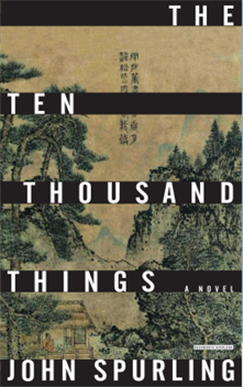
Cover for The Ten Thousand ThingsIn keeping with my goal to read all of the finalists and winners of the Walter Scott Prize, here is my review of the winner for 2015. The Ten Thousand Things is John Spurling’s novel about a turbulent period in Chinese history. It is written from the point of view of Wang Meng, an actual artist of the time, and inspired by Wang’s paintings of the ten thousand things, all of creation.

This novel is related by Wang from his prison cell, where he chooses to tell about his past in the third person. He has been arrested on charges of conspiracy because he accepted an invitation to view the art collection of the disgraced Chancellor Hu.

Wang’s story begins in a mountain retreat when he is already a grown man. He has resigned his minor government post to pursue his art, although strictly as an amateur. This action has disappointed his more ambitious wife, but she is barely a character in the novel.

China is uneasy under the Yuan dynasty, which is dominated by the Mongols. The Chinese upper class resent the fact that the powerful jobs go to Mongols. Taxes are heavy, and men are restricted to following the professions of their fathers. Wang’s own grandfather, General Meng, was controversial because of having decided to support the Yuan government instead of retiring from his government post as many of his peers did. In Wang’s time, revolts are underway under several different war lords and groups of bandits.

When Wang withdraws to his retreat, he has three fateful encounters. He meets Ni on the way there when he is forced to share a room in an inn. Ni is a great artist whose work affects how Wang views his own. Next, when Wang’s cousin Tao asks him to a nearby village to meet a woman he is thinking of marrying, Wang and Tao are just in time to witness a demand from the Red Scarf Bandits that she marry their chief. When her father asks Wang’s advice, he suggests that she choose for herself. She decides to marry the bandit, and soon becomes a bandit queen named the White Tiger. Finally, Wang meets Zhu, a would-be monk from a nearby monastery who asks Wang to take him as his servant. Wang politely explains he can’t afford to and advises him to join the bandits if he wants to learn about the world. Later, Zhu becomes a powerful war lord and then an emperor.

This novel documents the turbulent period of the overthrow of the Yuan dynasty and the establishment of the even more repressive, but Chinese-lead, Ming dynasty under the paranoid Emperor Hongwu. It moves a little slowly and is told in a detached way from the point of view of an artist who attempts to stay away from the seats of power. It also spends a good deal of time describing Wang’s paintings. The novel reflects a sophisticated and intellectual culture, although it certainly concentrates its story in the upper realms of this society.

link to NetgalleyI think it was this detached viewpoint that kept me from enjoying the novel more. The subject matter is interesting, as I know little of Chinese history and have long thought it was a ridiculous bias that we didn’t learn any history of the Far East in school except when it intersected with Western history. Yet most of the characters seem only sketchily drawn, and I didn’t fully engage. The novel is said to illustrate the principles of Daoism, but since my brief reading on that subject left me completely clueless, I did not understand in what way the philosophy is reflected, except perhaps in the perceptions of the narrator.

Related Posts

River of Smoke

The Blazing World

The Thousand Autumns of Jacob de Zoet

Something a Little Different: The Walter Scott Prize

Logo for Walter Scott PrizeI am stealing an idea from Helen of She Reads Novels, who has a page devoted to the Walter Scott Prize for Historical Fiction. She is attempting to read all of the novels nominated for the prize since 2010. Since I am always looking for good historical fiction and I have already read several of the nominees and winners, I thought I would try to do the same. You can find more information about the prize on the Walter Scott Prize website. The prize for 2015 will be announced this coming Saturday, June 13, so that is also exciting.

Here are the lists of nominees, showing the winners in bold. I have linked to my existing reviews, and I am also including links to Helen’s reviews. I have also added this list as a page under my About menu so that it is easy to find, and will continue to update the links on that page as I finish the books.

Cover for Wolf Hall2010

Sacred Hearts by Sarah Dunant
The Quickening Maze by Adam Foulds
Lustrum by Robert Harris
Wolf Hall by Hillary Mantel (My review) (She Reads Novels review)
The Glass Room by Simon Mawer
Stone’s Fall by Iain Pears (My review) (She Reads Novels review)
Hodd by Adam Thorpe

Cover for The Thousand Autumns of Jacob De Zoet2011

The Long Song by Andrea Levy (She Reads Novels review)
C by Thomas McCarthy
The Thousand Autumns of Jacob de Zoet by David Mitchell (My review)
Ghost Light by Joseph O’Connor (She Reads Novels review)
Heartstone by C. J. Sansome
To Kill a Tsar by Andrew Williams

2012

On Canaan’s Side by Sebastian Barry (She Reads Novels review)
The Sisters Brothers by Patrick deWitt (She Reads Novels review)
Half-Blood Blues by Esi Edugyan
The Stranger’s Child by Alan Hollinghurst
Pure by Andrew Miller (She Reads Novels review)

Cover of Bring Up the Bodies2013

Toby’s Room by Pat Barker
The Garden of Evening Mists by Tan Twan Eng (She Reads Novels review)
The Daughters of Mars by Thomas Kenneally (My review) (She Reads Novels review)
Bring Up the Bodies by Hilary Mantel (My review) (She Reads Novels review)
The Streets by Anthony Quinn (She Reads Novels review)
Merivel: A Man of His Time by Rose Tremain

Cover for Life After Life2014

Life After Life by Kate Atkinson (My review) (She Reads Novels review)
The Luminaries by Eleanor Catton (My review)
Harvest by Jim Crace (My review) (She Reads Novels review)
Fair Helen by Andrew Greig (She Reads Novels review)
An Officer and a Spy by Robert Harris (She Reads Novels review)
The Promise by Ann Weisgarber

Cover for Viper Wine2015

Zone of Interest by Martin Amis
The Lie by Helen Dunmore (She Reads Novels review)
Viper Wine by Hermione Eyre (My review)
In the Wolf’s Mouth by Adam Foulds
Arctic Summer by Damon Galgut
A God in Every Stone by Kamila Shamsie
The Ten Thousand Things by John Spurling