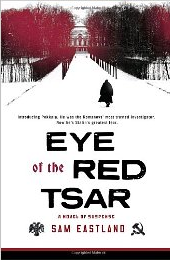
Day 171: Eye of the Red Tsar

Cover for Eye of the Red TsarI had a strange reaction to Eye of the Red Tsar by Sam Eastland. I felt as if the author had researched the time and place without actually grasping anything about it. The novel is placed in post-revolutionary USSR with flashbacks to pre-revolutionary Russia. Tsar Nicholas II and Stalin are both characters in the book, in their different time periods, but you do not get any feeling that the author understands what kind of people they were or anything about the politics involved. Given my fascination with Russia, this novel would seem to be a great fit for me, but I have nothing but objections to it.

Pekkala, a Finnish soldier, is a prisoner in a labor camp in Siberia at the beginning of the novel. He was Nicholas II’s private investigator before the revolution, when he became known as The Emerald Eye. He remained completely faithful to the Romanovs, so when the family was captured by the Bolsheviks, he was exiled to Siberia. But at the beginning of the novel, he is released because Stalin wants him to find out exactly what happened the night the Tsar and his family were executed. Of course, this question has remained a mystery to the western world until recently, but I did not buy at all that Stalin and his predecessors would not have already known perfectly well what happened to the Romanovs.

My first objection is about how Stalin is characterized. The book takes place partly in 1929, when Stalin is only a few years away from his reign of terror. Yet he is depicted as quiet and thoughtful, not exactly true to the historical consensus. As a kind of extension of that thought, even though the book is about a time and place when everything is politicized, the novel provides no political context for the reader.

Another problem I have is with the narrative style. As Pekkala conducts his investigation, he remembers his past, in order. When I compare Eastland’s technique with that used in The Darkest Room, where characters have fleeting thoughts or disjointed memories that eventually add up to something, this novel seems incomparably clumsy in execution.

Finally (somewhat of a spoiler), I found it completely unbelievable, given the loyalty of the main character to the Romanovs, that he would willingly agree to work for Stalin at the end of the book. I forgive myself for revealing this turn of events, as it is easy to see it coming. Readers are told at the beginning of the book that Stalin is known as the Red Tsar. Obviously, since Pekkala was the Emerald Eye under the Nicholas, he will become the Eye of the Red Tsar under Stalin.

Day 170: The Subtle Knife

Cover for The Subtle KnifeA few months ago, I reviewed The Golden Compass, the first book in Philip Pullman’s trilogy, “His Dark Materials.” I thought it was about time to review the second book, The Subtle Knife.

As I have said before, it’s most difficult to review the second book in a trilogy, because everything is building up toward the third book. Lyra follows her father, Lord Asriel, through a window to another world. There she meets Will, a boy from our world.

Will has taken care of his mentally ill mother since his father disappeared on an expedition years before. Recently men have been breaking into their house trying to find his father’s papers. Will kills one of them accidentally and flees into the other world through a window, where he meets Lyra.

Lyra is trying to find out about dust, but the alethiometer tells her to help Will find his father. What they find first is the subtle knife, which can cut through anything, even the fabric between worlds. Will becomes the knife’s keeper.

Although the concept of the knife cutting the fabric between worlds is interesting, I really loved the whole feel of the world and the characters in The Golden Compass. Some of the characters are still with us in the second book, but we are moving away from that world. However, I enjoyed The Subtle Knife. I just don’t think the rest of the trilogy stands up to The Golden Compass in imaginative power and characters you feel really invested in.

Day 169: The Distant Hours

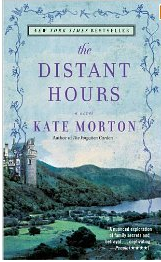
Cover for The Distant HoursKate Morton has been one my favorite authors ever since I read The Forgotten Garden, which is still my favorite of her books. The Distant Hours is another of Morton’s atmospheric novels about family secrets.

When a letter posted in 1941 finally reaches its destination in 1992, Edie Burchill is surprised at the emotional reaction of her usually cool mother. She finds out for the first time that her mother was an evacuee during World War II at the home of Raymond Blythe, the author of Edie’s favorite childhood book, The True History of the Mud Man.

Later, after Edie has been asked to write an introduction for a reprint of Blythe’s classic, she gets lost meeting a potential author and accidentally finds Milderhurst Castle, the once stately but now crumbling home of the Blythes. Living there are the Blythe sisters, Percy, Saffy, and the invalid Juniper. In a way, too, the house is still occupied by the memory of their overbearing father.

The novel alternates between the present time and 1941, as we discover what happened during one night in 1941 that has haunted the family ever since. Morton is deft at creating a compelling atmosphere in the moldering castle and in keeping her readers in suspense.

Morton’s latest book, The Secret Keeper, is due out in October. I can’t wait to get my copy!

Day 168: Cod: A Biography of the Fish That Changed the World

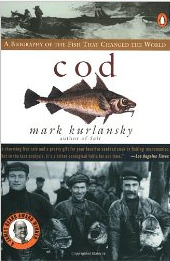
Cover for CodCod is the best known of Mark Kurlansky’s interesting micro-histories. If you are not familiar with the term, a micro-history is a short book that details the history of a specific and focused subject. Cod explores the importance of cod and the history of cod fishing beginning in the early days when the Vikings and Basques dominated the industry.

It was interesting to learn that Vikings and Basques going after cod were probably the first Europeans to “discover” America. They had been fishing off the coast for years before Columbus traveled to the Americas, keeping their fishing grounds secret.

Later, the eastern seaboard provinces of Canada and the New England states dominated the industry because of their location. The abundance and importance of cod provided many years of prosperity for these areas, but the later dearth of cod has had the opposite effect. Iceland, whose economy was almost solely dependent upon cod until recent years, has been severely impacted.

Of course, there is an ecological aspect to the history of cod. During the height of the fishing industry, the fish were so plentiful that it was said a person could walk across their backs. In the present, the fisheries are in danger of dying and many families with long histories in the industry are being forced to find other work. Kurlansky shows how the fishermen’s warnings about cod disappearing were routinely ignored by scientists and governments for years.

There is some overlap with Kurlansky’s book Salt, as he explains the importance that being able to salt the cod had to the success of the fishing industry. Before salting was begun, the cod had to be dried and a lot of it spoiled onboard. The chapters about battles over international waters are also fascinating.

As always with Kurlansky, the book is interesting and well written. It employs his usual format of mixing in recipes for preparing cod with the historical information.

Day 167: City of Shadows

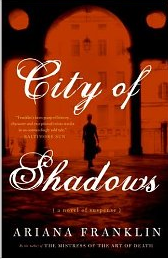
Cover for City of ShadowsAlthough I have read and liked books from Ariana Franklin’s “Mistress of the Art of Death” mystery series, I think that City of Shadows, a stand-alone thriller about a different period, is particularly good. On a side note, I am sorry to hear that Ariana Franklin has died, so we will never learn what her plans were for the characters in her series.

Esther Solomonova is a mysterious scarred woman who works for the phony Russian prince and nightclub owner Nick Potrovskov in 1920’s Berlin. However, the book begins a step before we get to Esther, when a woman is being chased through the streets of Berlin and dives into a canal to get away. Nick hears that this woman, Anna Anderson, is claiming to be Grand Duchess Anastasia of the murdered Romanov family, so he decides to take her under his wing in the hopes of getting a share of the Tsar’s fortune that has been left in England.

Anna is in an asylum, and the inmates claim that every six weeks a man lurks outside, trying to get a chance to murder her. After Nick removes her from the asylum, people begin dying. Only Detective Schmidt pays attention to Esther’s theory that someone is trying to kill Anna, since the only evidence is the testimony of insane people.

Franklin does a convincing job of mixing the true story of Anna Anderson with the completely fictional murder plot. She evokes a real sense of the chaotic, anarchic, starving Berlin in the time in which Hitler is coming to power.

Day 166: We, The Drowned

Cover for We, The DrownedBest Book of the Week!

We, The Drowned is an unusual novel by Danish writer Carsten Jensen that has become an international best seller. It relates the history of the author’s home town, the port of Marstal, Denmark, from 1848 to 1945. Although it picks principal characters to follow during these times, large portions of the novel are written in the first person plural, as though the entire town is the Greek chorus in a play. The novel follows the fate of the town as it rises to become a major shipping port to its near demise just before and during World War II.

The narrative style of the novel feels like a series of seafaring tales. Ships sink, sailors are never seen again, but the townsmen of Marstal continue to be lured out to sea. We follow them as the Danes go to war with Germany in the mid-19th century and the men of Marstal wonder why they are fighting men they traded with the week before. In this conflict, Laurids Madsen is shot upward from an exploding ship and lands again on his feet, unharmed, creating a legend about his boots.

Years later, his son Albert travels the South Pacific looking for his father, who went to sea when Albert was four and never returned. He finds him with a second family in Samoa.

As an old man retired from a prosperous career as a sea captain, Albert befriends a young boy, Knut Erik Friis, whose widowed young mother does everything she can to keep her son from going to sea. When she gains some economic power in the community, she undercuts the town’s shipping industry in an attempt to keep all the young men home.

These stories and many more, ending with Knut Erik’s experiences during World War II, tell the rich tales of the lives in this seafaring town. Although I was initially a little put off by the narrative style, I found myself barely able to put down this book.

Day 165: Alexandria

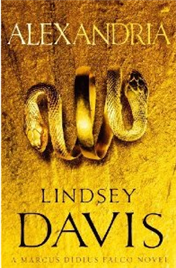
Cover for AlexandriaFor years I avidly collected all of Lindsey Davis’s Didius Falco mysteries. My passion has cooled a bit, as it usually does for series mysteries, but I still enjoy them enough to pick them up when I find them.

Marcus Didius Falco is a cynical, rascally, wisecracking “informer” during the Roman Empire of Vespasian. I have followed his path from the first book when he met Helena Justina, the fiery, unconventional daughter of a senator. Falco has had to work his way up from the plebeian rank and earn enough money so that he can legally be permitted to marry her.

In Alexandria, the 19th novel in this series, Falco and Helena Justina have been married for awhile when they travel to Alexandria with their two daughters, their adopted teenage daughter, and their mongrel dog for a vacation and visit to his uncle. Almost immediately upon arrival Falco is plunged into an investigation when his uncle’s dinner guest of the night before, Theon, the head of the famed library, is found dead, locked in his own office.

Of course, Falco has to figure out how Theon was murdered and why. He soon finds that several of the library’s scholars may want Theon’s job. Of course, people begin dropping like flies, including a philosophy student who is mauled by a crocodile. Falco begins to suspect that something else might be going on.

Davis’s books always involve a multitude of interesting, shifty characters and lots of dirty politics and other shenanigans, and Falco is always engaging and amusing. Davis does a convincing job of re-creating the ancient world in her books.

If you are interested in this series, I recommend that you start with the first book, Silver Pigs (recently renamed The Silver Pigs). Although the mysteries are stand-alone, developments in Falco’s personal life make it more enjoyable if you read this series in order.

Day 164: The Bone Garden

Cover for The Bone GardenThe Bone Garden is one of Tess Gerritsen’s Risoli and Isles series, but Isles only appears briefly, so it is more of a stand-alone mystery.

The novel takes place in two time periods. In the present day Julia Hamill has just purchased a 130-year-old house when she discovers an old skull in the overgrown garden. Medical examiner Maura Isles determines that the victim, a woman, was murdered long ago. Julia becomes fascinated with a box of newspaper clippings and letters that hold the key to the mystery.

In 1830’s Boston, Norris Marshall has joined the “resurrectionists,” grave robbers, in an effort to pay for his medical education. After a nurse and a doctor are murdered on the university hospital grounds, Norris finds he is a suspect. He seeks help from another student, Oliver Wendell Holmes.

I have only read a few Risoli and Isles books. I thought this one was passable, but I didn’t like it as well as others I have read. The attempt at 1830’s dialogue is awkward and painful to read, and in this case I didn’t see any reason to use a real historical person in the novel when a fictional one would have done just as well.