
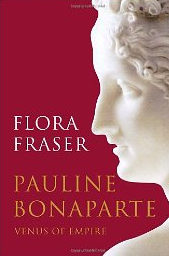
 I didn’t know anything about Pauline Bonaparte before I read Pauline Bonaparte: Venus of Empire. I picked it up because it was by Flora Fraser, a noted biographer who specializes in 19th century women. (She is also the daughter of Antonia Fraser, the famous biographer.)
Pauline Bonaparte was Napoleon Bonaparte’s youngest sister, renowned for her beauty. She lived a colorful life and is immortalized by a life-sized, nude statue by Antonio Canova that resides in the Villa Borghese in Rome.
The connection with the Borghese family is not one that they cherish. Pauline’s second husband was Prince Camillo Borghese. During their long marriage, they lived mostly apart, and Pauline entertained herself with numerous flagrant affairs.
In fact, Pauline’s reputation was dreadful. Napoleon’s enemies spread numerous rumors about her, even stooping to claim that her relations with her brother were incestuous. Not only did she not care, she encouraged that particular rumor to show how powerful she was.
Although she could be very charming, she spent most of her career manipulating infatuated men and intimidated women. Stories abound of her using generals as footstools, turning people our of their own houses, and so on. A particularly odd one was that when she was visiting an officer of the church, she made him cut a hole in the ceiling of his bathroom over the tub so that someone could stand on the floor above her and shower her with milk.
Although extremely jealous of the prerogatives granted her sisters (as they were of hers) and generally hateful to the Empress Josephine (she and her sisters held onto Josephine’s train during her coronation so that she could not move forward), Pauline’s most positive trait was her loyalty to her family. She was devoted, although not faithful, to her first husband, General Victor Emmanual Leclerc. When Napoleon fell out of power, she was persistent in trying to improve his living conditions and tried to get permission from the British to share his exile.
Fraser’s biography is interesting and well written. I found Pauline to be a fascinating subject, although not an admirable person.

 What? Me Read?