
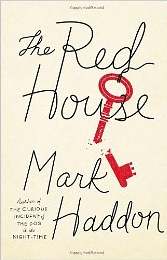
 I really enjoyed Mark Haddon’s The Curious Incident of the Dog in the Night-Time, so I was looking forward to reading The Red House. Curious Incident employs unusual narrative techniques, such as including math games, to try to re-create the thought processes of an autistic teen. The Red House also plays with narration, only not as effectively.
After being estranged for years, siblings Angela and Richard have met again at their mother’s funeral. In an impulsive attempt to restore ties with his sister, Richard rents a holiday house in Herefordshire and invites the other family to join his for a week. Richard’s family consists of his second wife Louise and her teenage daughter Melissa. Accompanying Angela are her husband Dominic and their children Benjy, Alex, and Daisy.
Each of the characters is dealing with issues. Angela had a miscarriage 18 years ago, and she has dwelled on this lost child ever since, naming her Karen and neglecting her teenage daughter Daisy as a result of this obsession. Dominic is having an affair. Daisy has become very religious and fights with Angela about it. Teenage Alex is yearning to have sex with Melissa. Richard is dreading a possible lawsuit from a patient. Louise barely knows the other family and is having problems with Richard. Melissa is awaiting the time when her parents learn that bullying by her group of friends has caused another girl to attempt suicide. Only young Benjy does not seem to have some sort of obsession.
The book jumps among the narrations of all eight characters. The voices are not always so distinct that you can immediately tell them apart. The one that is distinct is expressed as disjointed lists of things, but it is difficult to attach to anyone. For awhile I thought it might be that of the dead daughter and later I thought it may be Angela having a nervous breakdown. Most often, to figure out who the narrator was, I had to relate the narration to something that was already going on. One technique Haddon uses is to interject part of what each person is reading, which at first helps you know which person it is, but after awhile becomes tedious.
Virtually plotless, this dour novel consists of the characters struggling with their own thoughts and with each other. Generally, I disliked most of the characters and thought the novel was a frustrating reading experience.

 What? Me Read?