Day 248: A Long Finish

Cover for A Long FinishAurelio Zen’s assignment in A Long Finish reflects the corruption in the Italian police force and government that is always being pointed out in these books. Zen is assigned to go to Alba not by his superiors but by a famous movie producer. The producer wants him to investigate the murder of Aldo Vincenzo, a noted winemaker–more importantly, to free Vincenzo’s son Manlio so he can get the grape harvest in and oversee the production of the wine. Vincenzo was found stabbed in his own vineyards with his genitals removed. The producer is a wine connoisseur who wants to make sure this year’s vintage isn’t wasted.

Zen finds himself in a dreamy, unfocused state, having nightmares because of several successive personal losses. Unfortunately, I’ve read the Aurelio Zen novels in an entirely random order, so I was confused about the sequence of the events in his personal life. Zen also has a severe cold, and someone is leaving him anonymous phone messages.

The first scene in the book, however, was of the murder, so the readers know that just before his death, Vincenzo encountered a trespassing truffle hunter. But which person was it? The truth may lie 40 years in the past, as indicated by the method of Vincenzo’s death, with echoes of partisan fighting during World War II, or maybe that is just a ruse.

I may be tiring a little of Aurelio Zen. I couldn’t put my finger on anything definite, but throughout this novel I got the impression that Dibdin is just trifling with his readers.

Day 247: That Old Cape Magic

Cover for That Old Cape MagicI was so excited by discovering Empire Falls earlier this year that I went right out and bought a more recent book by Richard Russo, That Old Cape Magic. This novel observes the thoughts of Jack Griffin as his marriage implodes and again a year later as he tries to make amends.

Griffin is obsessed with not becoming his parents, a couple of academic snobs who have spent their lifetimes criticizing everything, willfully ruining other people’s possessions, and making enemies in their Midwest university departments. Yet he has given up a successful screen-writing career to teach at a New England college that his parents always aspired to, and bought an old, charming house. These decisions make him feel like he is living the lives they wanted.

As Griffin carts around his father’s ashes on the way to a wedding on Cape Cod, he behaves spitefully to his wife Joy, whom he blames for the changes in his life. In his drives around the Cape, where he and his family spent all their summers, he thinks about his past, his parents, and his marriage.

In the second part of the novel, he returns to the Cape for his daughter’s wedding with his father’s ashes still in the car, along with his mother’s. He has come with a date but his real desire is to win back his wife.

I think several things hampered me from enjoying this novel as much as I did the other. First, Griffin isn’t very likeable and his parents seem repellant, although we have some evidence that his memories may not all be accurate. One of the difficulties in Griffin’s marriage is his dislike of Joy’s family, but Joy’s family is almost stereotypically drawn as wacky, loud, and obnoxious, so it’s hard to appreciate why Joy cares for them as much as she does. Aside from being uncaring about his wife’s family and her needs, Griffin seems to be clueless about many things in his own life. Generally, since I usually need to relate to at least one character and only Griffin is fully realized, I found the novel a little unsatisfying.

Day 246: Kindness Goes Unpunished

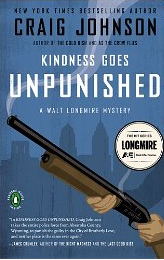
Cover for Kindness Goes UnpunishedHere it is, the first review of my second year of blogging. I just had to say that. Now, on to the review.

As much as I enjoy Craig Johnson’s series about Wyoming sheriff Walt Longmire, I find that I’ve been neglecting him and so am way behind in reviewing the series. One thing I admire most about this series is the sense of place–how Wyoming is depicted so clearly it is almost a character. Unfortunately, Kindness Goes Unpunished takes place in Philadelphia, so we miss that here, but the book is still action packed and lots of fun to read.

Sheriff Longmire and his best friend Henry Standing Bear travel to Philadelphia. Henry is setting up a collection of photos at a museum in preparation for giving a lecture, and Walt is visiting his daughter Cady, who works there as a lawyer.

Before Walt even gets a chance to see Cady, she is found at the bottom of some steps in a coma. Witness testimony seems to indicate that she was pushed down the stairs by her boyfriend, who turns out to have a drug habit. Shortly thereafter, however, the boyfriend is shoved off a bridge.

Philly cops wonder if Walt is responsible for the boyfriend’s death. Walt is torn between worry about Cady and his impulse to track down the killer, so Walt’s lippy deputy, Victoria Moretti, gets on a plane from Wyoming. It helps that she is a Philadelphia native and has relatives in the police force. Walt makes a deal with the Philly police to assist them in their investigation. (No, Brits, that doesn’t mean the same thing here as it does in the U.K.) We readers also get to meet the entire Moretti clan, including Victoria’s mother, who seems inclined to flirt with Walt.

Although I missed the Wyoming setting, Johnson effectively employs the fish-out-of-water technique to produce a novel that is as good as ever.

Extra Special Post! First Year’s Top Ten

image of booksThis week marks the one-year anniversary of my blog, so I decided that would be the perfect time to announce my top ten books instead of doing it at the end of last year. My list is a little different from other lists in one other way. It is a list of the top ten books I’ve reviewed in the past year, not those that were published that year. Also, since it was difficult to narrow down my list even though I restricted myself to the best books list, I had to make some artificial rules for myself–for example, to only select one book from a series or by an author.

So, with no further ado, here is my list, in the order of appearance on this blog (earliest to most recent):

Day 245: Unbroken: A World War II Story of Survival, Resilience, and Redemption

Cover for UnbrokenUnbroken is the incredible story of Louis Zamperini, an Olympic runner whose plane went down in the Pacific during World War II. He and his pilot Phil (Russell Allen Phillips) survived many days on a small raft only to be captured by the Japanese and interred in a series of brutal POW camps.

The book begins with Zamperini’s childhood in California as an almost feral creature who was always in trouble for stealing and other mischief. His unconquerable spirit served him well through his travails in adulthood but caused problems for his parents and himself when he was a child. His unruly years were ended, or at least subdued, by his brother Pete’s interest in training him as a runner, as he had always been the kid who ran away from his pranks the fastest. Once Louie began to take the sport seriously, he became a very fast runner and began winning medals. Although he only finished 8th at the 1936 Olympics, he ran his last lap in 56 seconds, and his dream was to return to the Olympics and medal.

After Pearl Harbor Louie became a bombadier and made many flights in dangerous and ill-equipped planes until his B-24, known as a lemon, went down during a search for another missing plane. I was particularly surprised at how unsafe the planes were and how ill-equipped the men were when their plane went down. Their raft contained only some chocolate and a few flares, and its repair kit pieces were ruined because they weren’t kept in a waterproof envelope. The three men who survived the crash had no equipment to make drinking water from sea water and were reduced to attempting to catch rain water. They had no food except the chocolate (which one of the men ate the first night). Braving strafing by a Japanese plane, shark attacks, dehydration, starvation, and a typhoon, Louie and Phil survived more than 40 days at sea. The other man died.

Their raft landed on an atoll in the Marshall Islands, where they were immediately captured by the Japanese. At first treated kindly, once they were transferred to POW camps, they encountered unbelievable brutality. Aside from being routinely starved–while Red Cross shipments intended for them were stolen by the Japanese–they were forced into hard labor and regularly beaten. Louie in particular because of his ungovernable nature became the scapegoat of an insane, brutal guard named Mutsuhiro Watanabe.

About half of this book is devoted to the men’s experiences in the camps, with the focus on Louie after he and Phil were separated. Eventually, though, the men were saved with the end of the war. The rest of the book related Louie’s trials with PTSD and alcoholism and how he overcame those problems to live a productive life. The book ends with his accomplishments even in an active old age, including carrying the torch at the 1988 Olympics in Nagano on his 81st birthday.

Overall, this is an interesting book, but I found the descriptions of the brutality at the camps overwhelming. Although I am not squeamish by any means, I kept reading a few sentences only to have to put the book down. I read it for a book club, and the other members reported having the same difficulty, even skipping over complete sections. The writing was excellent–Laura Hillenbrand’s Seabiscuit is a favorite–and the story compelling, but the details difficult to absorb.

Day 244: The Killings on Jubilee Terrace

Cover for The Killings on Jubilee TerraceThe cast of a long-running British soap opera, “Jubilee Terrace,” is perturbed. Director Reggie Friedman has just informed them that a detested former cast member will be rejoining the show.

Not only is Hamish Fawly extremely nasty, he loves to cause trouble. In this case, he announces to everyone that he is engaged to marry Bet Garrett, an occasional cast member who is the real-life wife of Bill Garrett, the bartender on the show. Bet, who loves to make Bill miserable, promptly dispatches a letter from her lawyer claiming custody of their three daughters, even though she doesn’t really want them.

Detective Charlie Peace arrives on set because the police have received an anonymous letter claiming that the death of a previous cast member, Vernon Watts, was no accident. Finding no substance for the claim, Peace thinks he’s seen the last of the cast when someone sets Hamish’s house on fire, burning to death Hamish and a woman, presumed to be Bet. But shortly, it becomes clear that the victim is another woman, who also had a connection to Vernon Watts.

The novel has many characters, and they are so one-dimensional that I found it difficult to keep them straight, especially as most of them are called by two names, their character’s name and their own. I found The Killings on Jubilee Terrace only mildly interesting, even though it has a difficult solution.

Day 243: The Pursuit of Love

Cover for The Pursuit of LoveIt’s always fun to re-read Nancy Mitford’s charming and funny autobiographical novel about her youth and young womanhood. Mitford’s alter ego is Linda, a young woman with terrible taste in men, who throws herself from one extreme to another in pursuit of love.

Mitford’s strength is her portrayal of peculiar but lovable characters, all modeled upon her own eccentric family or on figures in society. The novel is narrated by Fanny, a sensible but lonely girl who spends a lot of time with her cousins, the Radletts. Her terrifying Uncle Matthew (modeled on Mitford’s father) loves to hunt his children instead of foxes, a game the children love. Aunt Sadie is unutterably vague, which she probably has to be to live with Uncle Matthew. Uncle David is a cultured hypochondriac. The Bolter, Fanny’s mother, is supposedly a portrayal of Lady Idina Sackville, a famous society woman who kept leaving her husbands and was a member of Kenya’s famous Happy Valley set.

Mitford starts the novel with childhood–the children are hunted, hang out in the linen cupboard fantasizing about running away, and generally run wild–and follows the older girls into young adulthood. The novel finally centers on the story of how Linda first impetuously marries a stuffy banker who bores her silly, then leaves him for a communist who only thinks about his causes, and finally falls into the arms of Fabrice, a French duke who is a world-class womanizer. Characterized by facetious observations of society life and dialogue brimming with zingers, Mitford’s novel is a joy to read.

Just as an aside because I’ve recently read a few posts about cover design, I originally copied into this post the most recent cover of the book, which shows a romantic black and white photo of a debutant holding a bouquet of flowers with a pink banner for the title. I decided to replace it with this older cover (the one on the copy I have), which I think does a much better job of conveying the type of novel it is, much more of a social commentary than a romantic novel.

Day 242: The Tuesday Club Murders

Cover for The Tuesday Club MurdersThe Tuesday Club Murders is a collection of Miss Marple short stories structured around a club in which the members tell each other about crimes or mysteries and the others try to solve them. Of course, Miss Marple is the only member to get the right solution, even though some of the club members are eminent jurists and a Scotland Yard detective. As usual, the other members of the club, except a few most in the know, completely underestimate her.

I’m not that fond of crime short stories because there isn’t really enough room to develop much of a plot. In particular, the format chosen for this book is even more sketchy than usual because the characters involved are only described by the story tellers. You don’t end up with a mystery so much as a puzzle, and one that you probably don’t have enough information about to solve. But then, Christie often withholds information in her novels, too.

That being said, Christie’s biggest talent is her ability to sketch believable characters with just a few words. Of course, her humor is another asset. I may have only solved half the crimes, but I laughed a few times.

Day 241: True Grit

Cover for True GritBest Book of the Week!
After the Coen brothers version of True Grit came out a couple of years ago, I became curious about the book. If you have seen that version of the movie, it is almost identical to the book and is much more faithful to it than the version from 1969 starring John Wayne.

For those who are not familiar with the plot, 14-year-old Mattie Ross travels into Indian Territory intending to track down her father’s murderer, Tom Chaney, a hired man who killed Mr. Ross for his extra horse. She looks for the U.S. marshall with the most grit and is pointed to the drunken Rooster Cogburn, who is reluctant to take on the job. She also meets a Texas Ranger named LaBeouf who is after Chaney for the murder of a Texas judge. Mattie is determined that the villain will hang for the murder of her father.

What makes True Grit unusual is the portrait of Mattie through her own words. She is indeed a unique character in fiction, scrappy, opinionated, tight with her money, not to be cheated, not to be turned from her self-imposed task, and tough as nails. Her narration drags us into the story and won’t let us go until it is over. This will be a quick read, because you won’t be able to put the book down.

The characters also speak in a stylized way using old-fashioned dialect that seems oddly formal and elaborate to our ears. It is expertly reproduced in the more recent movie.

If I can combine a book review and movie reviews, I have to say, “Sorry, John Wayne fans.” The Coen brothers movie starring Jeff Bridges is much better. I rented the 1969 version shortly after seeing the other movie and was surprised to see the contrast. Not only has the 1969 version been bowdlerized a bit, but the difference lies principally in the atmosphere created and the acting. The older movie is shot in standard western territory, probably in the hills of California, while the newer one is shot in a bleak landscape that makes us feel the danger and solitude.

As far as acting is concerned, Glenn Campbell as LaBeouf is pathetic as an actor, stiff and awkward. LaBeouf in the more recent version is played by Matt Damon, and I didn’t even recognize him for quite some time, so much does he submerge himself in his role. Although years ago I thought Kim Darby was good as Mattie, Hailee Steinfeld, acting at a younger age, is amazing. The older movie also minimizes but still fails to carry off the unusual style of dialog, coming off as stilted, whereas the newer movie embraces it.