Day 326: Life After Life

Cover for Life After LifeBest Book of the Week! Year!

From the descriptions of this book, I wasn’t sure I would like it even though I usually enjoy Kate Atkinson, a very playful writer. But what a great book–completely engrossing, oddly funny, and immensely satisfying.

Ursula Todd is born on a snowy night in 1910, but the umbilical cord is wrapped around her throat, so she dies. On the same night, Ursula is born again, but this time she lives. As she gets older, she faces various hazards, some of which she does not survive. Each time she is born again, on the same snowy night.

Through vignettes during the course of Ursula’s life, Atkinson skillfully and compellingly weaves the story of how small decisions in life can affect larger issues. We know a very large issue is coming up from the beginning, because in the first scene of the novel, Ursula assassinates Adolf Hitler and is killed in turn by his men.

Life After Life is a stunningly inventive novel about choice, fate, free will, and the nature of time, which Ursula explains to her psychiatrist (who believes in reincarnation) is not a circle but a palimpsest–a manuscript that has been overwritten but on which you can still see some of the writing.

I found this novel amazing, having never read anything quite like it. It is fascinating, funny, touching, and thought-provoking. I personally am going to miss Jackson Brodie, but Atkinson has launched herself far beyond him.

Day 325: Over Sea, Under Stone

Cover for Over Sea, Under StoneOver Sea, Under Stone is a charming children’s story with an Arthurian theme. Simon, Jane, and Barney Drew are vacationing with their parents and great uncle Merriman Lyon in a fishing village in Cornwall. While exploring the attic of the old house they rented, the children discover an ancient map of the local coast line. Barney realizes that the map refers to King Arthur.

The children’s parents are befriended by a Mr. Withers and his sister Polly, who invite the entire family to go fishing on their yacht. Jane is reluctant to go, though, and while everyone else is out, discovers a guide book that is similar to the map. It soon becomes clear that the Withers and perhaps other parties are looking for the secret that the documents reveal.

After a robbery, in which the robbers only rummaged through books and documents, the children decide to confide in great uncle Merry. They all figure out that the map and guide book may hold the secret to the Holy Grail. The children and their uncle become forces of the Light, while the others are forces of the Dark.

Over Sea, Under Stone is an entertaining book that should appeal to older grade school and middle school children. As an adult, my only quibble with it is the coincidence that other people suddenly begin looking for the map in the house just after the children find it. However, that is something that most kids wouldn’t think of.

The novel is well written and packed with adventure. I believe it is the first book in a series called The Dark Is Rising.

Day 324: Trick of the Dark

Cover for Trick of the DarkCharlie Flint is a profiler who is on probation because her testimony freed a man who went on to murder four women. She is asked by Corinna Newsam, her old tutor, to investigate the lesbian lover of the tutor’s daughter, Magda. Corinna Newsam thinks that this lover, Jay Stewart, may be a serial killer, because several people who were in her way conveniently died, including Magda Newsam’s husband on the night of their wedding.

Charlie finds herself attracted to a woman she meets in a seminar. (Spoilers follow in this paragraph and the next. I usually don’t include spoilers, but these are integral to my criticism.) This woman is clearly manipulating her from day one, and in the course of her investigation, Charlie violates the confidentiality of the people she is investigating by confiding in her. Of course, without this happening, there wouldn’t be a plot, but it is still the crux of my problem. I don’t think it would be likely that a person in her position would make the mistake of confiding information on a sensitive case to a new acquaintance, even if she is dating her.

It is the nature of this violation that bothers me most, as it is extremely unprofessional and I felt it unlikely from a profiler. Of course, the woman actually turns out to be connected to the murders, and this coincidence also bothered me.

Finally, I am reluctant to say this for fear it will be misconstrued, but at least five characters are fretting about their sexuality. These characters are lesbians, but I don’t enjoy this kind of emphasis in heterosexual literature either.

I am a big fan of the Tony Hill/Carol Jordan books, and I also like the Kate Brannigan series by McDermid. I know she has a Lindsay Gordon series, but I don’t think I have read any of those. McDermid has written some of the best stand-alone thrillers I have ever read, particularly A Place of Execution. I was disappointed not to enjoy this novel as much.

Day 323: Oliver Twist

Cover for Oliver TwistOliver Twist was one of the first adult books I read as a child, although I believe that David Copperfield was the very first one. This book is, of course, Dickens’ famous indictment of the British treatment of and attitudes toward the poor, as followed through the adventures of Oliver Twist, an innocent and hapless young orphan.

Oliver is born in the workhouse after his mother dies in childbirth without identifying herself. He is named by the beadle and brought up at a baby farm, the intent of which seems to be to starve as many babies to death as possible. The story really begins when Oliver is 10 years old and is moved to the workhouse to begin an illustrious career picking oakum, which is unraveling and picking apart old ropes. There he is voted by the boys to be their representative in asking for another bowl of thin gruel at mealtime (or rather is the only one naive enough to agree to do it).

This act brands Oliver as a malcontent, and he is apprenticed out to a coffin maker with dispatch. His employer seems disposed to be kind, but he is bullied by a “charity boy,” Noah Claypole, as well as by the housemaid and the coffin maker’s wife. Finally, after being unjustly punished for standing up for himself, he runs away.

Oliver’s adventures lead him to London, where he innocently falls in with a gang of thieves lead by the infamous Fagin. Oliver’s struggles to make his way in life without becoming a criminal and the mystery of his identity are the focuses of the rest of the book.

Although this novel has a few amusing and lovable characters, it is fairly grim compared to some of Dickens’ later efforts. It is merciless in its satire of institutions such as the workhouse and the law courts. Oliver himself is more of a symbol for goodness than a fully developed character, yet we are touched by his plight.

It is a long time since I read this novel, and I found I had forgotten just how complex the plot is. Although I do not feel that it is as good as some of Dickens’ later works, as his first serious novel, it is compelling reading.

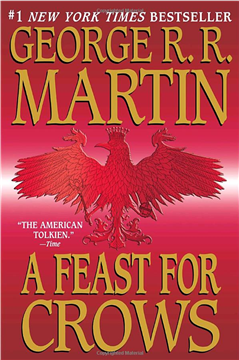
Day 322: A Feast for Crows

Cover for A Feast for CrowsBest Book of the Week!
It’s been awhile since I reviewed a book in A Song of Ice and Fire, and at the rate I’m going, the next book will be out before I catch up!

At the beginning of this fourth novel in the series, the War of the Five Kings is almost over, and several of the contenders for the crown are dead. Stannis Baratheon is the only king who has responded to the cries for help from The Wall, where Jon Snow is now Lord Commander of the Night’s Watch. Stannis’ religious beliefs are causing problems at The Wall, however, particularly because he has brought along the witch Melisandre. Jon must send his friend Sam and Maester Aemon away from the wall to save the maester’s life, as his family is an enemy of the Baratheons.

Tyrion Lannister is accused of murdering his father Tywin and has fled the city. Cersei Lannister’s son Tommen is now king, with Cersei acting as Regent. This situation in King’s Landing is a dangerous one, because Cersei is clearly a psychopath. She has complete control over the city and has many megalomaniacal plans, including trying to bring down her son’s wife. However, she soon seems to be working toward her own defeat.

Brienne, having long ago promised Catelyn Stark to save her daughters in exchange for Jaime Lannister’s freedom, is still searching for Sansa Stark, who has been removed to the Eyrie for her safety by the creepy Petyr Baelish, also known as Littlefinger. Littlefinger has been pretending that Sansa is his daughter, but he soon murders his wife and plans to put Sansa in her place.

Cersei has sent her brother Jaime to the Riverlands to establish order. He seems to be getting disillusioned with Cersei, and is appalled she has made him break his promise to Catelyn, among others. After all, “Lannisters always pay their debts.”

Arya Stark has crossed the waters to Braavos, where she has found shelter in the House of Black and White, a temple of assassins. When Arya kills a man who bragged that he deserted the Night’s Watch and then confesses the murder to the Kindly Man, her mentor, he gives her a potion to drink and she wakes up blind.

Characters have died and Daenerys is not featured in this novel, but new characters are being brought to the fore. In Dorne, Arianne Martell, princess of Dorne, tries to force her father, Doran Martell, into war by attempting to have Myrcella Baratheon, his ward, crowned as queen of Westeros. This plot results in tragedy.

Without giving away too much, it is difficult to convey how exciting this series is. One of the most intriguing features is that you never know what is going to happen with a character. Martin has populated this series with a plethora of them—so many that you need the reference at the back of the book to keep track of the minor ones—but your favorite character in one book can be dead in the next, or maybe not. He is skillful at depicting characters who are convincingly human and keeps up the suspense masterfully.

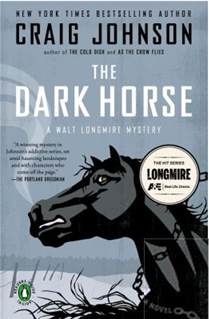
Day 321: The Dark Horse

Cover for The Dark HorseSheriff Walt Longmire goes undercover in this exciting entry to the series. Mary Marsad has been sent to the Absaroka County jail after confessing to shooting her husband, Wade, after he burned down the couple’s barn with Mary’s horses in it. Not only has Mary confessed, she was found with the murder weapon and has gunshot residue on her hands.

Even though the case is out of his jurisdiction, Walt feels that Mary may be innocent and has been asked to look into the case by the sheriff of the other county. Walt goes to the town of Absalom posing as an insurance agent to see if he can figure out what happened. He discovers that Absalom holds many secrets, including motives for other people to want Wade Marsad dead.

This novel takes place during two different time frames, while Walt is undercover and two weeks beforehand, showing the reasons why Walt thinks Mary is innocent and why he doesn’t take his friends with him.

As usual, the recurring characters from this series have their places in the story, and we are always pleased to encounter Walt’s best friend, Henry Standing Bear, and his foul-mouthed deputy Victoria Moretti, among others. Johnson is a capable writer who creates convincing characters and vividly evokes the rugged landscape of Wyoming.

Day 320: The Malice of Fortune

Cover for The Malice of FortuneThe Malice of Fortune follows a current trend of mystery fiction to use actual historical people as detectives. In this case, the novel is set in 16th century Italy, and the historical detective is Niccolò Machiavelli, assisted at times by Leonardo da Vinci.

It is 1502 in the Papal States of Italy, and the infamous Pope Alexander VI, the former Rodrigo Borgia, has received word of his beloved son Juan, who was murdered years before. A woman was found butchered in Imola, and with her body was an amulet Juan always kept with him. The Pope summons the courtesan Damiata, whom he suspects of complicity in Juan’s death, and takes her little son hostage while he dispatches her to investigate.

In Imola, Damiata finds that someone has been murdering and butchering women and then leaving quarters of their bodies around the city. When she travels out to the scene of the latest discovery, she finds that Juan’s brother, the dangerous Duke Cesare (nicknamed Valentino) Borgia, has Leonardo da Vinci on the scene as his investigator. Da Vinci thinks that the killer is playing a game by constructing puzzles for him. At the scene some masked men provide an additional clue by fleeing the investigators.

Damiata also meets Niccolò Machiavelli, who is in town representing the city of Florence, which is afraid that Duke Valentino and his condottieri, or mercenaries, are planning to attack the city. Damiata suspects one of the three condottieri generals of being the murderer, but she does not know which one.

Machiavelli provides a different insight into the murderer. He has made a study of what he calls “the necessity” for each man–what drives him–and he begins trying to discover the murderer’s necessity. Machiavelli and Damiata team up to find the murderer.

This novel has interesting characters and situations, but at some point I felt as if the characters are chasing around too much with little result. Instead of building suspense, the plot seems unplanned and disorganized.

Michael Ennis is a historian, and the historical background is convincing and seems accurate. Compared to his previous novel about medieval Italy, The Duchess of Milan, a straight historical fiction novel about the powerful d’Este family, The Malice of Fortune is a little disappointing.

Day 319: Murder on the Orient Express

Cover for Murder on the Orient ExpressMurder on the Orient Express is Agatha Christie’s classic mystery featuring Hercule Poirot. Everyone has of course seen the lush 1974 movie featuring a flock of movie stars and Albert Finney as Poirot.

Hercule Poirot is visiting Istanbul when he unexpectedly receives a telegram prompting him to cancel his plans and book a seat on the Orient Express leaving that night. He is able to book a compartment in first class, but only after some difficulty.

Poirot’s fellow passengers include a Russian princess, a Hungarian count and countess, a Swedish missionary, a British colonel, an annoying American widow, and other unusual characters. As always with Christie, her characters are expertly and colorfully drawn.

On board the train, Poirot is approached by the repellent Mr. Ratchett, an American businessman who believes his life is being threatened, asking for protection. Poirot dislikes Ratchett and declines his offer.

After a disturbed night, during which Poirot is awakened by a cry and spies a woman in a lurid silk kimono walking down the hall, Ratchett’s body is found dead in his compartment. He has been stabbed 12 times. The railroad executive traveling on the train begs Poirot to attempt to solve the crime before the train reaches Yugoslavia.

It begins to look as if an intruder disguised in a railway uniform broke into Ratchett’s compartment and murdered him then escaped out into the snow. Poirot’s investigation turns up a suggestion that Ratchett was the leader of a gang who kidnapped and killed the child Daisy Armstrong (a crime based upon that of the Lindbergh kidnapping), resulting in much tragedy for the family. He also begins finding links between some of the passengers and the Armstrongs.

This particular mystery is famous not only for its exotic locales but also for the unusual solution to the murder. Despite my familiarity with the plot, it made enjoyable reading.