
 This week’s Best Book is Parrot and Olivier in America by Peter Carey.
Month: May 2013
Day 310: The Killer Inside Me
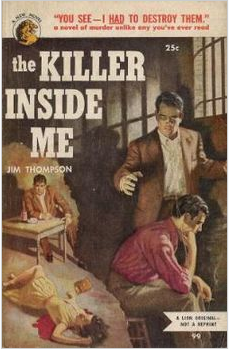 Jim Thompson’s classic noir thriller The Killer Inside Me was one I had never read, so I picked it up out of curiosity. Normally, I am not drawn to classic noir, even though I like a crime novel that is dark. This brief novel easily kept my attention, though.
Lou Ford is a deputy sheriff in a small Texas town. He projects the image of a jovial good guy, maybe even a little stupid, who continually spouts clichés. But he has actually been hiding his sociopathic tendencies for years.
Ford begins a sadomasochistic relationship with Joyce Lakeland, a prostitute. He sees a way to use his relationship with Joyce to get revenge for his brother’s death. As a teenager Ford sexually abused a little girl, and his foster brother Mike took the blame. After he got out of jail, Mike died in a construction accident, and Ford has blamed the local owner of the construction company for Mike’s death.
Ford and Joyce begin blackmailing the owner of the construction company in return for keeping his son’s affair with Joyce secret. Then Ford sees a way to take it all one step further. Of course, things don’t always go as planned.
As in reading Patricia Highsmith’s Ripley novels, a large part of the fascination of this disturbing book lies in wondering how Ford is going to get out of one fix after another. Thompson’s writing is deft and tight. You will be glued to the page, even if you don’t like noir.
Day 309: Parrot and Olivier in America
Best Book of the Week!
Peter Carey’s Parrot and Olivier in America is a fictional riff upon Alexis de Tocqueville’s trip to America in the early 19th century, from which resulted the classic Democracy in America. Olivier de Garmont is the character meant to be Tocqueville, an aristocrat with liberal leanings who is nevertheless an elitist snob.
Parrot is his servant, a man who has lived a colorful but frustrating life. An Englishman, he has had his life disrupted since he was a boy by another French aristocrat, the Marquis de Tilbot, who spirited him away from England after his father, a typesetter, was arrested as an accomplice to forgery.
In dangerous post-revolutionary France, Olivier’s mother has decided it would be wise for Olivier to leave the country, as his liberal leanings have offended the conservatives, but he is unacceptable to the liberals because of his aristocratic birth. She ends up shipping him off to America with Parrot as his secretary, on loan from Tilbot and instructed to report back Olivier’s movements.
But America inflames Parrot’s own democratic leanings. He believes himself to have a talent for engraving that he has never been able to develop while working as Tilbot’s servant, and he resents his status as a “vassal.” While Olivier feels that their rocky start has developed into a relationship that is almost love, Parrot affectionately? calls him “Lord Migraine.”
This novel is narrated in alternating chapters by Olivier and Parrot. It is entertaining–wittily and robustly written–although sometimes we seem to have stumbled into a Dickens novel, especially when reading about Parrot’s early life. In fact, I read recently that Carey wrote an earlier book, Jack Maggs, based on Magwich of Great Expectations, so that feeling is probably not too far off.
Day 308: Love in a Cold Climate
 Love in a Cold Climate is more of a companion novel to Nancy Mitford’s The Pursuit of Love than a sequel, because it focuses on a different group of characters. Fanny is still the narrator, and she returns to tell a little more of her own story but mostly that of her beautiful friend and distant relation Polly Hampton.
When Fanny receives an invitation to stay with the family upon their return from India, she is happy to renew her friendship with Polly. Polly’s demanding mother, Lady Montdore, has been pushing her toward marriage, but Polly resists. Polly has always been difficult to read, unlike Fanny’s Radlett cousins from The Pursuit of Love, who “told everything.” Although Polly is so beautiful that she could have her pick of the eligible bachelors, she tells Fanny that she finds the whole life of the social season boring.
Lady Montdore is a rapacious, snobbish manipulator with social ambitions, although not without charm. Another family member who is important to the novel is also a snob, “Boy” Dougdale, the husband of Polly’s aunt, Lady Patricia. Fanny and her cousins have always called Boy “the Lecherous Lecturer” because of his tendency to furtively grope very young girls. Much to everyone’s surprise, Polly’s secret comes out when, shortly after Lady Patricia’s death, she marries a reluctant Boy, for she has been in love with him for years.
Polly is ostracized from her family and cut out of her father’s will as a result. But the plot thickens upon the arrival of Lord Montdore’s heir, the effeminate and hilarious Cedric Hampton.
As usual with Mitford, we have a strong suspicion that all her ghastly and funny characters strongly resemble real-life society members of her time. Her novels are full of vivid characterizations and incisive dialogue. Even in today’s world, so removed from her own, her novels are extremely funny.
As a side comment about the cover art, I find the covers of the most recent editions of Mitford’s novels to be too romantic and to do nothing to convey the spirit of her novels. I was able to find a better cover for The Pursuit of Love, but this was all I could find for Love in a Cold Climate.
Day 307: Unnatural Death
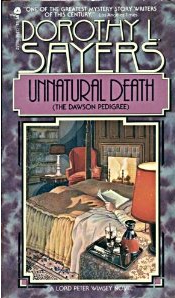 After a long battle with cancer, Miss Agatha Dawson dies, leaving her considerable fortune to her great niece, Miss Whittaker. Nothing may be suspicious about this, but a local doctor is uneasy. He did not attend her at her death, but he treated her earlier and distrusts Miss Whittaker. When he cautiously voices his doubts, he is drummed out of the community for blackening Miss Whittaker’s name. So, he turns to Lord Peter Wimsey for assistance.
Miss Dawson’s nurse insists that the old lady was delirious the last month of her life and couldn’t possibly have written a will. The witness to Miss Dawson’s will claims that Miss Dawson did not want to be involved in the signing of the document. This does seem suspicious. Lord Peter is vaguely interested, but when he starts looking into the case, odd things happen. The first is that the maid dies.
Lord Peter and his friend Inspector Parker pursue the case, Lord Peter with his usual humor and urbanity. Lord Peter is an interesting character. A World War I veteran who is still haunted by the events of the war, he hides his nerves with bouts of silliness. He is a collector of rare books and a pianist who also flies his own plane and barrels around the countryside in his motorcar.
By and large, I enjoy Sayers’ Lord Peter Wimsey novels, although on occasion they get bogged down in a myriad of details, for, as a Golden Age mystery writer, Sayers prefers to present her readers with puzzles rather than motives. However, the complexity in Unnatural Death is created with the plethora of suspects who managed to traipse through the dying woman’s bedroom, all with their own stories–an approach that is more to my taste than complicated railway timetables.
Day 306: The Cat’s Table
 In the early 1950’s, the 11-year old Michael Ondaatje set sail from his home in Sri Lanka for England to meet his mother and go to school. The Cat’s Table is a fictionalized tale of this journey, he tells us.
On board the Oronsay, Michael (nicknamed Mynah) becomes friends with two other boys–Cassius, a wild, rebellious boy from his school, and Ramadhin, gentle and contemplative, with a bad heart. Also on board is Michael’s cousin Emily, a 17-year-old beauty with whom he is close.
Although Michael’s father has arranged for an acquaintance to look after him, she is in first class and only summons him occasionally during the voyage. Michael and his two friends are assigned to the “cat’s table” with the most insignificant passengers on board–a tailor who never speaks; Mr. Mazappa, a jazz musician who admits he is “on the skids”; Miss Lasqueti, a seemingly colorless spinster; Mr. Fonseka, a literature teacher from Colombo; and Mr. Daniels, a botanist who is transporting an entire garden in the hold of the ship. Other important characters are a deaf Singhalese girl named Asuntha whom Emily befriends and a mysterious prisoner who is brought above board late each night and provides fuel for the boys’ imaginations. Michael and his friends find that no one is paying attention to them, so they run wild all over the ship.
At first this narrative proceeds more or less sequentially in a series of vignettes telling of different passengers or events. Later, the narration branches out, moving forward in time to later periods and incidents in Michael’s life related to the people he knew on the ship, and then back again. Toward the middle of the novel I felt confused, as if the narrative would never resolve itself into a coherent story.
But it does. Events on board the ship affect the future lives of several of the passengers, particularly those of Michael and Emily. In getting to that place, we experience the sights and sounds of this exotic and evocative passage across the Indian Ocean and the Arabian Sea, up the Suez Canal, and into the Mediterranean.
The novel is beautifully written, with the vignettes working together in the same way that Michael describes a series of paintings by Cassius, which he sees in a gallery years later. At first the paintings seem abstract, but if he looks at them from the right distance, he sees they perfectly depict the events of a particular night in their voyage together. The vignettes, like fragments seemingly disconnected and abstracted, slowly come together to show us a coherent whole, of Michael’s understanding of the events of the voyage, of his reinterpretation of those events later in life, of how they affect his life and those of others.
Special Post! Best Book of the Week!
 This week’s Best Book is The Girl Who Kicked the Hornet’s Nest by Stieg Larsson!
 What? Me Read?