Day 486: Empress of the Night

Cover of Empress of the NightIn early November 1796, Catherine the Great of Russia suffered a stroke and lay on her deathbed for 36 hours before she finally succumbed. Eva Stachniak’s second novel about Catherine imagines her spontaneous flashbacks of her life, interrupted by moments of fleeting awareness, as she lies there helplessly.

Empress of the Night covers some of the same ground as Stachniak’s The Winter Palace, only the previous novel is told from the point of view of Varvara Nikoleyeva, Catherine’s spy turned confidante, and concentrates mostly on the time before Catherine was Russia’s ruler. Varvara is only a fleeting presence in Empress of the Night, and I wonder if readers who had not read The Winter Palace would be confused by references to her.

Stachniak’s deathbed approach for this novel by definition causes it to be disjointed in narrative style and sometimes difficult to follow chronologically. The novel portrays Catherine as a figure more sympathetic than otherwise, but other characters are left relatively undeveloped.

Catherine’s memories go all the way back to her arrival in Russia as Sophie von Anhalt-Zerbst-Dornburg, a prospective bride for the Empress Elizabeth’s spoiled and childish heir Peter. We follow her struggles to be accepted as a future wife, to conceive, and to maintain some kind of standing in Elizabeth’s court, although that subject is covered more thoroughly in the first novel. The narrative carries us through the coup against her husband after Elizabeth’s death and the most important events of Catherine’s reign, ending with her attempts to marry her granddaughter Alexandrine to the king of Sweden and to leave her office to her grandson Alexander instead of her foolish and tyrannical son Paul.

Although this novel is interesting, I was not as drawn in as I was by the first book. The parts of the novel dealing with Catherine’s stroke and its aftermath interrupt the flow of the narrative too often. I was also taken aback by the preponderance of attention given in the novel to Catherine’s favorites, especially to the annoying Zubov, versus the actual events of her rule. The emphasis seems to lie with her personal attachments, which I frankly think is unlikely for a world ruler. I also find it hard to believe that Catherine had so much patience with some of her relatives and lovers, most of whom are characterized as being annoyingly selfish.

Since I have read a fair amount about Catherine’s life, I was able to follow the references to important events with little difficulty, but I am left wondering how easy it would be for someone who is unfamiliar to form a good understanding of what is going on. Still, I think this novel draws an appealing portrait of a complex and difficult person.

http://www.netgalley.comMy original understanding of The Winter Palace was that it was the first in a trilogy about Catherine the Great. I am left wondering if I was mistaken, because this novel does not seem to leave anywhere for the writer to go in a third novel. Empress of the Night is ultimately much less satisfying than The Winter Palace in the depth it applies to its subject, which makes me wonder if Stachniak simply lost interest.

Day 485: Into the Darkest Corner

Cover for Into the Darkest CornerAlthough I can’t say I found this thriller terrifying, it was certainly difficult to put down. First-time novelist Elizabeth Haynes effectively evokes suspense by telling her story in two parallel time periods—the earlier one where we have a good idea of what happens and the present where we do not.

In the present, Catherine Bailey is a terrified woman suffering from OCD and PTSD. Three years before, her abusive boyfriend Lee Brightman nearly killed her. Since he managed to discredit her with her friends before that and she had a breakdown during the trial, his punishment was light. Although Cathy has moved away from London to Lancaster and obsessively performs her security checks, she is certain that he will come for her when he gets out of jail.

Five years earlier, Cathy is a care-free young woman who likes picking up men at bars. She meets Lee, who is mysterious about his work but stunningly handsome. We readers have seen him murder his previous girlfriend at the beginning of the book, though, and Lee is soon manipulating Cathy to try to separate her from her friends.

In response to suggestions from her new neighbor, the post-trauma Cathy finally begins getting help for herself, but she is wise enough to know that there is a difference between an unfounded fear and a real fear. Of her new contacts and medical professionals, only a female police officer seems to understand that she may actually be in danger.

Haynes is good at keeping up the suspense, even for the earlier plot for which we already understand the basic outlines. Awhile back I reviewed Accidents Happen, featuring a heroine in a similar condition facing a similar threat. Into the Darkest Corner seems much more realistic in its portrayal of a person suffering from OCD and depicts its characters’ behavior more believably.

Day 484: The Black Count: Glory, Revolution, Betrayal, and the Real Count of Monte Cristo

Cover for The Black CountTom Reiss, previously the author of the fascinating biography The Orientalist, seems to be drawn to unusual figures who were famous in their own time but have become virtually unknown. Such is the case with Thomas-Alexandre Dumas—the father of the famous author of The Count of Monte Cristo, among other classics—who reached the heights of his fame as a great soldier and general of revolutionary France.

Dumas, who went by Alex rather than Alexandre or Thomas, had a colorful past. He was born on the island of Saint-Domingue (now Haiti), the son of a black slave and a French marquis, Antoine Davy de la Pailleterie. His father was a wastrel and a scoundrel who, although he apparently did not raise his son in slavery, sold him in order to raise the passage money for his own return to France after his family had thought him dead for years. After claiming his right to his title and property (which his relatives had been maintaining and improving for years at their own expense), Pailleterie redeemed his teenage son and brought him up in privilege.

However, shortly after entering manhood, Alex broke with his father, took his mother’s name, and proceeded to make his own way as a soldier. He was the first person of color to become a general-in-chief of the French army and was the highest ranking black officer in the western world of his time.

This book is an account of Dumas’ fascinating life, in which his physical courage, ability, and principled behavior won him acclaim. Unfortunately, he was not as gifted politically and inadvertently made an enemy of Napoleon Bonaparte, who perceived him as a rival and really comes off here as a jealous and power-hungry opportunist. Bonaparte’s resentment, in combination with an abrupt change in policy of the French government to remove the rights previously granted subjects of color, ended in the loss of his career and a death in neglect and poverty.

The book is written in an energetic and informal style for the general public, although it is copiously documented in the back. The Black Count is an engrossing story of an event-filled life.

Day 483: Reread: The Strangled Queen

Cover for The Strangled QueenThis article is a repeat review of the second book in Maurice Druon’s excellent Accursed Kings series. I wrote my initial reviews years after I read the books, from memory. This review is from a recent reread in preparation for my first review of the third book in the series.

The name of Philip the Fair would glow down the centuries only by the flicker of the faggots he had lighted beneath his enemies and the glitter of gold he had seized. It would be quickly forgotten that he had curbed the powerful, maintained peace in so far as it was possible, reformed the law, constructed fortresses that the land might be cultivated in their shelter, united provinces, convoked assemblies of the middle class so that it might speak its mind, and watched unremittingly over the independence of France.

So says Druon in his prologue to The Strangled Queen about Philip IV of France (Philip the Fair), whose death in 1314 begins the action of the novel.

Marguerite of Burgundy has not heard of Philip’s death. She and her sister-in-law Blanche, Philip’s daughters-in-law, are imprisoned in the Château-Gaillard for adultery, and she does not know that her husband has become the king of France, Louis X. When her cousin Robert of Artois comes to tell her, she naïvely believes he wants to help her, unaware how he has assisted in her downfall. What he actually wants is for her to agree to an annulment, as now she poses a big problem to the succession.

But Marguerite doubts when she should not. Although she would gladly exchange her harsh prison for a convent, she is afraid that once she signs, those in charge of her will leave her where she is. She also does not want to declare her daughter a bastard, the other requirement of her release.

Louis X soon sets his sights on marrying Cleménce of Hungary. To do so, he must get a pope installed who will agree to give him an annulment. However, the cardinals have been arguing ever since the death of Pope Clement V, who with Philip the Fair was a victim of the curse of the Grand Master of the Knights Templar (whose death by burning at the stake is referred to in the quote at the beginning of this review).

The weak and stupid Louis is faced with a battle between the forces of order and progress, represented by Enguerrand Marigny, his father’s coadjutor, and the old ways of feudalism, represented by his uncle, Charles of Valois. Whoever can get Louis a pope or his marriage with Cleménce will ultimately win, but in the meantime he begins stripping away all of the governmental reforms instituted by his father.

Bitingly told, about a fascinating period of French history, these novels introduce us to a world of complicated alliances, treachery, and politics, as well as murder and mayhem. Lately the novels are being marketed as the original Game of Thrones. There are certainly strong similarities.

Day 482: The Map of Love

Cover for The Map of LoveBest Book of the Week!
The Map of Love is an absorbing novel to read now, just after the Arab Spring and during the troubled times that have continued on. It is a love story certainly, its title tells you that, but it also explores the roots of the political turmoil in present-day Egypt and some of the other countries that used to be a part of the Ottoman Empire.

The novel follows the course of two cross-cultural love affairs 90 years apart. In 1900 Anna Winterbourne travels to Egypt in an attempt to overcome her grief. She is the widow of a man who recently served in the Soudan, and even though their marriage was not a happy one, she is sorrowful that she could not help him overcome his despair at participating in an unjust war. Almost accidentally, she meets Sharif al-Barroudi, a Cairo lawyer and activist, and falls in love with him.

Anna’s diary and letters are discovered by her great-granddaughter, Isabel Cabot. Isabel herself has fallen in love with ‘Omar al-Ghamwari, a famous Egyptian-American orchestra conductor who is rumored to work with the Palestinians. ‘Omar feels that their age difference is too great for a relationship, but he suggests that Isabel take her find to his sister Aman in Cairo so that she might help Isabel translate some of the materials.

Aman becomes absorbed in reading Anna’s diaries and letters and realizes very soon that she and Isabel are related, for Anna’s beloved sister-in-law Layla is Aman’s own grandmother. With Layla’s diaries of the same time period, she begins to reconstruct Anna’s story and that of Egypt’s history during a turbulent period. Aman has returned from life abroad to live in Cairo in another turbulent time.

Anna’s courtship is fraught with difficulties, but once she and Sharif are married, she is caught up in his work for Egyptian independence from the Ottoman Empire and from British oversight. As the years go by, his efforts extend to attempts to keep Palestinian land, once owned by his family and by his neighbors and occupied by hundreds of thousands of Muslims, from being bought up by Zionists who would expel them.

The blurb for this novel stresses the similarities between the two love stories, and there are many points of similarity, but the focus of the story in the current time is more with Aman than with Isabel and ‘Omar. Aman is at first at loose ends in Cairo, but she becomes involved with trying to help the fellaheen who occupy her family’s land, as they are treated unjustly by a corrupt and paranoid government. I was frankly more interested in Aman and in Anna and Sharif than I was in Isabel and ‘Omar, who are much less present in the novel.

For me, not very politically aware in regard to problems in this part of the world, this was a fascinating and revealing reading experience. It points up the complex history of the area from a point of view we westerners seldom hear. It is affectingly told in the context of a great love affair between two lovingly created characters. The characters of the two sisters, Layla and Aman, are also vivid. This novel is beautifully written and evokes for us a vibrant culture.

Day 481: St. Lucy’s Home for Girls Raised by Wolves

Cover for St. Lucy'sDifficulties of youth and adolescence are the themes of Karen Russell’s unusual collection of short stories. Many of them are set in the Florida Everglades among bizarre and tacky theme parks or tourist destinations, where children sled through the sand on crab shells or visit enormous conches.

The first story, “Ava Wrestles the Alligator,” provides an introduction to the two sisters who are more fully developed in Russell’s later novel Swamplandia! Abandoned momentarily at their Everglades theme park home, Ava has a murky encounter with the Bird Man and tries to rescue her sister Osceola from her ghost lover. That story is expanded in the novel, which I really enjoyed.

Although certainly all are unusual, some of the stories are more bizarre than others. In “from Children’s Reminiscences of the Westward Migration,” a 19th century family makes a difficult crossing west, their wagon pulled by their father, the Minotaur. In the title story, human children of werewolves are sent away to be raised by nuns so that they can have a better life than their parents.

Russell’s stories are at once peculiar and oddly touching, full of young misfits who are even more out of place than all adolescents think they are. At times funny, such as the descriptions of the wolf-girls’ canine behavior when trying to adjust to their new school, the stories all reverberate with longing. Russell’s writing is brilliantly fierce and original, sparked by her own peculiar vision.

A few of the stories felt to me as if the author was just trying to think of the strangest ideas possible, and she almost lost me in “Lady Yeti and the Palace of Artificial Snows.” But ultimately, I enjoyed the stories, although I prefer the more developed characters and plot of Swamplandia!

Day 480: Playing with Fire

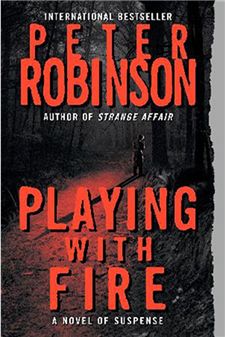
Cover for Playing with FireThis DCI Alan Banks mystery begins with a fire on a couple of canal barges. A squatter named Tina Aspern has been killed on one and an artist named Tom McMahon on the other. Accelerant is present, and it appears that McMahon’s boat was the origin of the fire.

On the scene appears Tina’s boyfriend Mark Siddons, but his alibi that he was with another woman after a fight with Tina checks out. Banks and DI Annie Cabbot and their team are able to discover very little about McMahon except that he has failed as an artist and buys cheap old books from a store owned by Leslie Whitaker.

Soon another fire kills Roland Gardiner in his caravan (mobile home). The police are trying to link the two men, but Gardiner was unemployed and almost a recluse. Tests reveal that both McMahon and Gardiner were drugged before the fires were set.

Annie’s boyfriend Phil Keane, an art expert, suggests that one use for old paper is to employ it in forged artworks. When the police find a fire-proof safe in Gardiner’s caravan containing money and some drawings that seem to be Turners, Banks and Cabbot think they may at least have uncovered a motive. But who could the murderer be? Is it Leslie Whitaker?

Finally, tracing a rented Jeep leads them to a shadowy figure, a man who does not seem to exist. He turns out to be very dangerous indeed.

Playing with Fire is a fast-paced and complicated mystery. Some sixth sense made me guess the killer almost as soon as he appeared, but I don’t think the solution is obvious. If you enjoy an intelligent police procedural, I think you’ll like Robinson’s series. The only other book I have read by him, which was not really part of the series (a more atmospheric novel in which Banks appears but is not part of the story), I enjoyed even more.