Day 665: The Sleep Room

The Sleep Room In this atmospheric novel set in the 50’s, Dr. James Richardson is a young psychiatrist when he accepts what appears to be an exciting opportunity to work with the world-famous Dr. Hugh Maitland. Maitland has just opened a clinic in rural Suffolk where he will be employing some experimental therapies and hires Richardson as a doctor for the facility. Richards is surprised to find he’ll be the only doctor on staff with just weekend relief.

When Richardson begins work at the clinic, he is surprised that Maitland will not let him examine the patient records. One of Maitland’s beliefs is that mental problems are chemical and need chemical solutions, not psychotherapy. In the Sleep Room,  one of his experimental therapies is keeping six women asleep for months.

Although Richardson has some twinges of doubt about Maitland’s ideas, he defers to him as the expert. Soon he has other things to think about. He becomes very busy with his work and is also romantically involved with a nurse, Jane Taylor.

Small odd things happen beginning almost with his arrival, though. He thinks someone is behind him when no one is. He hears sounds when no one else is in the room. Things disappear and reappear in places where they shouldn’t be. Richardson begins thinking that the stately home housing the clinic has a poltergeist.

The Sleep Room is a difficult book to review because it slowly builds up quite a bit of suspense, but then I found the explanation for the events absurd. Yet, there is a reason for that and I can’t really get into it without giving away too much. Let’s just say that after an apparent climax there is a long, boring explanation followed by a short, apparently aimless follow-up, and then everything gets turned upside down.

One problem is that the final twist isn’t signaled well enough by the rest of the novel and actually doesn’t make sense in terms of the total of the novel’s narrative style. I can think of another book that employed a very similar trick but much more successfully. So, although I was captured by this book, I find that it ultimately doesn’t work.

Finally, the novel is only adequately written and poorly edited. In particular, I noticed loads of unnecessary passive voice and several instances of confused homophones: “knave” instead of “nave” and “taught” instead of “taut,” for example. These problems were with the published book. I was not reading an advance reading copy.

Related Posts

The Solitary House

Your Presence Is Requested at Suvanto

Andrew’s Brain


Day 664: Miss Marjoribanks

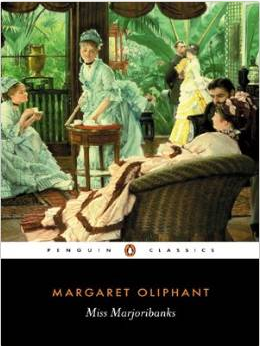
Cover for Miss MarjoribanksBest Book of the Week!
It’s not often that I discover a delightful novel by a classic author whose works I am unfamiliar with. But that’s the case with Miss Marjoribanks. It is a wonderfully ironic comic novel about middle class mores with an exasperating and ultimately lovable heroine.

We first meet Lucilla Marjoribanks at the age of 15. Her long-ailing mother has died, and Lucilla rushes home vowing to be a comfort to her father. Dr. Marjoribanks, who has been looking forward to a comfortable bachelor existence, wastes no time in sending her back to school.

Four years pass, and Miss Marjoribanks returns from her tour on the continent determined to devote herself to her father for the next ten years, suggesting that by then she may have “gone off” a little and will start looking for a husband. Lucilla is a young woman of energy and complete self-confidence who is determined to be a force in Carlingford society. But first she must deal with a proposal from her cousin, Tom Marjoribanks. She loses no time in dispatching him to India.

Dr. Marjoribanks watches in amusement as Lucilla calmly removes the reins of his household from his redoubtable cook Nancy and begins to take control of Carlingford society. Her first project is to begin a series of “evenings” every Thursday.

As Lucilla deftly and with dauntless good humor manages the affairs of her friends, somehow none of a series of eligible men ever come up to scratch with a marriage proposal when her friends expect them to. But Lucilla insists she will dedicate herself to her father’s happiness at least until she is 29.

Although Lucilla, with her managing ways, could easily be a figure of satire, I grew to admire her and like her friends and neighbors, who are fully realized even though  this book is the fifth in a series and I have not read the others. We even feel sympathy for Barbara Lake, the contralto whose voice goes so well with Lucilla’s that Lucilla invites her to her evenings. Barbara, from a lower strata of society, sees Lucilla’s actions as condescension and rewards Lucilla’s impulse with spite.

I was hugely entertained by Lucilla’s career and have already started looking for more books by Oliphant. Margaret Oliphant, I find, was once one of the most popular authors of the mid-19th century, and she deserves to be remembered.

Related Posts

Anderby Wold

Good Behaviour

Mrs. Dalloway


Day 663: Pastoral

Cover for PastoralAndré Alexis states that his intention for this novel was to write a modern pastoral. If you’re not familiar with this term, it’s not surprising, for pastoral literature hasn’t been popular for hundreds of years. A pastoral is a work about life in the country, sometimes comparing it to life in the city, showing the pleasures of a simpler existence.

Alexis tells us explicitly, though, that his protagonist, Father Christopher Pennant, expects the rural town of Barrow, Ontario, to be simple but finds it is not. Indeed, events force him through a crisis of faith.

Father Pennant is a little disappointed by his posting to his first parish of Barrow but is determined to do a good job. There he meets a young woman, Liz Denny, who has just discovered her fiancé is sleeping with another woman. Another parishioner with a problem is Father Pennant’s caretaker, Lowther Williams, 62 and certain he will die at 63. He has set Father Pennant a test to determine if he is the proper person to attend to his affairs after his death.

This is an unusual novel and I’m not quite sure what I think of it. Although I enjoyed Father Pennant’s journey, his conclusions about faith are not definitive and we’re not sure where he will end up. I was also interested in whether Liz would decide to marry Rob after all.

The novel takes place in an indefinite time period that could be any time from the 50’s on. If it is in the present, the town seems old-fashioned. A detail that struck me as odd is that at least three characters keep prayer books with them, and these characters are not religious. Now, things could be different in rural Canada, but as far as I know, I have never even seen a prayer book outside church and don’t know anyone who has one. So, I had to wonder whether something was meant by it.

The descriptions of nature are truly gorgeous. Father Pennant spends more and more of his time exploring it and wonders during his struggles if the study of nature may not be enough for anyone. The novel is written with a gentle humor and sense of irony, and the language is truly lyrical at times.

By the way, my copy is an expensively produced paperback, very nicely printed on thick, high-quality paper. Unfortunately, the last 8 or 10 pages are out of order, which was momentarily confusing.

Related Posts

The Hour I First Believed

Gilead

Religion and the Decline of Magic

TBR Book Tag!

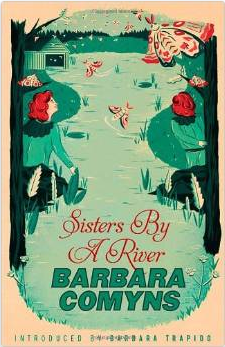
Cover to Sisters by a RiverAs a change of pace, I took up the offer of Naomi at Consumed by Ink to participate in the TBR Book Tag. The only rules are to answer the questions and then tag some more people (if you want). So, please let me know if you’d like to participate (or I might tag someone)!

1. How do you keep track of your TBR pile? This is probably going to seem anal-retentive. I have the bottom of my nightstand completely filled up with books, and the overflow of more recently purchased books is on my desk. The nightstand is stacked in reading order with the genres mixed up together, and the books on the desk get put into the nightstand as the quantity of books in the nightstand dwindles. However, there’s no guarantee when I pick up the next book that I’ll feel like reading it, so I often go through the pile looking for one that I feel more like reading.

2. Is your TR mostly print or e-book? It is almost all print books. I have a couple of e-books from Netgalley on my iPad at most times.

3. How do you determine which book from your TBR to read? I take the next one in the nightstand unless I just don’t feel like it, and then I go down the pile until I find one I want to read. Sometimes, if I just bought a new book that I really want to read, I’ll take it off the desk.

4. A book that’s been on your TBR the longest? The Decline and Fall of the British Empire by Piers Brendan. My husband bought it for me. It’s not that I don’t think the subject might be interesting, it’s just that he buys from the Bargain Books, and although you sometimes find a real bargain there, often those books are there for a reason. I’ll probably read it one of these days. At least Brendan is a historian. Sometimes my husband has bought me nonfiction books written by people with no credentials in the subject whatsoever.

5. A book you recently added to your TBR? Sisters by a River by Barbara Comyns

6. A TBR on your list strictly because of its beautiful cover? I will admit to doing this occasionally, but not right now.

7. A book on your TBR that you never plan on reading? Maybe not A Shropshire Lad, which I got free from the Folio Society.

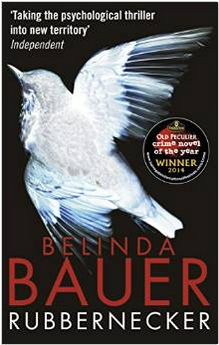
cover for Rubbernecker8. An unpublished book on your TBR that you’re excited about? I only have a couple unpublished books, but I guess I’m looking forward most to Rubbernecker by Belinda Bauer, who writes delightfully scary thrillers.

9. A book on your TBR that basically everyone has read but you? The Little Friend by Donna Tartt. I read Tartt’s first book (The Secret History) years ago and thought it was over-rated, so I never read the second one. Then this past year I read The Goldfinch. Excellent!

10. A book on your TBR list that everyone recommends to you? Right now I don’t have one. I’ve got a lot of obscure books in my pile.

11. A book on your TBR that you’re dying to read? Greenbanks by Dorothy Whipple

12. How many books are on your TBR shelf at Goodreads? 63, but I’m not good at keeping it up. I have completely different books on my Wish List on Amazon, and most of the books in my TBR at home are not on the Goodreads list.

I have tagged Ariel of One Little Library and Cecilia of Only You.

Let me know if you’d like to be tagged!


Day 662: The Mermaid’s Child

Cover for The Mermaid's ChildI was really delighted with Longbourn, Jo Baker’s twist on Pride and Prejudice. I have more mixed feelings about The Mermaid’s Child, Baker’s latest.

Malin Reed is raised by her father, who tells her she is the daughter of a mermaid. Her father, the ferry operator, is affectionate, but everyone else in town treats her with disdain. Malin herself is an odd mixture, a girl naive enough to believe in mermaids but hard schooled, bullied by the village boys and by her teacher. But she has seen a mermaid herself, when the circus was in town.

When her father dies, her grandmother tells her she can’t control her (although we see little evidence that she is uncontrollable) and sends her to “Uncle George” to be a skivvy and bar maid. There she is mistreated and learns to service more than the bar.

Then one night she walks off with a stranger, a man who has given her a smile. He has promised to deliver a rain machine to the village, which is in a terrible drought. With her myopic naivety, she hasn’t even realized he is a con artist.

So begins a picaresque journey for Malin that eventually becomes a search for her mermaid mother. This search takes her to many unlikely places.

I wasn’t sure how I felt about this novel. Were it not for the realism of Malin’s situation, I would take it more for a fantasy, and that is how it is being marketed. But it isn’t really a fantasy except possibly in the narrator’s mind, nor is it magical realism. Unlikely is the word to apply to her adventures but then again, I’m not sure we’re supposed to take Malin’s story that literally. She tips us off in the first few pages that she may be an unreliable narrator.

Still, there is not much to anchor this book except Malin’s character. Most of the other characters are one-dimensional, and anyway we don’t spend much time with them.

This is just an observation, but I don’t think I’m giving away too much when I say this is the fourth historical novel I’ve read this year in which a girl is disguised as a boy. So, what’s up with that? Are historical novelists bothered by the restrictions a woman was subject to in the past?

http://www.netgalley.comI guess I would sum up by saying I found the novel mildly entertaining. It starts out fairly believably and quickly becomes rather grim but with each adventure also becomes less likely. It’s as though it wants to be closer to something like The Rathbones but doesn’t quite manage to push out the boat.

Related Posts

Longbourn

The Rathbones

Ahab’s Wife Or, the Star-Gazer


Day 661: The Bully Pulpit: Theodore Roosevelt, William Howard Taft, and the Golden Age of Journalism

Cover for The Bully PulpitNoted historian Doris Kearns Goodwin approaches her subject of the relationship between Theodore Roosevelt and William Howard Taft from several insightful angles. Although her book examines their careers separately, it is focused on the differences in their personalities and approaches that finally led to the serious rift in their friendship of many years. This rift also led to Roosevelt’s third run for president, which split the Republican ticket.

One of the major differences that Goodwin identifies is their relationships to and use of the press. The journalists particularly close to Roosevelt and involved in the fortunes of both presidents all worked for McClure’s magazine and make up an impressive list of names in journalism: Ida Tarbell, Ray Stannard Baker, William Allen White, and Lincoln Steffens.

I wanted to read more by Goodwin after I read Team of Rivals, the great history of Lincoln’s career that inspired the movie Lincoln. Although I also have her book about FDR and Eleanor Roosevelt in my queue, I was interested in this one because I know only a little bit about Teddy Roosevelt and almost nothing about Taft, just the broad outlines of their careers.

Without going into detail about the careers and personalities of either man, although I developed respect for both, after reading this book, I confess to having a lot of sympathy for Taft over their split. The fact is that Roosevelt regretted his decision not to run for a third term and so looked for excuses to find fault with Taft’s presidency. After Roosevelt’s return from Africa, he criticized Taft’s record of progressive legislation even though it was actually better than Roosevelt’s own. Taft later acknowledged that he wasn’t as good as Roosevelt in publicizing his accomplishments or explaining his policies to the press.

This book is thoroughly interesting and revealing of the characters of both men. It is carefully researched, and it is also very well written. Although quite hefty at 750 pages, it moves along at a good pace and does not get bogged down with extraneous details.

Related Posts

Team of Rivals: The Political Genius of Abraham Lincoln

The River of Doubt: Theodore Roosevelt’s Darkest Journey

The Gods of Gotham


Day 660: Straight Man

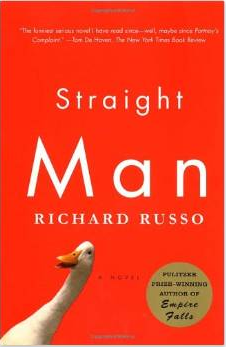
Cover for Straight ManSo far, I have enjoyed Empire Falls the most of Richard Russo’s novels, and Straight Man is at least also set in the rust belt, which he depicts so well. However, rather than being a depiction of small-town life, it is a rich spoof of academia. My husband, formerly the spouse of an academic, tells a joke, probably an old one, that the reason politics in academia is so vicious is that the stakes are so low. That these battles are being fought not on the campus of a great university but of an obscure college in a small Pennsylvania industrial town makes it more ironic.

William Henry Devereux, Jr., (Hank) sees himself as a bit of a rebel, although his rebelliousness mostly confines itself to snarky comments in faculty meetings and satiric opinion pieces on academic life in the local paper. He was once the author of a decently reviewed novel, but now he finds himself the interim head of the English department at a small Pennsylvania college.

Hank has been ignoring rumors that the college is to undergo stringent cuts on the grounds that the same rumors make the rounds every April. The faculty members in his department are constantly embattled, most recently over the job search for a new department head. Hank is better at enraging them than smoothing things over, and at the beginning of the novel suffers a wound to his nose when a professor hits him with her spiral notebook.

Maybe Hank wouldn’t have gotten himself into quite so much trouble, but his wife Lily is out of town on a job interview, and he is preoccupied by a possible kidney stone when he begins taking the rumors seriously. One of the reasons he has discounted them is that the college is breaking ground on an expensive new technology center and he can hardly believe they could claim financial problems requiring layoffs at the same time.

Such is the case, he finds, and with his department members all worried about their jobs, he chooses the groundbreaking ceremony to stage a protest, claiming he will kill a duck (which is in reality a goose) from the campus pond for every day he doesn’t get his budget. Soon he finds himself a minor media celebrity and a suspect of campus security when someone actually does kill a goose. In the meantime, his daughter’s marriage is imploding, he keeps imagining his wife is having an affair with the dean, his scholar father who years before deserted him and his mother for a graduate student is returning, and an attractive daughter of a colleague might be trying to seduce him. The events of this week force him to examine his relationship to his own life.

I found this novel both a bit over the top and amusing, as well as true. If I have a criticism, it is to wonder about some modern male authors’ fascination with bodily functions, and why they seem to think they’re funny. But I guess I can’t constrain this complaint to just novelists, because I’ve been staying away from comic movies for years for the same reason.

Related Posts

That Old Cape Cod Magic

Lucky Jim

The Bridge of Sighs

Day 659: The Prague Cemetery

Cover for The Prague CemeteryThe Prague Cemetery opens in 1897 with a monologue that is so vile and bigoted against just about everyone—the French, the Germans, the Italians, Jesuits, Masons, women, and especially Jews—that I almost put it down at that point. That monologue is the ranting of the main character, Simonini, as learned at his grandfather’s knee. Simonini is an absolutely repellent person who makes his living forging wills and other documents but who also works for the French secret police, and the German secret police, and the Okhrana, making up lies and creating international incidents.

Simonini has a problem. He has gaps in his memory. Further, when he explores a passage in his house, it leads to the rooms of someone who wears a cassock. Following the advice of an Austrian Jew (whom he calls Froïde), he begins writing down what he can remember of his life. The next time he awakens, he finds his diary annotated by the Abbe Della Piccola, who seems to remember the time periods he cannot but doesn’t remember the others. It is soon obvious that these are two personas of the same man.

Simonini is already a forger when he begins his first employment in espionage, spying on the leadership of Garibaldi’s army for the Piedmontese secret police. He always ends up exceeding his orders, though, so when he blows up the ship containing Ippolito Nievo, who is in charge of Garibaldi’s finances, instead of simply assuring the books go to the government and nowhere else, he is shipped off to Paris.

Simonini is most concerned with the fate of what he considers his life work, a document that is supposed to be a true account of a meeting of eminent rabbis—and one Jesuit—in the Prague cemetery, where they plot against the Gentiles and scheme for world domination. Although Simonini has plagiarized some of this document from other sources, he has fabricated most of it, including the setting. Over the course of 40 years, he perfects this document, eliminating the Jesuit and changing it to a series of protocols, all the while trying to sell it to different governments. It is this document that becomes the infamous Protocols of the Elders of Zion, used by the Nazis and other hate-mongers through the years to justify anti-Semitism, even though everyone involved in its creation knew the document was apocryphal.

Although this tale is supposed to be some sort of answer to Dan Brown’s The Da Vinci Code, being based on actual instead of made-up events, and though it is told with proper postmodern irony, it left a bad taste in my mouth. As Simonini and his abettors make up more and more ridiculous stories linking, say, the Masons to Satanic rites, with the public gleefully believing everything, I felt disgusted. Almost every character in the novel except Simonini was an actual person, and all the events the novel is based on are true, which makes it even more disturbing. Eco even has Simonini responsible for framing Dreyfus. Simonini also murders people and dumps their bodies in the sewer beneath his house.

Maybe I agree with one reviewer that some readers may not understand irony. I’m not sure. The construction of a truly dark and repellent protagonist reminded me of the novel Perfume, except that I enjoyed Perfume. I just know that although I have a dark sense of humor myself, this novel made me want to take a bath.

Related Posts

Great House

In the Garden of the Beasts

The Bones of Paris

Day 658: Euphoria

Cover for EuphoriaI switched around my book for today so that I could review a book that is about love rather than about hate (my original selection). I wasn’t thinking about Valentine’s Day coming up tomorrow when I originally selected the review. Happy Valentine’s Day!

***

Best Book of the Week!
Lily King based many of the events in her novel Euphoria on the life of anthropologist Margaret Mead. The result is a fascinating examination of another culture and Mead’s work methods as well as a love story.

When Nell Stone and her husband Schyler Fenwick (Fen) crawl out of the New Guinea jungle after grueling months spent studying the Mumbanyo, they don’t even know it is Christmas Eve. Nell has found the Mumbanyo people too militant and unsympathetic to work with, so she has insisted they leave against Fen’s wishes. We see almost immediately that Fen is jealous of Nell’s fame from the publication of her book on the Solomon Islands and that he can be brutal. Since the anthropologists consider the territory around the Sepik River to be already claimed by Andrew Bankson, their plan is to study the Aborigines in Australia.

At a Christmas party in their hotel, they meet Bankson. He has been working alone for two years and is dreadfully lonely, has even recently attempted suicide. He also feels stymied in his approach to research, wanting someone to bounce ideas off of. He has been begging for a partner to no avail.

Feeling an instant connection to Nell and Fen, Bankson urges them to pick a tribe to study near him on the river, and he takes them along it to choose. He hopes they choose the people in a village that is close to him, but they choose the Tam, seven hours away.

Here, Nell settles down to work hard, learning about the women and children. She is not allowed in the men’s street, so Fen’s job is to collect information about them. But Fen seems to be more interested in doing things with the men than in actually working on his research.

In the meantime, Bankson has been resisting his terrible loneliness and his attraction to Nell. But finally he comes to visit.

This brief novel is really wonderful in its characterizations, its descriptions of life in a New Guinea village, in its sheer richness. It reminded me a lot of another wonderful book, State of Wonder by Ann Patchett.

Related Posts

State of Wonder

The Bone People

The Cruelest Journey