Day 841: Night

Cover for NightHere is my review of my Classics Club spin choice for Spin #11!

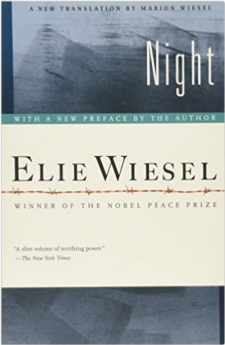
Night is Elie Wiesel’s spare and harrowing description of his and his father’s time spent in a series of concentration camps during World War II. He begins his story in 1944, where in the town of Sighet, Transylvania, the war did not seem to have touched the Jewish population. They had heard of problems in Budapest, but they knew nothing of the larger Nazi activities aimed at their people.

The first indications came from Moishe the Beadle, a man with whom Elie has been studying the Kabbalah. As a foreign Jew, Moishe was deported to a work camp. But he came back to tell everyone that all of the deportees were driven to Poland where they were forced to dig trenches and then shot. Moishe was wounded but managed to get away and returned to warn them. No one believed him, however. They naively refused to believe the Germans could behave that way. Elie and his family could have gotten a visa out of the country, even at that late date, but they stayed.

Next, all the Jews were rounded up into two ghettos, and not much longer after that, they were shipped out to Auschwitz. Once the women and girls were separated from the men and boys at the camp, Wiesel never saw his mother or sister again. He was 15 and probably only lived because an inmate told him to say he was 18.

At only 120 pages, this is a short but affecting description of his experiences in the camps. It does not dwell overly much on the horrific conditions, but we understand how terrible it was. The book also deals with Wiesel’s spiritual landscape, as he changed from a devout boy to a man who no longer believes.

This book is not a testament to human fortitude, for Wiesel makes it clear that humans under evil conditions behave badly. Instead, it is an important documentation of a black time in human history.

Related Posts

The Narrow Road to the Deep North

Unbroken: A World War II Story of Survival, Resilience, and Redemption
The Book Thief

Day 840: Juggling

Cover for JugglingI am usually a huge fan of Barbara Trapido, but I have to admit to being slightly disappointed by Juggling. I think my problem is in the depiction of its characters.

Christina is the youngest of two sisters. Her parents, Alice and Joe, decided to get married after Alice’s best friend died and Alice decided to adopt her baby, Pam. They all moved to the U.S. from England, and Christina came along seven months later.

Christina is a pushy, lippy, verbally active child, and from early on she doesn’t get along with her father. She finds him too controlling and manipulative, even though he seems to encourage her sauciness.

When Alice met Joe, she was dating Roland. Later, Roland met and married Gentille, Peter’s French mother. Although Peter gets along with Roland, the move from his quiet Paris apartment to England and boarding school is hard on Peter until he comes under the protection of Jago.

Jago is a popular boy in school, but like many popular boys, he tends to be a bully and hangs with a thuggish crowd. Still, he is good friends with Peter until adolescence, when Peter’s lack of coolness becomes too obvious.

Fatefully, Christina and her gentle sister Pam enroll at the same school as Jago and Peter. Christina is fascinated by Jago, but she and her sister are too clean cut in their American fashions for him to be bothered. Still, Jago finds himself drawn to Pam. Pam is oblivious and begins a friendship with Peter based on a mutual love of music. Then a terrible event occurs that changes everything.

This Trapido novel is all over the place, with a boy who floats in the air, another boy who is a mean bully, a Cambridge don who cheats his student by stealing her paper, reshuffling of partners into too many combinations, a woman who purposefully tries to cause problems between a woman and her daughter. And we’re supposed to like all the characters, I think.

I usually like Trapido characters despite their flaws, but in this case I didn’t. I found it hard to like Christina, who takes everything so personally that she splits from her family about something that happened to someone else, even splitting from that person, who was not at fault. I didn’t buy her antipathy to her father. In fact, if anyone is manipulative, it is she. The more likable characters, such as Peter and Pam and Alice, are neglected for the loudmouths and bullies. About the only one of the more forceful characters I liked was Dulcie, who is loud and exuberant, not a bully.

Trapido seems to have made a thing about people pairing up with the wrong partners. In this case, there are just too many of them and too many coincidences. Hence the title of the book, I suppose.

Related Posts

Sex and Stravinsky

Brother of the More Famous Jack

The Travelling Hornplayer

Day 839: Charles Dickens: A Life

Cover for Charles DickensCharles Dickens: A Life covers some of the same material as The Invisible Woman, Claire Tomalin’s excellent book about Dickens’ affair with Nelly Ternan, but it is broader in scope and provides more information about his life. Of course, The Invisible Woman was in a way ground-breaking, because it brought out into the open a relationship that was concealed for many years. In fact, the Dickens biography by Peter Ackroyd, which came out in 1991, the same year as The Invisible Woman, dismissed the affair as an improbability.

I much preferred this biography to Ackroyd’s. While Ackroyd practically falls all over himself telling us what a genius Dickens was, Tomalin is not afraid to examine the whole person, warts and all. Certainly, Dickens was charming, energetic, lots of fun for his friends, and the possessor of a serious social conscience. He was also one who ruthlessly cut ties to some friends and family, occasionally for trivial reasons; who treated his wife shamefully when he separated from her after 22 years of marriage (insisting, for example, that his children take his side and cut off ties to her); who made a young girl from a financially struggling family his mistress when he was more than twice her age. I feel that his fame was not good for him—that it gave him an inflated sense of his own importance and made him think he was infallible. Of course, he was probably the most famous person of his time. We have no modern equivalent.

Those interested in Dickens’ life and works will enjoy this biography. Dickens’ story is unique. He certainly had a difficult early life and worked hard for his success. He also started out as a much nicer person than the man he became, so during most of the book he is very likable. In fact, it’s easy to see why he was so loved by most of his friends and family. He was one of those charming people who are loved whether they deserve it or not. And in many ways, he did deserve it.

The book is extremely well written and very well researched, with more than 100 pages of notes and bibliography. Although more than 400 pages long (not counting the back matter), it moves along nicely and is entertaining. There are three insets of pictures and photos to illustrate the discussion along with a few interspersed drawings.

Just a small comment on my recurring theme of the quality of publishing. My copy of the book was bound upside down. Yes, the cover is on upside down, which I found rather disconcerting as I was always picking it up to read upside down. Unfortunately, I had it too long before opening it to return it for another copy.

Related Posts

The Invisible Woman: The Story of Charles Dickens and Nelly Ternan

Charles Dickens

Jane Austen: A Life

Fourth Anniversary! 10 Best Books of the Year!

Cover for The WakeAs on my previous blog anniversaries, here is my annual post of the 10 best books I read this year. As always, this list involves some tough choices. For example, if I read more than one terrific book by the same author during the year, I only pick one, and that choice may be fairly arbitrary.

These books aren’t listed in any particular order, just the order that I reviewed them. They can be from any genre and from any time period. There are some classics as well as new books on this year’s list. Again, unusually, this year’s list contains one nonfiction book (The Warmth of Other Suns) and one book of short stories (Family Furnishings).

Day 838: The Forgotten Room

Cover for The Forgotten RoomThe Forgotten Room is a romance novel, which is not my genre, but it has enough of a focus on family secrets to keep my interest. The novel relates the stories of three romances, set at different times in the same mansion in New York. Written by three romance authors, I suspect that each one wrote one of the stories.

In 1892, Olive Van Allen is employed in the house as a servant, but she is there under false pretenses. The owner of the house, a nouveau-riche businessman named Pratt, hired her father as an architect for the house but then ruined him by refusing to pay him. Olive hopes to find paperwork to prove Pratt owed her father money, but she is distracted by falling madly in love with one of the sons of the house, the artistic Harry Pratt, and stealing meetings with him in his attic studio.

In 1920, Lucy Young takes a job as a secretary at the office of Cromwell, Polk, and Moore, a law office that handles the affairs of the Pratt family. She also takes a room in a boarding house that used to be the Pratt mansion. In addition to the desire for advancement, Lucy hopes to discover in the Pratt papers the connection between the Pratts and her mother and perhaps learn why her mother whispered “Harry” on her death bed. Lucy is also soon torn between two men, her boss, Philip Schuyler, and a handsome art dealer from Charleston, South Carolina, John Ravenel.

In 1944, Kate Schuyler is a doctor serving in a hospital that used to be the Pratt mansion. She gives one of her patients, Captain Cooper Ravenel, her own room in the top of the hospital because the hospital is overcrowded. But she is surprised when Captain Ravenel seems to recognize her and calls her Victorine.

The pleasures in this novel came from trying to figure out how these people are related and what happens to Kate’s mother and grandmother. The tension is supposed to come from whether Kate will be parted from Captain Ravenel, who is engaged to be married to someone else. There’s not much doubt about that, though, and it’s more interesting to find out what secrets kept the other lovers apart.

link to NetgalleyUnfortunately, Olive’s story is based on something a few words could have cleared up and the spitefulness of Prunella Pratt, Harry’s sister. Lucy’s is a little more understandable. What I found unlikely was Prunella’s conversion at the end of the novel to an old lady who regrets her actions and encourages Kate to follow her heart. Yeah.

Related Posts

The Other Daughter

At the Water’s Edge

Beautiful Ruins


Day 837: Highwayman: Winter Swarm

Cover for Highwayman: Winter SwarmHighwayman: Winter Swarm is a novella-length story that appears to be an episode of a larger novel. This confused me a little until I read that the publisher, Endeavor Press, was publishing electronic novels in installments.

Samson Lyle is a former Roundhead major who is now a highwayman, doing his best to sabotage the efforts of Oliver Cromwell and particularly General Goffe. Lyle’s disaffection came about because of his refusal to participate in Goffe’s massacres of Catholics in Ireland. Lyle’s goodwife was killed in battle after this incident, and Lyle believes the death was no accident. Since then, he has been a bandit, seeking revenge.

Lyle, known as the Ironside Highwayman, is assisted by a teenage girl, Bella, whom he rescued as a young girl from prostitution, and a tavern owner, Eustace, whose live he saved. He also has various informants around the countryside.

The novella opens with a daring theft of the strongbox containing the back pay for the Middlehurst garrison. Later, Lyle attacks the salt detail, knowing Goffe cannot get through the winter without salt to preserve the meat.

This novella is mildly enjoyable as an old-fashioned swashbuckling adventure. If I understand what the publishers are doing correctly, I’m not sure how well it will work. As the first installment, the novella spent time on exposition that may have to be repeated, but it spent little time on characterization. In the tricks Lyle plays on the soldiers, it reminds me just a bit of the first book in Dorothy Dunnett’s Lymond Chronicles, but there is no way to judge whether the series will develop any depth. In general, I felt the approach to be unsatisfying, even though I like the idea of reading a novel in serial form, like the Victorians did. But this episodic approach, which probably doesn’t assume people will read the episodes in order, is not the same thing. It reminds me more of episodic graphic novels, without the pictures.

Related Posts

Viper Wine

The Candlemass Road

Captain in Calico

Day 836: My Name Is Lucy Barton

Cover for My Name Is Lucy BartonBest Book of the Week!
Lucy Barton grew up very poor in rural Illinois. She looks back to a time as a young married woman, living in New York City with her husband and two daughters and learning to write. At the time, she had not returned to her parents’ house since she went to college. Something horrible associated with her father is hinted at.

Much of Lucy’s story centers around a stay in the hospital, where for some weeks she has an undiagnosed illness. Her husband can’t bear hospitals, so he asks her mother to come. Her mother stays with her, never leaving her room and refusing to use the cot the nurses provide. During this visit, her mother tells her stories about people they both know.

For much of their lives, Lucy’s family has been outcasts. At school other children complained that they smelled funny. For many years, they lived in a garage with exposure to extreme cold and no access to running water. When she was a little girl and both her parents were at work, her older siblings at school, her parents would lock her into her father’s truck. One time a snake was in there with her. These are some of the horrors of Lucy’s childhood.

link to NetgalleyWe can see that Lucy loves other people for the slightest show of kindness. We can understand why.

My Name Is Lucy Barton is an affecting story about a woman learning to deal with her own past and loving people despite it. The novel is also about becoming a writer.

Strout’s prose is wonderful as usual, picking out the little details of life that make her prose so convincing. I delight in Strout’s depictions of ordinary life and people.

Related Posts

The Burgess Boys

Olive Kitteridge

Amy and Isabelle

Day 835: Ross Poldark

Cover for Ross PoldarkYears ago I used to enjoy the odd Winston Graham novel, but it was his crime novels rather than his historical novels I read, Marnie and The Walking Stick. I didn’t get interested in the Poldarks until the recent Masterpiece rework of the series.

Ross Poldark returns to his home in Cornwall from the war in America to find nothing as he expected. His father has died, and his slovenly servants have not kept up the house or the farm. Someone has set about a rumor that he died, and the girl he loves, Elizabeth Chynoweth, is engaged to his cousin Francis.

Ross sets about trying to put his property in order and to deal with his feelings about Elizabeth. He investigates whether he can get one of the mines on his property back into order. He also involves himself in the problems of his tenants.

While he is at a fair to buy livestock, he plucks an urchin out of a fight about a dog. Although the child is dressed as a boy, she is a girl, Demelza. When Ross finds her father has abused her, he agrees not to return her to her family and takes her as a kitchen maid.

Ross Poldark is an interesting historical novel dealing with the problems of the time in Cornwall. I don’t know much about Cornwall, which is associated in my mind with many of the novels of Daphne du Maurier. Although this novel certainly involved me, I found myself unable to separate it from the Masterpiece series. For example, although Demelza is described as dark, I still kept picturing her as a redhead. Since the Masterpiece series is based on the first two books, I’ll have to wait until the third book before I can begin to separate it in my mind. Certainly, the first novel seems just as effective as the series, which has so far followed the novel closely.

Related Posts

Castle Dor

Daphne du Maurier: The Secret Life of the Renowned Storyteller

Treasure Island