Day 892: Wild Strawberries

Cover for Wild StrawberriesThis title does not refer to the Ingmar Bergman film but to the second (or third, depending on where you look) Barsetshire novel by Angela Thirkell. Unlike the others I’ve reviewed lately, Wild Strawberries was written before World War II. It is a delightful and gentle comedy with a romantic triangle.

Wild Strawberries is about a summer with the Leslies. Lady Emily is universally adored, a vague woman always leaving a trail of her possessions behind. She is also a managing type whose attempts to arrange things that are already decided repeatedly throw the family into chaos. The novel opens with a hilarious scene in which the family is late for service and disrupts the sermon while Lady Emily tries to tell everyone where to sit. Lady Emily is the mother whose passing is much lamented in Enter Sir Robert, which I reviewed a few months ago.

And if I am not mistaken, Agnes, a daughter of the house, is the same Lady Graham who is a major character in Enter Sir Robert, and as in that novel, Robert is continually referred to but not present. Agnes is a young mother with three children, kind but silly, and entirely obsessed with the children.

Other members of the household are Mr. Leslie, gruff but kind, sons John and David, and grandson Martin. Martin is the son of the Leslies’ deceased oldest son. John is a widower who has been mourning his wife Gay. David is a charming but selfish playboy.

The Leslies have invited Mary Preston to spend the summer with them while her mother recuperates at a spa on the Continent. Mary is Agnes’s niece by marriage, and her affections play a major part in the plot. She is a young, naive girl who is immediately charmed by David. John, on the other hand, falls in love with her when he hears her singing. We find ourselves rooting for John, but in Thirkell’s novels, the characters we like best are not always successful in love.

Providing humor are a visit from Mr. Holt, a toady to the upper class and expert on gardens, who invites himself to visit the Leslies, and the establishment at the vicarage of a French family. Seventeen-year-old Martin gets himself embroiled in a demonstration to restore the French monarchy, and Mr. Holt finds himself rewarded for his gate-crashing by being entertained by Agnes and her children.

This is a delightful novel with sympathetic and engaging characters and a great deal of humor. I enjoyed it very much.

I have to say that my Moyer Bell edition (not the one pictured above) was riddled with typographical errors, including a chapter that literally ended in the middle of a word, to be completed after the next chapter title. I just picked this up at a used bookstore, but next time I buy Thirkell, I will look for a Virago edition.
Related Posts

Enter Sir Robert

Miss Bunting

Happy Returns

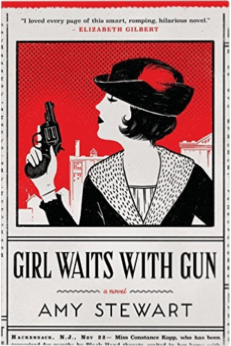
Day 891: Girl Waits with Gun

Cover to Girl Waits with GunConstance, Norma, and Fleurette Kopp are driving their carriage into Paterson, New Jersey, one day when they are broadsided by an automobile driven by a wealthy man accompanied by a bunch of thugs. The men try to drive away but are stopped by the townspeople. The man turns out to be Henry Kaufman of Kaufman Silk Dying Company.

When Constance tries to collect $50 from him for repairs to their buggy, she and her family find themselves the victims of harassment. They receive threatening letters, bricks are thrown through the windows of their farmhouse at night, and men invade their property. Constance’s trip to the police gets no help from the prosecutor’s office, but Sheriff Heath teaches Constance and Norma how to shoot and sends deputies out to patrol the house.

The threats don’t stop, though. Instead, the attacks escalate and the women receive kidnapping threats against Fleurette, who is only 16.

In the meantime, Constance has met Lucy, a young dyer, who says she had a child by Kaufman. She said she sent the baby away with other children during a recent strike, and he is the only one who didn’t come back. She is sure Kaufman kidnapped him.

This novel is fun, exciting, and well written, with interesting characters, placed during a period when there was a lot of labor unrest in the Northeast. Constance is an engaging heroine. Although the plot involving Lucy is made up, the rest is based on a true case of the time, taken from newspaper articles from 1914. This novel makes truly enjoyable reading.

Related Posts

Empire Girls

Birds of a Feather

Dandy Gilver and a Bothersome Number of Corpses

Day 890: Charlotte and Emily

Cover for Charlotte and EmilyI have read two of Jude Morgan’s literary biographical novels but never felt I was really seeing the true character of the subjects. However, with Charlotte and Emily, Morgan seems to have found his subject.

Charlotte and Emily covers most of the Brontës’ lives, from the time they were children until Charlotte marries Arthur Bell Nicholls. By that time, all the other Brontë siblings have died.

Charlotte is the main character of the novel, although it is occasionally told from the point of view of Anne. Emily remains distant from the reader, harder to know.

Much of the novel is concerned with the focus of the entire family on the future of brilliant Branwell, the only son. The girls are sent for schooling so that they can be teachers and earn money to help educate Branwell. Although Charlotte wonders if she can become a writer and even tries sending poetry to Southey, the poet laureate, she is discouraged by both Southey and her father.

Of course, Branwell never finds a vocation and instead becomes a wastrel. Charlotte and Anne work doggedly as teachers, although they hate it. Emily gets herself sent home both from school and work.

I have read biographies of the Brontës, but this novel is the first I’ve read that gave me a sense of what their lives may have been like. I found it completely absorbing. If you are a Brontë lover, this is a book for you.

Related Posts

Passion

The Secret Life of William Shakespeare

Indiscretion

Day 889: An Inquiry into Love and Death

Cover for An Inquiry into Love and DeathFor light reading with a supernatural twist, I’m developing an affection for the novels of Simone St. James. Her romantic suspense novels are set in post-World War I England and feature spunky heroines who get embroiled in mystery, always with a supernatural element.

Jillian Leigh is an Oxford student in one of the few colleges for women. She is summoned away from her studies with news that her Uncle Toby has died. Her parents expect her to take care of his affairs, saying that her father is unable to leave his work in Paris.

Jillian hasn’t actually seen her uncle since her parents broke with him when she was 14, for reasons she does not know. The one thing she knows about him is embarrassing, that he worked as a ghost hunter. Other than that, she remembers him as a shy, quiet person who was kind to her.

She is appalled, however, to find she is expected to identify his body. He was staying in the seaside village of Rothewell, thought to be haunted by the ghost of a smuggler, when early one morning he fell off a cliff.

Jillian stays in the house where Toby lived, an isolated cottage nearest the activities of the purported ghost. Almost immediately, odd things begin happening. She finds things in odd places, a book in  the stove, for example. At night she hears what she thinks is a tree scratching her window, but in the daytime she sees there is no tree anywhere near it. Then Scotland Yard Inspector Drew Merriken arrives and tells her that Toby may have been murdered.

After reading a few of St. James’s novels, I have no doubt there will be a romance with the inspector, but her combination of ghost story and mystery is truly suspenseful. I found this to be another enjoyable romantic suspense novel.

Related Posts

The Haunting of Maddy Clare

The Other Side of Midnight

The Winter People

Day 888: Tinkers

Cover for TinkersGeorge Crosby lies dying. He is an old man who retired and then became a clock repairman for 30 years. As he dies, he remembers the life of his father, who was a tinker—a traveling salesman of household items in the rural wilds of Maine—and an epileptic. In a way, of course, George also tinkers, with clocks.

This novel’s writing is truly astounding. Harding has a way of examining ideas and objects down to the bone. At other times, musings seem almost hallucinogenic. I wasn’t sure I understood the point of view, though. If all of the novel is from the point of view of George, as most reviews of the book seem to imply, how does he know what happened to Howard, his father—or is he imagining a life for his father?

To me, the novel seems to be about both men, in particular, about the circumstances that led to George being raised without his father. In the hard primitive life of backwoods Maine, George’s mother is resentful and cold. It is his father who is more considering and thoughtful, but a poor provider who might stop to weave pallets of grass instead of selling his goods. After a particularly bad epileptic attack, the only one witnessed by the Crosby children, George’s mother decides to have their father committed.

This novel was difficult for me to read, because I was so interested in some aspects of the plot that I glanced over some of the gorgeous prose or couldn’t concentrate on it (not my usual approach). The prose is the point of this book, however, and the meditations it evokes.

I believe this book is related to another book that also bought. I can’t remember if it is the sequel to the other book, or the other book is a sequel to it. I’ll be interested to see if reading both books enlightens me more.

Related Posts

The Quickening Maze

Mrs. Dalloway

Olive Kitteridge

Day 887: Fair Helen

Cover for Fair HelenBest Book of the Week!
I was completely entranced by Fair Helen from the first moments of reading it. It’s based on a 16th century ballad, “Fair Helen of Kirkconnel Lea.” Since one of my interests (although sadly not pursued for years) is early ballads of Great Britain, Ireland, and Appalachia, this is a good fit for me.

Harry Langdon is a city man, a scrivener from Edinburgh, the son of a craftsman, so the Borderlands seem wild to him when he answers the summons of his good friend Adam Fleming. Adam feels he needs his friend’s support. He fears his stepfather, his father’s brother, might be trying to kill him. And Harry is surprised to find Adam’s stepfather in the role of Heidsman instead of Adam after the recent death of Adam’s father. (If this sounds familiar, it’s supposed to.)

But Adam is more concerned about the disposition of his love affair. He has fallen madly in love with Helen Irvine, a beautiful and vivacious girl. But the Irvines and the Flemings have been feuding for years. (If this sounds familiar in a different way, it’s supposed to.) Helen’s parents want her to marry Robert Bell, a man with more prospects than a member of an unmade family.

We know from the beginning of the novel that none of this will end well, for we have the text of the ballad before us. And Harry in his old age is telling this story of the most important event in his life and the two people he loved most. For Helen is his cousin, and the two of them were very close as children.

The situation is complicated by the politics of the Borderlands. Harry finds himself summoned by Walter Scott of Buccleuch, a lord who frankly terrifies him (a very different Wat Scott of Buccleuch than the one depicted by Dorothy Dunnet), and is forced to spy on his friends. It becomes clear to him that there have been attempts at murder, if not of Adam, but who is behind them and why?

The novel is written in a mix of Scots and English, with a glossary provided. It is a strong style that goes well with its subject matter. At first, I was thrown off by the footnotes, which are all in the wrong places. I didn’t realize what was going on and thought they were simply non sequiturs. When I figured it out, I spent a lot of time flipping pages, trying to match them up. I honestly wasn’t sure if it was a printing error until I ran across the following passage:

I had aimed to set down plainly only what I witnessed concerning the events at Kirkconnel, to correct the folk haivers and bring some understanding. Yet already I find footnotes, asides and addenda have begun to run wild down the margins and among the lines. I like to think of them as bright wildflowers that border and run through the acres of turnip and kale by which we feed ourselves.

So, Greig is having some fun with us and in more ways than one, although this is in general not a light-hearted novel. It is lovely, though, full of yearning and regret, with a backbone of history for those who are interested.

In my recurring theme of quality printing, I have to say that this is the first modern book with properly bound signatures that I’ve seen in a long while, as opposed to the signatures being hacked off and glued. That’s great, and it means my book will stay together longer. However, the end papers were pasted down carelessly. They have creases, and some of the pages of the book stick out beyond the cover. So, Quercus Books, one big step forward and a few small ones back.

Related Posts

The Candlemass Road

The Disorderly Knights

Turn of the Tide

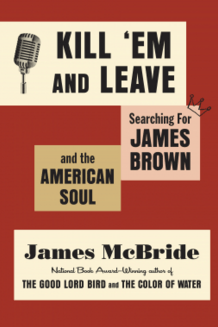
Day 886: Kill ‘Em and Leave: Searching for James Brown and the American Soul

Cover for Kill 'Em and LeaveKill ‘Em and Leave is a difficult book to categorize—part biography, part music history, but what it most closely resembles in writing style and approach is a series of magazine articles on the subject of James Brown and his legacy. That is not meant as a criticism, and the book is written with energy and flair.

I do not know a lot about James Brown, and my general sense of his life may incorporate some of the information that McBride would be quick to point out as lies or exaggeration. But McBride is not setting out to whitewash, just to find the truth.

And the truth is hard to find. McBride tells us that Brown was secretive, not just about money and the details of his private life but about his real self. McBride is only able to find out fragments of the truth about Brown, because Brown let people make things up about him and was more interested in creating his own legend than in revealing himself. So, McBride pursues his subject by visiting the places where he lived and talking to old friends and employees.

McBride doesn’t want to focus on the drugs and the mistreatment of women and the scandal. He wants to explore Brown’s legacy to American music and to the people in his life, good and bad. The shocking handling of his estate, which was left in trust for the education of poor children and is being ransacked by a series of lawyers, is also a focus. The damage the suits have done to the reputations of the original trustees, including the imprisonment of his honest and innocent accountant, David Cannon, is a sin. But McBride makes clear that Brown was a bad employer, erratic, distrusting, tight, and more people than Cannon have taken a fall for him. And not one poor child has received a cent of his money.

link to NetgalleyThis is a fragmentary but fascinating portrait of a complex man. If you are interested in the issues of African-American life, the history of American music, the issues of legacy, corruption in the music business or in South Carolina politics, or simply in a well-told story—any of these will assure your enjoyment of this book.

Related Posts

The Good Lord Bird

I Know Why the Caged Bird Sings

The Black Count: Glory, Revolution, Betrayal, and the Real Count of Monte Cristo


Day 885: The Last Summer of the Camperdowns

Cover for The Last Summer of the CamperdownsHi, all, I just wanted to tell you before I get started that I began a new project, attempting to read all of the Man Booker Prize shortlisted books since 2010. See my new Man Booker Prize Project page for more information, and join me if you want to.

* * *

The Last Summer of the Camperdowns is one of those books that I made a note I’d like to read some time ago, but by the time I got to it, could not remember what it was about. When that happens, I don’t read the cover. I just plunge in. I was surprised to find myself reading a sort of modern gothic novel.

Riddle Camperdown is a 12-year-old girl spending the summer at her family’s dune-side house on Cape Cod in 1972. Her name says a lot about the eccentricity of her family, for she is named after Jimmy Riddle Hoffa (yes, that one), and her father sometimes calls her Jimmy. “Camp” Camperdown is a labor organizer, composer, and politician, a noisy brash, boisterous, charismatic true believer. His wife, Greer, seems a mismatch for him. She is a cool, chic ex-movie star with an acid tongue. Riddle, who adores her father, thinks her mother only cares about money and status.

Another of the couple’s regular arguments starts up when they learn Michael Devlin is returning to the area. Michael is a rich, privileged man who used to be Camp’s best friend, but an incident during World War II drove them apart. Riddle is also fascinated to learn that Michael was engaged to Greer and stood her up at the altar.

Riddle and Greer are avid riders, so when that afternoon they go over to see Greer’s friend Gin, Riddle wanders off to the yellow barn to see a mare with a foal. When she is in the barn, something horrible happens, something she doesn’t see but only hears. She thinks she hears someone or something being chased through the barn and then dragged back to the tack room. She is terrified, but just as she is getting the nerve to open the tack room door, Gin’s employee Gula comes out.

Riddle is already terrified of Gula, so she pretends she hasn’t heard anything. Inexplicably, though, she is too terrified to tell her parents.

Soon, they learn that Michael Devlin’s youngest son Charlie has disappeared. It doesn’t take long for Riddle to guess it was Charlie she heard in the barn. That night, the barn burns down with several horses in it.

As Riddle is repeatedly terrorized by Gula, her parents’ marriage seems more and more fraught. Michael Devlin begins threatening Camp’s political campaign with a tell-all book, and Camp fears what he sees as his wife’s attachment to Devlin. In the meantime, Riddle falls in love with Michael Devlin’s oldest son, Harry.

This novel is quite suspenseful, with a plot that is far more complex than it first seems. If there were two small things I didn’t quite buy, one was the extremeness of the Camperdowns’ arguments at first. The other was how long it took Riddle to tell the truth, considering how Gula was threatening her, even going into her room and leaving things. Although ultimately Riddle was also hiding the fact that she hadn’t told the truth right away, I would think she would be too scared not to tell.

Related Posts

The Little Friend

Once Upon a River

Swamplandia!