Day 1111: The Gustav Sonata

Cover for The Gustav SonataUntil the very end of The Gustav Sonata I wondered what its point was. It is a novel detached from its characters even as it puts them through events that should make us sympathetic. Further, although it is set in a specific time and place, there is little feel for what it was like then and there. This effect is in strong contrast to Tremain’s two novels about Merivel, set in Restoration England.

The novel begins in 1947, when its main character, Gustav Perle, is five years old. Although Gustav is Rose Tremain’s exact contemporary, parts of the novel are set earlier, before Gustav was born.

Gustav’s father died when he was a baby. He was a member of the police force for their small town in Switzerland, but he lost his job before Gustav was born, under circumstances that Gustav’s mother does not fully understand. All she knows is that Erich died “helping the Jews.”

Gustav’s mother Emilie has raised him without a shred of affection but only with criticism. The lack of affection is tempered somewhat by his lifelong friendship with Anton, whom he meets the first day of Kindergarten. Emilie does not like Gustav’s friendship with Anton, because Anton is Jewish. But Anton and Anton’s family are all Gustav has, really.

Anton is always a self-absorbed person. He is nervous and highly strung, a musical prodigy. Anton’s mother thinks he will become a famous musician, but he is terrified in competition and performs badly.

An important theme in this novel is Swiss neutrality and its correspondence with personal neutrality. Gustav, although faithful to his friends, is always concerned with self-mastery and holds back from his own life events. But so does this novel hold back from its characters, as if observing them through a glass.

I found this novel interesting but not involving. I think it took too long to get to its point. It is another novel for my Walter Scott prize project.

Related Posts

Merivel: A Man of His Time

The Glass Room

A View of the Harbor

Day 1110: Margaret of Anjou

Cover for Margaret of AnjouMargaret of Anjou, the second book of Conn Iggulden’s Wars of the Roses series, begins in 1454 with an ambush. Angry at the lands that have been going to the Nevilles, York’s allies, Henry Percy, Earl of Northumberland, attacks a Neville wedding party on its way home from the wedding. York has been acting as Protector and Defender of the Realm while King Henry VI is suffering from mental illness. Although York has ruled well, he has favored his own allies over the friends of the King, even to murdering or imprisoning some, and has earned the enmity of the Queen, Margaret of Anjou.

But the tide is about to turn. Henry awakes from his stupor, amazed to find that Margaret has borne him an heir. He immediately dismisses York and Salisbury, Richard Neville, from his court. Soon after, he and his allies ride out to bring them to heel, starting the battles of the Wars of the Roses.

While the Yorkists reluctantly turn to treason, this book seems a little more balanced than the first between the two sides. Salisbury and York clearly have their reasons for resentment of the king’s favorites, and it is true that Henry is not an effective ruler. Still, no one hesitates in plunging the country into years of uproar and instability.

Margaret of Anjou

Like the first novel, this one switches point of view between the main characters, including Derry Brewer, the king’s spymaster, who is one of the few fictional characters. This technique allows us to understand the various positions, for some are self-righteously explaining away their own treachery. York is presented as a tragic character, while Margaret, who has often been reviled in history, is treated sympathetically. After her husband sinks back into his stupor, she does everything she can to protect her son.

I am continuing to enjoy this series, which, although it simplifies the many conflicts of this time, brings clarity to the main figures and events.

Related Posts

Stormbird

The Wars of the Roses

Henry VI, Part I

Day 1109: The Sussex Downs Murder

Cover for The Sussex Downs MurderJohn Rother sets off from Chalklands Farm for a holiday, but later his car is discovered not far from home. There is evidence of a struggle, and his bloody cap is found next to the car. But has John been kidnapped, attacked? There is no way to know.

Superintendent Meredith can’t help suspecting that John’s brother, William, had something to do with John’s disappearance. The two brothers co-own the farm and a lime-burning concern on the property, and rumor has it that John was flirting with William’s wife, Janet. But Meredith can’t prove John has been harmed.

Then one of the Rothers’ lime customers reports finding a bone in the lime. The bone is found to be a human tibia. When Meredith’s men go through the lime shipped since the murder, they find more bones. Moreover, Janet was spotted taking a package out to the lime kilns.

From the minimal information they start with, the police begin to collect more, but it doesn’t make sense. A strange man is seen fleeing the area where John’s car was found. Was he an accomplice? A bogus message lured William out on the night of his disappearance. Still, it looks like William murdered his brother, and Meredith is about to arrest him when he is found dead, an apparent suicide.

This mystery is fairly complicated, but I had an inkling of what was going on almost from the beginning and never changed my mind. I turned out to be right. As with the other Bude mysteries, the emphasis is on the puzzle. The characters, except for Meredith, are cyphers.

Related Posts

The Cornish Coast Murder

Death on the Riviera

The Lake District Murder

Day 1108: His Bloody Project

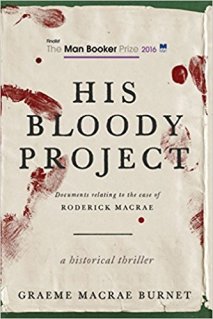
Cover for His Bloody ProjectI was actually reading another novel on my iPad when I picked up His Bloody Project because my iPad needed charging. I was so riveted by it that I couldn’t go back to the other novel until I finished this one.

In 1869 Scotland, 17-year-old Roddy Macrae is in jail awaiting trial for the murders of three people. Roddy has admitted the murders and is ready to take his punishment, which in this time means hanging. His advocate, Mr. Sinclair, thinks there are mitigating circumstances and asks him to write his account of the crimes.

The entire novel is made up of documents—first, Roddy’s account, then the medical reports of the victims and psychiatric evaluations, finally the account of the trial and what happened afterward. Although there is no doubt who committed the murders and little doubt of the outcome of the trial, Burnet manages to conjure up a great deal of sympathy for Roddy and a terrific amount of suspense.

Not only does Burnet create a complex psychological depiction of Roddy, he also deftly depicts the life of highland crofters in the mid-19th century. The novel deals with such issues as class discrimination, the inequities in the lives of crofters and their domination by the landlords, the limitations of our system of justice, and the beliefs held in the infancy of psychiatry. These observations make the novel sound heavy, but it is eminently readable. This is one of the books I read for my Booker Prize project, and I’m really glad I did.

Related Posts

Corrag

Burial Rights

Alias Grace

Day 1107: Conclave

Cover for ConclaveThe only book I’ve ever read featuring a papal conclave (except one of Maurice Druon’s Accursed Kings series books, which has one as a subplot) was Dan Brown’s Angels and Demons. That novel featured a series of bizarre murders. Robert Harris is skilled enough to generate the same level of suspense through secrets and activities that are much more likely.

As Dean of the College of Cardinals, it is Cardinal Lomeli’s job to conduct the conclave after the death of the Pope. Not only is Lomeli sincerely grieved at the Pope’s death, but he is also dedicated to doing his job well. He thinks the front-runners for the office will be Cardinal Tremblay, the Canadian Camerlengo; Cardinal Bellini, the Secretary of State; Adeyemi, the African Cardinal Major Penitentiary; and Cardinal Tedesco, the Patriarch of Venice.

Just before the cardinals are sequestered, a new cardinal appears, Vincent Benítez, newly appointed Archbishop of Baghdad. No one knows about the new appointment, but his credentials seem to be in order, and his appointment was kept secret because of the vulnerability of a Catholic cardinal in Iraq.

Another problem Archbishop Wozniak reports is that Cardinal Tremblay met with the late Pope just before the Pope died. Cardinal Wozniak tells Cardinal Lomeli the Pope confided to him that he had asked Cardinal Tremblay to resign from all his offices. Tremblay denies that this conversation took place and implies that the Pope was becoming unstable.

The suspense mounts as each vote fails to choose a candidate and secrets are revealed. Lomeli is dismayed to find himself becoming a viable candidate as others fall out of the running. He also finds indications that the late Pope was putting things in motion, months before his death, to affect the election.

Again, Harris has written a suspenseful and deeply interesting novel. The characters seem convincing—Cardinal Lomeli is extremely likable and all demonstrate human foibles without being caricatures. The ending is somewhat unbelievable, and although it is not really predictable, I was able to guess at something similar. That is a small caveat, though. All in all, Robert Harris is rapidly becoming one of my favorite genre writers.

Related Posts

An Officer and a Spy

Conspirata

The Strangled Queen

Day 1106: Unnatural Habits

Cover for Unnatural HabitsPhryne Fisher meets Polly Kettle, a journalist on the track of a story about pregnant women disappearing from the Abbotsford convent, where they work in the Magdalene laundry. Phryne thinks that Polly is too naive and foolhardy and that she will soon run into trouble. And she is right—almost immediately, Polly disappears.

When Phryne looks into it, she learns that several girls have disappeared from the laundry. She also hears that a shady employment agency is offering actresses parts overseas and that her friend, Doctor MacMillan, has been asked to verify the virginity of a surprising number of young women lately. Could a white slavery ring be practicing in Melbourne? But why would they want pregnant women?

link to NetgalleyI am finding with Greenwood that things that appear to be related usually aren’t. As with the other Phryne Fisher novels I’ve read, there is more than one criminal involved, which I feel is a cheat.

Also, Phryne is beginning to seem a bit cartoonish to me as she battles evil and sexism. For light reading, these novels are enjoyable, but I think I have read enough of them.

Related Posts

Raisins and Almonds

Murder in the Dark

Lady Cop Makes Trouble

Six in Six

Six in Six logoI wasn’t aware of the Six in Six meme until this year, but it sounded like something fun to participate in for July. I read about it on She Reads Novels, but it is hosted by The Book Jotter. The idea is to pick six categories under which you list six books you have read during the first six months of the year and post these lists any time in July. If you would like to participate, too, you can see a fuller description with suggestions of categories on The Book Jotter’s post. Here are my categories and books. I don’t have all of my reviews posted, but I’ll try to remember to add the links to this page as I post them.

Six Tales of Peril

Six Delightful Classics

Six Classic Murder Mysteries

Six That Disappointed

Six Historical Novels

Six Different Countries

  • The Trespasser by Tana French (Ireland)
  • The Shadow Land by Elizabeth Kostova (Bulgaria)
  • Pure by Andrew Miller (France)
  • Number9Dream by David Mitchell (Japan)
  • A Gentleman in Moscow by Amor Towles (Russia)
  • The Gustav Sonata by Rose Tremain (Switzerland)

Day 1105: Fludd

Cover for FluddAll of Hilary Mantel’s writing has some sort of edge, but I’m beginning to feel that I enjoy more her work that isn’t quite as satirical, her historical fiction, for example, as opposed to some of her earlier, blacker works. Fludd was written in 1989 and fits firmly into the latter category.

Mantel’s note states that she depicts a 1950’s-ish Catholic church that never existed, but having read her memoir, I would venture to say that there are seeds of her childhood both in the setting and in her depiction of the church.

Father Angwin is a well-meaning, old-fashioned sort of priest working in an ugly church stuffed with statues of saints in a dismal working-class town called Fetherhoughton. He has long ago lost his faith, but he is struggling along as best he can. The bishop, whom he calls His Corpulence, wants him to make the church more “relevant:” modernize the service and get rid of the saints. He also says he is sending Father Angwin a curate.

Although Father Angwin thinks the people need the saints, he reluctantly buries them in the church yard. Shortly thereafter, a man appears at the door of the presbytery whom everyone assumes is the curate. People find themselves confiding their innermost secrets to him. He never seems to eat, but his food disappears. No one can recall his face when he’s not there.

Sister Philomena is a young Irish nun in the convent. She was evicted from her Irish convent because her mother claimed her skin rash was stigmata, and she went along with it. Her days are tormented by Mother Perpetua, the terror of the convent. She also finds herself confiding in Fludd.

But who is Fludd? Is he the curate, a demon, an angel? In any case, he’s an agent for change.

I don’t think I understand Catholicism, or indeed any religion, well enough to grasp the theological issues or even everything Mantel is poking fun at. I think this novel would be a much more pointed weapon if read by a lapsed Catholic. Mantel claims to have seen a demon, and demons lurk throughout her work. This is a funny but peculiar one.

Related Posts

Giving Up the Ghost

Beyond Black

The Assassination of Margaret Thatcher