Review 1426: The Wardrobe Mistress

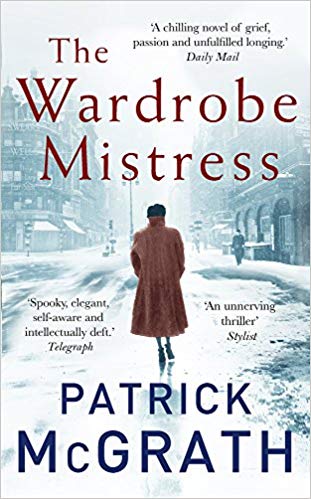
In post-World War II London during a cold winter, the famous actor Charlie Grice, called Gricey, has died. His widow, Joan, a wardrobe mistress, is bereft. When a young actor, Daniel Francis, takes over Gricey’s role as Malvolio and plays it exactly the same, Joan comes to believe that he has become Gricey.

As Joan is beginning to befriend Daniel Francis, or Frank Stone, his real name, she makes a horrible discovery about Gricey. Behind the lapel of one of his coats she finds a badge, the emblem of Britain’s fascist party. This is doubly horrible because Joan is Jewish. Asking around discreetly, she finds what everyone else knows—Gricey was indeed a fascist.

The stress on Joan becomes even worse as her friend Frank begins working with her daughter Vera on The Duchess of Malfi. Vera’s husband and his friend Gustl ask her to help them fight the fascists by infiltrating them.

This novel is written from an omniscient viewpoint with a first person plural accompaniment by the ladies of the chorus. This technique lends it a certain ironic tone. It’s a creepy and atmospheric novel that chills to the bone.

I read this novel for my Walter Scott Prize project.

Related Posts

Munich

Midnight in Europe

The Spoilt City

Review 1425: High Wages

Jane Carter is a young girl hoping to get a job in Tidsley so she can move out of her stepmother’s house. While her father was alive, she was educated and cherished, but since the age of 15, she’s only been tolerated in her home. In front of Chadwick’s shop, she sees a sign posted for a shop girl. This would be a good opportunity for her, because Chadwick’s is the best draper in Tidsley. And, as she is of genteel appearance, she is hired.

She is excited to get the job, although she slowly realizes its problems. The room above the shop where she must live is not very nice, but it seems fine to her, and her roommate, Maggie, is friendly. However, Mrs. Chadwick skimps on the girls’ food, and Mr. Chadwick sometimes cheats her out of her commission, taking it for himself. Worse, though, is his caution at change in the shop. Jane finds she is good at her job and has ideas that will make money, but Chadwick often won’t let her try them.

A difficulty she isn’t aware of, as Maggie and her young man, Wilfred, invite her out with them every Sunday, is that Wilfred is falling in love with her. She, herself, is attracted by a young man named Noel Yarde, but he is above her in class. Then, lives change as World War I begins.

This novel has an appealing heroine, naïve yet practical, and not to be beaten down. Its realistic portrait of the times, particularly as they change over a period of about eight years, is interesting. The flavor of the northern town, with its grimness and social barriers, is interesting, too. As usual with Whipple,, I enjoyed this novel very much.

Related Posts

They Were Sisters

Because of the Lockwoods

Greenbanks

Review 1424: Little

Best of Ten!
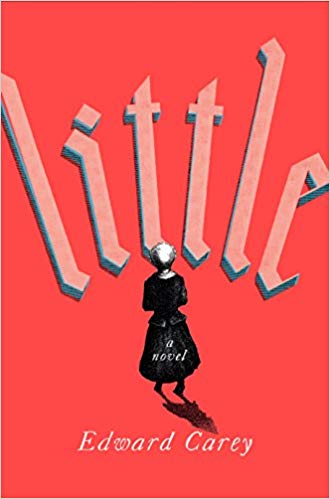
Often I don’t read reviews attentively or more often I don’t remind myself what a book is about before reading it, so I didn’t realize for some time that Little is a fictional biography of Madame Tussaud. It is an idiosyncratic one, to be sure.

Marie, often called Little for her small stature, is familiar with loss. In 1760, when she is five, her father dies. Her mother never recovers from it, and shortly after she and her mother take up residence with Doctor Curtius, for whom her mother is employed as a servant, her mother commits suicide.

Doctor Curtius is one of many peculiar characters, Marie not excepted, who occupy the novel’s pages. He is a very odd creature, unused to others, who models body parts in wax to be studied by anatomists. Marie is not dismayed by his peculiarities and is entranced by his wonderful collection of body parts. So, he begins teaching her to draw and model objects in wax.

At Little’s suggestion, they model the entire head of some subjects. Soon, they have a business of selling heads of themselves to customers. Dr. Curtius is mistreated by the hospital, so when a traveling Frenchman, Louis-Sébastian Mercier, suggests they move to Paris from Switzerland to model great men, they do.

Shortly after they arrive in Paris, Doctor Curtius falls under the influence of their landlady, the Widow Picot, who soon has Little working for the entire family, not just Doctor Curtius, even though Little has never been paid. Madame Picot makes no secret that she would like to get rid of her. In the meantime, she and Doctor Curtius begin by modelling the heads of famous criminals. By now, the French Revolution threatens.

Little is narrated in a sprightly, whimsical fashion even when it relates things that are not so pleasant. That, and the pervading personality of its main character, are two of its charms, even as it becomes darker. This is a strange and wonderful novel.

Related Posts

The Fountain of St. James Court or, Portrait of the Artist as an Old Woman

Birdcage Walk

A Tale of Two Cities

Review 1423: Literary Wives! The Home-Maker

Today is another review for the Literary Wives blogging club, in which we discuss the depiction of wives in fiction. If you have read the book, please participate by leaving comments on any of our blogs. Be sure to read the reviews and comments of the other wives!

Eva of Paperback Princess
Lynn of Smoke and Mirrors
Naomi of Consumed By Ink

* * *

The Home-Maker is a reread for me, so let me just provide a link to my original review and then discuss our regular question.

What does this book say about wives or about the experience of being a wife?

Evangeline Knapp is a perfect example of a woman, like my mother, who was not suited to be a housewife, a kind of person not recognized in her time. Unlike my mother, who at home was the female equivalent of Lester Knapp at work, Evangeline compensates by becoming overzealous and overparticular in her housekeeping, making the immaculate home a miserable place for everyone, including herself.

In this ground-breaking work of 1924, the couple are forced to switch places, and Evangeline finds her place in life. At work in a department store, her efficiency and energy are appreciated, and because she enjoys the work, she loses her resentment. The Knapps change from a dysfunctional family to one that is much happier, because everyone is happy in his or her role. In  fact, to keep this happy solution in this chauvinist time, they have to come up with a rather shocking solution. The Knapps develop a true partnership in their marriage.

Literary Wives logoI like this novel because instead of depicting a family in stasis, it presents a problem that probably wasn’t much recognized in its time and shows how the family relationships improve as a result of its solution. The marriage evolves from a somewhat unhappy one to a happy one, and everyone is fulfilled. Lester understands Evangeline’s need for meaningful work, and he enjoys taking her position in the household, albeit not providing an immaculate household but a loving, slightly messy one. Evangeline’s sharp temper subsides.

In her way, Evangeline is a little more exaggerated version of Brenda in Happenstance, who began to have periods of anger before she took up quilting.

Related Posts

Happenstance

A Lady and Her Husband

The Awakening