
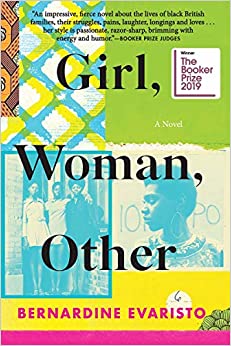
Readers who prefer traditional narrative styles beware—there are hardly any periods in Girl, Woman, Other. Although I often enjoy more experimental novels, this bothered me at first, because it forces Evaristo to start a new paragraph almost every sentence, if you can call them sentences—many are more like lists. After a while, I got used to it.
Girl, Woman, Other is about the lives of British black women, twelve women who each has her own chapter. The plot, which is minimal, centers around a play about black female warriors named The Last Amazon of Dahomey, written and produced by Amma, a radical feminist gay woman. The novel is divided into four parts, each devoted to the lives of three women who have some type of relationship to each other. But there are more relationships within the book, some of them surprising.
The novel is fresh, the stories interesting, many of the characters justifiably angry. I wasn’t sure how much I liked it, though, until the Epilogue, which was touching.
All-in-all, Booker prize winner or not, I would call this novel of linked stories a semi-successful experiment in form and writing style. It is at times a little didactic through characters’ speeches, but it does tell some powerful stories about the experiences of black women, women’s sexuality, women in general.

 What? Me Read?
I loved this, I steered away from it for a while because I thought it was in actual poetry but then discovered it wasn’t and was OK with the style.
I had to get used to it a little, but I did.