Review 1721: Winter and Rough Weather

According to the Foreword of Winter and Rough Weather, it is related to two other books by D. E. Stevenson, Vittoria Cottage and Music in the Hills. It has been a long time since I read Vittoria Cottage, and none of the characters in Winter and Rough Weather rang a bell. I finally had to look up my old review to find the link between the two is James, who is a minor character in this novel.

Jock and Mamie Johnstone are preparing for the arrival of their nephew, James Dering Johnstone, and his bride Rhoda. James and Rhoda will be occupying Boscath, the farm adjoining the Johnstone’s Mureth, except separated by a river that can at times be raging.

Rhoda has abandoned a promising career as an artist to marry James and at first finds herself unhappy in their remote farm that doesn’t have a telephone and can be cut off by weather. After a while, though, she makes friends in the area and begins painting again and teaching a promising youngster named Duggie, who is the son of Lizzie, the Mureth cook.

This novel has a firm sense of place in the border country of southern Scotland and has a host of mostly likable characters. It is about everyday post-war life there, although it has a few subplots—Adam and Nan Forrester, the village doctor and his sister, both have unhappy love affairs. The neighboring farm to Mureth, Tassieknowe, has been bought by a rich man whom everyone dislikes and who is running his farm poorly.

I enjoyed this novel and mean to look for the other one, Music in the Hills, which I believe comes before this one.

I received this book from the publishers in exchange for a free and fair review.

Vittoria Cottage

The Baker’s Daughter

Mrs. Tim Gets a Job

Review 1720: Lyndon Johnson and the American Dream

As a young adult in the late 60’s and 70’s, I did not have a high opinion of Lyndon Johnson. Although I was not political, like many people, I was against the Vietnam War. It wasn’t until I lived in Texas that I saw another side to Johnson, who was revered for, among other things, bringing electricity to rural Texas to ease the work of women.

Doris Kearns Goodwin worked in the White House in the late 60’s, and when Johnson asked her to help him write his memoirs, she declined because she also was against the war. However, Johnson was a master of persuasion, and she finally agreed. The memoir never got written, but Goodwin had unprecedented access to Johnson because of it and eventually used her notes to write this biography.

Goodwin is obviously interested in the pursuit and use of power, and Johnson is a perfect subject for that interest. She depicts a man who did not pursue power for itself but for the good he could do with it. I failed to mark them in the text, but many of his comments about the presidency and the use of power contrast starkly with the thinking of our last regime, which was fizzling out as I read this book.

Goodwin paints a picture of a complex man, brilliant but at times crude, organized, manipulative, a consummate negotiator, but a man with good intentions. It’s a pity that the war overshadowed and overwhelmed the other accomplishments of his presidency. Because of it, we forget that he put into process programs to help the needy and people of color. Medicare and the Voting Rights Act are down to him as well as other programs that were not handled as well because of his preoccupation with the war or that were gutted by Richard Nixon.

I did get a little bogged down in the chapter about the war, and it being a different time, today’s readers may have problems with how Johnson and others refer to minority groups. Still, I found this book really insightful and interesting, as it explores the reasons for some of his controversial decisions.

Related Posts

The Bully Pulpit: Theodore Roosevelt, William Howard Taft, and the Golden Age of Journalism

No Ordinary Time: Franklin & Eleanor Roosevelt: The Home Front in World War II

JFK: Coming of Age in the American Century: 1917-1956

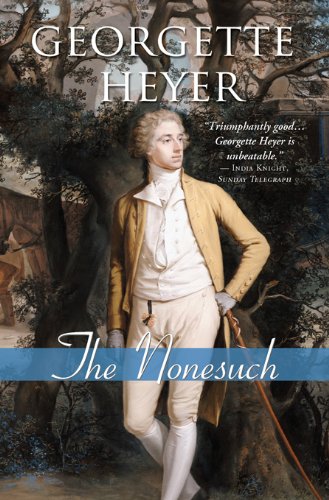
Review 1719: The Nonesuch

Often when I am in the middle of some hefty nonfiction book, I take a break by reading some sort of light fiction. I was reading a biography of Lyndon Johnson when I thought I hadn’t read any Georgette Heyer lately, so I picked The Nonesuch out of my library.

The inhabitants of the village of Oversett are all interested when they hear that Sir Waldo Hawkridge, known as the Nonesuch, has inherited Broom Hall from the miserly Joseph Calver and will be arriving to look it over. The young men are excited to see this notable whip. Up at Staples, kindly Mrs. Underhill is dismayed to learn that Sir Waldo has arrived with a lord, his young cousin Lord Lindeth, for her unprincipled but beautiful ward, Tiffany Wield, has announced that she means to marry into the nobility. Tiffany’s governess/companion, Ancilla Trent, remarks with her customary humor and calmness that they will just have to convince Tiffany she is wasted on anyone under a Marquess.

Lord Lindeth meets Tiffany after she carefully arranges an encounter while he is out fishing. When Waldo sees her and her affect on Lindeth, he is dismayed. However, he is much struck by Ancilla. It is Ancilla who does not have a high opinion of Corinthians, the set to which Waldo belongs.

As usual with Heyer, this novel is full of likeable characters, humor, and an engaging hero and heroine. I tend to like Heyer’s sillier plots best, because they are so funny. This is not one of them, but I enjoyed it very much just the same. A perfect Covid-era lightener. (I re-read it last January.)

Related Posts

The Convenient Marriage

Sprig Muslin

Cotillion

Review 1718: Literary Wives! The Amateur Marriage

Today is another review for the Literary Wives blogging club, in which we discuss the depiction of wives in fiction. If you have read the book, please participate by leaving comments on any of our blogs.

Be sure to read the reviews and comments of the other wives!

Eva of Paperback Princess
Lynn of Smoke and Mirrors
Naomi of Consumed By Ink

* * *

It’s December 7, 1941. Michael Anton is working in the family store in an Eastern European Baltimore neighborhood when Pauline comes in with some neighborhood girls. It’s apparent to everyone that he’s a goner. Excitement is in the streets because of that day’s declaration of war against Japan, and in the impulse of Pauline’s excitement, Michael enlists.

Michael is injured during training, so he never goes to war but instead marries Pauline. Michael is steady, perhaps a little stolid. Pauline is emotional, reacting to every little thing and often over-reacting. The Amateur Marriage follows what is really an ill-assorted couple through their marriage—children, deaths, family crises—and beyond.

Tyler is excellent in her minute observations of everyday life. She sees the cracks in the American dream and reveals them with empathy. I enjoyed this novel, although at times Pauline drove me crazy.

What does this book say about wives or the experience of being a wife

At first, I thought Tyler was going to show how this admittedly mismatched couple could still make a lasting marriage, but that turned out not to be the case. The couple come together almost completely by chance, and later, when we learn about Pauline’s previous dating career and her career while Michael is in the service, we realize that if Michael had gone to war, Pauline would almost certainly have found someone else before he got back.

In the beginning of the relationship, the chemistry between them works pretty well, even though they obviously go into marriage with different expectations. Michael, for example, believes they will continue to live above the store, while Pauline assumes they will buy a house in the suburbs even though they can’t afford one. Michael at first seems relatively unambitious, while it is Pauline’s ideas that push him to do better than his parents’ store. The difficulties come when the chemistry starts to wear off.

This novel depicts a couple a little older than my parents although more conservative. In fact, in many ways they resemble my parents, some in temperament and others generationally. However, frankly Pauline is sometimes so volatile that I don’t know how anyone could live with her. It seems as though someone more expressive than Michael would make her feel more secure but would be even more likely to fight with her. And some of the things she says when she’s upset, which in later years seems like all the time, are really nasty.

Although Tyler isn’t explicit about this, I can’t help thinking that a lot of Pauline’s unhappiness comes from the sterile suburban life that my mother also lived, because the Antons do eventually move to the suburbs. Theirs is a typical 50’s marriage, with Michael away working a lot and not as involved with his children as he could be, with Pauline taking all the responsibility for the house and child care.

Pauline, a social girl, is isolated in the suburbs except for neighborhood parties and gossip by the pool or visits back to the old neighborhood (which, however, was not her old neighborhood, but Michael’s). However, she also cultivates a helplessness that I found shocking, when later in life she can’t light her own pilot light or shovel her own driveway.

Literary Wives logo

Michael is a little more of a mystery because we don’t hear from him as often. He makes the same kind of mistakes as my father did, for example, buying practical gifts instead of frivolous or romantic ones. They fight about money, but he has had a careful immigrant upbringing of scrimping and saving, while hers has been more privileged—and she does seem to do some reckless spending.

I also felt this novel showed how people tend to concentrate on the negatives of their relationship when they’re at odds. It is only when things are long over that both Michael and Pauline begin to remember some of the things that brought them together in the first place.

Related Posts

Monogamy

Alternate Side

Happenstance

Review 1717: Joanna Godden Married and Other Stories

After reading Joanna Godden, I was excited to learn there was a sequel. “Joanna Godden Married” is a longish short story or a short novella, in this volume combined with several other stories.

To say much about “Joanna Godden Married,” I must include spoilers for the previous novel. Joanna has sold her farm and moved because of the disgrace of being an unwed mother. She is looking for a new farm to buy as a hobby, determined to devote her attention to her baby son, Martin. But Joanna is a woman of so much energy that being a hobbyist won’t last long.

Most of the other stories are about ordinary people living in the marshlands of Sussex. In “Mrs. Ardis,” a woman on a remote farm hides Peter Crouch for the sake of his friendship with her son after he has shot a gamekeeper while poaching. In “The Mockbeggar,” an old Romany couple encounters an upper-class runaway couple while sheltering in an abandoned house. In “Good Wits Jump,” after working hard to save money for her marriage, Nellie learns her old friend is ill and needy.

Other stories are about a woman determined to break with a careless lover, a Romany family who decide to thank an old farmer in their own way, and a woman who goes to tea with an old lover, perhaps whom she should have married.

I liked these stories, although some were sad. However, after reading a few pages, I did not read the last two, described as “Christian fairy tales.”

Related Posts

Joanna Godden

The Tenant of Wildfell Hall

That Lass o’Lowrie’s

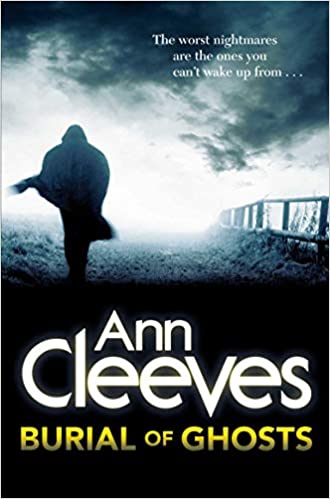
Review 1716: Burial of Ghosts

Yesterday was the beginning of RIP (Readers Imbibing Peril), which continues through October. During these two months, the goal is to read gothic novels, mysteries, crime novels, horror, or other dark and mysterious books! This one certainly qualifies, so it’s my first book for RIP XVI.

________________________

Having read all of the existing Vera Stanhope and Shetland novels, I decided to try a few of Ann Cleeves’ stand-alone novels. Burial of Ghosts seemed more to me like one of Catriona McPherson’s thrillers than Cleeves’ mysteries.

Lizzie Bartholomew is in Morocco recovering from traumatic events when she meets and has a short affair with an older man, Philip Samson. Some time after she returns to her home in Newbiggen, she receives a letter from a lawyer, Stuart Howden, telling her that Philip has died from cancer and asking her to attend his funeral. Later, at his office she learns that he left her a small legacy, provided she try to find and befriend a teenager named Thomas Mariner. Howdon implies that Mariner is Philip’s illegitimate son.

When Lizzie finds Thomas, she luckily goes into the house with a neighbor, because Thomas is dead, stabbed to death. Still, because Lizzie was previously involved in a stabbing and because she has been diagnosed bi-polar, Inspector Farrier questions her as a suspect. When he checks her story, he tells her that Stuart Howden denies knowing her. However, Farrier does not believe she stabbed Thomas.

Lizzie decides to try to discover who killed Thomas. She finds that Thomas was prepared to be a whistle blower but not for what.

It’s not a surprise that the mystery is difficult to figure out, although I was surprised that Lizzie, having found that Howdon lied, doesn’t question the rest of his story. I enjoyed this novel but felt there was no way to guess the solution.

Related Posts

The Sleeping and the Dead

The Long Call

Strangers at the Gate

Reading Thirkell’s Barsetshire Series in Order: #4 August Folly + #3 The Demon in the House Wrap-up

Thanks so much to those people who participated in reading or commenting on the third book in the series, The Demon in the House. I am so sorry that some of the would-be participants in the U. K. were unable to find a reasonably priced copy. I didn’t anticipate that as a problem, although I have had to pay a bit more for some of the books farther on in the series. Here are this month’s participants:

Liz Dexter of Adventures in Reading

Penelope Gough

Yvonne of A Darn Good Read

Our next book is August Folly. I will be posting my review for that on Thursday, September 30 (too bad, because of the name, that it wasn’t scheduled for last month!). I hope that you will be able to participate. At least this book shouldn’t be as hard to find.

And here again is our little badge if you would like to post it on your review.