
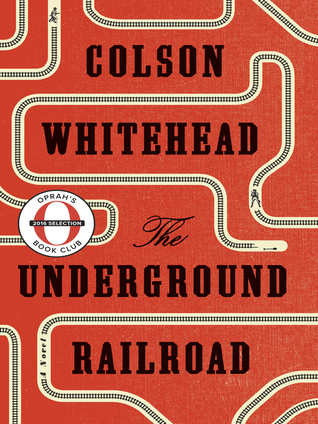
Cora is a slave on a brutal Georgia plantation. When a new slave on the plantation, Caesar, tells her he is going to escape and invites her to come, she at first refuses. But later her master’s brother inherits the plantation and sets his eye on her, so she and Caesar escape using a branch of the underground railroad.
Up to this point the book is grim and realistic, but Whitehead makes his underground railroad an actual train, destination unknown, and here the novel departs from reality so that Whitehead can make points about the evils of slavery and racism in all its incarnations.
Caesar and Cora arrive in what seems to be a utopian South Carolina, where the state has decided to educate and train slaves who have been freed. But there’s a deeper, darker subtext to the plan.
Determined to capture Cora is Ridgeway, an infamous slave-catcher. Cora’s mother Mabel disappeared when Cora was a girl, never to be seen again, and he took it as a personal failing. So, he’s determined to catch Cora, and he eventually turns up in South Carolina.
I have to admit I have problems sometimes with magical realism, and the combination of a real train and a South Carolina that never existed ground me to a halt. However, as Cora’s adventures continued, eventually I was charmed again and found the novel a powerful work of imagination.

 What? Me Read?
2 thoughts on “Review 2144: The Underground Railroad”