
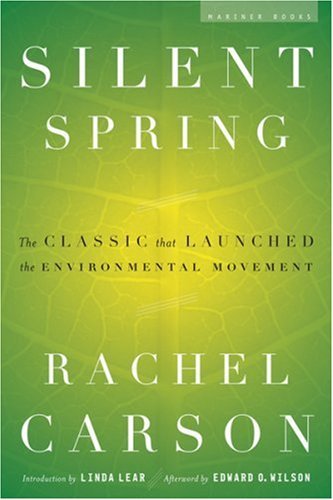
I have always intended to read Silent Spring, so its appearance on the list of books published in 1962 gave me a good reason to read it for the 1962 Club. However, publishing my review that week didn’t work out on my schedule. That being said, it works out to be a perfect read for Nonfiction November.
People probably realize that the book was largely responsible for the banning of DDT in the United States, but maybe don’t understand that much more about it.
Carson was a biologist in a time when that particular science was not highly regarded because of the fascination with physics and chemistry as a result of World War II. Particularly in the 1950s and 60s, blanket applications of pesticides and other chemicals seemed to have become the knee-jerk reaction to not only agriculture and forestry pest problems but also to problems of disease. What Carson accomplished in Silent Spring was to bring together the results of widely scattered studies to show that (1) the chemicals are deadly poisons, not just to insects but to all life; (2) applications of the chemicals have been largely ineffective and had unintended consequences; (3) continued application could result in the loss of all life; and (4) there are better solutions that are less costly for the same problems. She tells us about these issues in clear prose that instances many stories of failed or successful programs and experiments.
As I read this book, I had a clear memory of myself as a child riding my bike through a cloud of insecticide that was being sprayed from a truck being driven through my neighborhood. There was no sense on my part or apparently on the part of the sprayers that this could be harmful to me or anyone else outside at the time. Over the years, I’ve wondered why there seem to be more and more cases of cancer than there were when I was younger. Now I think I know why.
If you read this book, you’ll continue to be amazed at the instances where, after a disastrous application of pesticides by the Department of Agriculture to try to solve a problem, the next step was found to be . . . another application of pesticides. It’s a wonder there’s a creature left in our forests and fields, not to mention our waterways. This book is said to be the beginning of the environmental movement. I believe it.
Related Posts
The Bird: A Natural History of Who Birds Are, Where They Came From, and How They Live

 What? Me Read?
Apparently she didn’t want to write the book because she wasn’t well. It’s hard enough to write anything, let alone a groundbreaking work that everyone screams about. Thank you for this.
Yes, she didn’t live much longer afterwards.
Thanks for including links to other related reviews. Enjoyed the reminder for The Omnivore’s Dilemma; had that on one of my reading lists.
REALLY enjoyed Pollan’s The Botany of Desire.
It’s a good one.
Oh, I didn’t see your second paragraph. I haven’t read that one. I’ll have to look it up.
It’s terrifying, isn’t it, what we do to “improve” things without enough consideration of unintended consequences? I wish I believed it wasn’t still happening. I’ve never got around to reading this book but it always crops up in the bibliographies of current books on environmental topics, so it’s clear how influential it still is.
It’s still worth reading, especially as DDT is only banned in the U. S. and probably a few other countries but is in use in other countries around the world, and as we continue to use other hazardous chemicals.
I managed to read two books that mentioned it without actually reading it, I need to rectify that!
It’s a landmark book.