
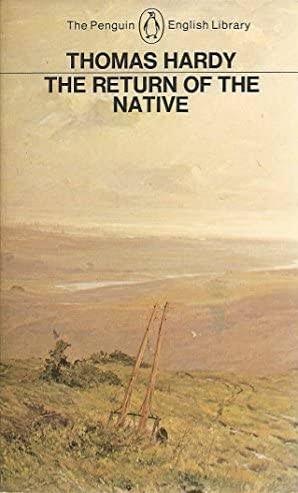
A love triangle—or rather a love pentagon—is at the heart of The Return of the Native. I put this novel on my Classics Club list because, although I read it years ago, I could remember nothing about it.
The Return of the Native is Hardy’s most contained novel, all of it taking place on Egdon Heath. The action begins on Guy Fawkes night with the lighting of bonfires. The occupants of one barrow are discussing the supposed marriage that day of Damon Wildeve and Tamsin Yeobright. But Tamsin returns home in distress and unmarried, saying Wildeve made a mistake with the license.
Wildeve has told Tamsin they can marry on Monday, but on that very night he goes to see Eustacia Vye, the girl he dropped for Tamsin. Eustacia is a vibrant, proud woman, and there is no doubt that she is tempted to get revenge on Tamsin.
Tamsin and her aunt view themselves disgraced if the marriage doesn’t come off, even though Wildeve lets weeks go by as he tries to court Eustacia. But Eustacia has heard of the return after years away of Tamsin’s cousin Clym, an educated man who works as a diamond seller in Paris, and sight unseen, she decides he’s the man for her. She hates the heath and wants to go to Paris. So, she misses a rendezvous with Wildeve and he marries Tamsin.
With this ill-conceived marriage, we are halfway set up for the tragedy. Then Eustacia marries Clym even after he tells her he plans to run a school for the poor on the heath, thinking she can easily change his mind after the wedding. The fifth point of the pentagon is occupied by Diggory Venn, a rettleman, or man who sells the red substance used to mark sheep and whose skin and clothing are dyed red from handling it. Although the Introduction to my edition explains that Hardy meant him to be a rather freakish figure about the heath, he ends up using him as a sort of deus ex machina, always in aid of Tamsin.
A strong theme of snobbery is inherent in the novel as we learn (1) that Wildeve was meant for better things but ended up owning the neighborhood pub, (2) that Tamsin turned down a proposal from Venn even when he was a respectable dairyman because he wasn’t good enough for her, (3) that the only suitable suitors for Eustacia in the neighborhood are the morally dubious Wildeve or the unambitious Clym. And Mrs. Yeobright clearly disapproves of both her son’s and niece’s choices.
So, we’re all set up for one of Hardy’s tragedies, in which he lays into the Victorian idea of marriage while making all his characters suffer. I usually like this stuff, but Hardy was forced by his publisher to add on the last section, thus providing a happier ending and making the story seem to last a little too long.

 What? Me Read?
I enjoyed this a few years ago in the midst of lockdown, but didn’t get around to reviewing it. Your review makes me realise I’ve already forgotten the entire plot! It certainly didn’t rank as one of his best for me, but it was a comfort to go back in time to simpler tragedies!
Yes, it isn’t his best. I read it long ago and didn’t remember the plot, either.
I haven’t read this one yet but I like the sound of it, especially Eustacia for hating the heath and wanting to get to Paris!
She’s not exactly a heroine in this book, however.
I love Hardy, but this isn’t one of my favourites. I wonder if the version with the original ending would have been better.
I think it just ended before the last couple chapters. That was my impression, anyway.
I “did” this for A-level and could probably still rattle off themes and character comparisons (I did Far from the Madding Crowd for O-level and I bet the quotations I memorised are still somewhere in my head!). I love the reddleman and I did love this even more when I read it outside school decades later. Every time it’s hot and I have to walk across a park or heath Mrs Yeobright comes into my mind!
Poor Mrs. Yeobright! Far FTMC is one of my favorites, along with Tess.