

I’m way behind on finishing the shortlisted books for the 2011 James Tait Black prize, but now that I have, it’s time for my feature, where I say whether the judges got it right. This year’s shortlist is unusual, because it contains three historical novels out of the four. It’s also going to be difficult from my perspective because I loved two of the books on the shortlist, but I haven’t read one of them since 2012.
Let’s start with my least favorite book. That one is La Rochelle by Michael Nath. This novel has a vestigial plot about a missing girlfriend and a friend’s obsession with her. But mostly it is about the main character, whom I found unpleasantly fascinated with women’s anatomy and not afraid to say so. The novel deals with nights of drinking too much with the missing women’s partner until the main character finally does something different, ending a labyrinthine scheme that I thought was silly and absolutely unnecessary.
Next is my second least favorite of the four, which was the winner for that year, The Lotus Eaters by Tatjana Soli. When I originally started to read it, I had forgotten why I was reading it and took it for a standard historical novel about a woman photographer’s affairs with a married man and then with his assistant. However, it turned out to really be about the experience of being a war correspondent during the Vietnam War and the main character’s growing love for the country. After giving it a second try, I finished it, but I still felt quite a bit of distance from the characters.
Now we get to two favorite books. The first one was the book I read long ago and for which I wrote my fifth review for this blog, The Thousand Autumns of Jacob De Zoet by David Mitchell. Although it had hints of the sci-fi time travelers that he incorporates into most of his novels, at that time I had only read one other book by him, and the focus on historical fiction was so strong that I didn’t notice them. The main character is an employee of the Dutch East Indies company in 18th century Japan. He is fascinated by the culture, even though the Dutch are restricted to one island off the coast and the Japanese are generally not allowed on the island. He falls in love with a Japanese girl who is allowed on the island as the student of a Swedish physician. When he refuses to participate in his boss’s graft, he is deserted on the island and makes his way to the main island. I found the descriptions of the customs and laws of Japan at the time really interesting, and the book becomes an adventure.
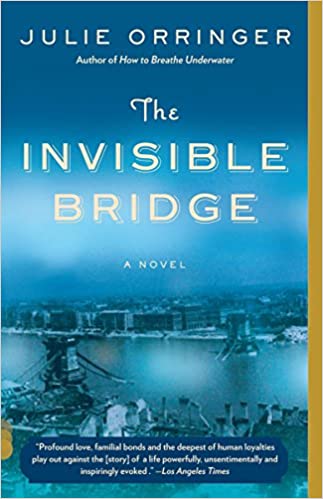
But another type of adventure is experienced by the main characters of The Invisible Bridge by Julie Orringer. This novel was based on the experiences of her grandparents during World War II. The main character, a Hungarian Jew, arrives in Paris in 1937 to study architecture, but he soon loses his scholarship because of anti-Semitism. He also meets an older woman with whom he falls in love. This novel becomes one of great breadth, covering events of World War II, the Hungarian Holocaust, life in work camps, and the siege of Budapest.
I so much enjoyed both of these last two novels that it’s hard to pick, but I choose The Invisible Bridge, simply because of its depth and breadth, and also just slightly because I have a vague recollection that The Thousand Autumns of Jacob de Zoet eventually goes to some places that were a bit unbelievable.

 What? Me Read?