
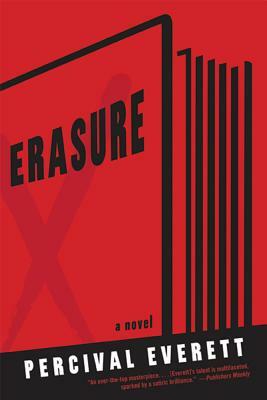
If you’ve seen the movie American Fiction, you already know the plot of Erasure. I haven’t seen it yet, and I read this book for my A Century of Books project.
Thelonius (Monksie) Ellison is a writer of high intelligence whose dense, uncompromising novels have failed to make a hit with the general public. He has just put out his latest book, but his agent, Yul, is having difficulty placing it and has been told that Ellison is too far from his ethnic origins as a Black man.
Ellison lives in California, where he is a university professor, but on a visit to Washington, D. C., for a conference, he finds that his mother isn’t doing well. Eventually, he is forced to move back to D. C. to take care of her. That means taking a leave of absence, but he hasn’t sold his book. His mother’s affairs are in poor shape, so he finds he needs money.
He is infuriated by a recent book that is making a splash, We’s Lives in Da Ghetto. It’s written by a middle-class midwestern Black woman based on one week that she spent with relatives in New York, and it employs every known cliché about the lives of Black people.
On a whim, Ellison sits down and writes a parody of this kind of novel, which he titles My Pafology. He submits it to Yul, who is horrified, and asks him to submit it to publishers under the name of Stagg Leigh. Shockingly, Random House takes it as straight and offers him lots of money.
This novel produces spoof upon spoof. Even Everett’s character Ellison takes himself so seriously that I think he’s being mocked. Certainly, he starts out mocking academia with the learned talk he gives at the beginning of the novel. This talk is incomprehensible, and yet it makes another academic leap up and shout, “Bastard!” at him. He also hits the publishing industry, the reading awards organizations, and television interview programs.
The novel is presented as Ellison’s diary, so it includes learned jokes (most of which I didn’t understand), imagined conversations between various dead people in the arts, recollections from his past, especially about his father, and the entire text—about 50 pages—of My Pafology.
As My Pafology gains attention, Ellison begins to lament that he ever compromised his standards. Forced occasionally to masquerade as Stagg Leigh, he feels as if his own persona as a cultured Black man is being erased. Maybe he feels that that whole culture is being erased.
Parts of this novel were above my head, particularly some of the little scribbles in the diary. Also, when I say Everett is heaping on the satire, I’m not saying that the novel is funny (although some of it is). Most of the time I felt sorry for Monksie, who is too unyielding for his own good and knows it, but cannot stop.
Percival Everett is having a moment lately, which has resulted in four of his books being in my pile, of which this is the second. I’m not sure if I like his work, but it is at least interesting.

 What? Me Read?
I’m not sure I’m going to like him either having abandoned James, but I must say this one does sound interesting. Satire’s always a bit hit and miss for me, though, especially if it’s not particularly funny. But I do feel that I have to investigate him further since he seems to be everywhere at the moment, so this one will be next on my list…
Yes, it is for me, too. I liked this one a lot better than The Trees, but I haven’t read James yet. Yes, he is everywhere. I have to read three of his books for different prize projects, and then this one.
I haven’t read any Everett, with the exception of a sample chapter of James, which really didn’t appeal (despite other readers I trust promising it is terrific). If I was to read any of his novels, I think this is the one I’d go for.
I will be reading it sometime, since it is part of one of my projects, but it is way down on my pile. I might move it up after I finish A Century of Books.