
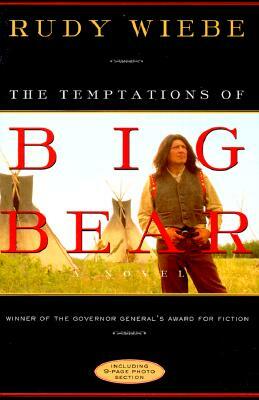
I can’t remember whether I found this book when looking for more about native peoples or for filling holes for my A Century of Books project. In any case, it does both.
Readers from the U. S. may not be familiar with the name “Big Bear,” but I’m betting Canadian readers are. He seems to have been their equivalent of Sitting Bull.
In The Temptations of Big Bear, Wiebe tells Big Bear’s story beginning in 1876, when the Cree, of whom Big Bear was a chief, along with other groups of native peoples and the Métis, meet to discuss a treaty with British officials. The treaty calls for the people to “sell” several hundred thousand acres to the government in exchange for small reservations and regular payments as well as assistance when they are hungry. Big Bear does not sign the treaty. He wants to wait to see what happens.
Within a few years, it becomes apparent that the buffalo, upon which the Cree depend, are dying out, so Big Bear signs the treaty. However, he does not select a reservation for his people. Instead, they continue to move among their usual environs.
This novel leads up to events at Frog Lake in 1888, where some of the Cree warriors attack the settlers, kill some, and take others prisoner. These attacks follow years of broken promises and starvation. Although Big Bear tries to stop them, he is disregarded. Of course, he is held responsible by the authorities and tried, despite all the white witnesses but one having testified for him.
This is an eloquently written novel. It is insightful and interesting, and Big Bear’s last speech at his trial made me cry.
Wiebe doesn’t cite sources, and it’s hard to tell whether some of the speeches and writings are verbatim from records or not.

 What? Me Read?
It’s odd, but I never thought of there having been native people in Canada – the “Indians” in America seem to have got all the attention in culture over here, maybe because of cowboy books and films. It was only when I visited my Canadian relatives and they took me to a reservation that I became aware of a similar history in Canada. And yet I’m supposedly reasonably well educated! It made me wonder what other bits of British history had been omitted from our education…
A lot of them were the same people. They moved back and forth over the borders. Chief Joseph and his people, the Nez Perce, were trying to get across the border to Canada when they were tracked down by the U. S. military and pretty much wiped out. The rest were captured and dragged back.
Yes, I suppose the border is just an invisible line! I guess living on an island makes me think of borders differently – as something that doesn’t move. Although the border between Scotland and England was pretty fluid for centuries.
Exactly!