
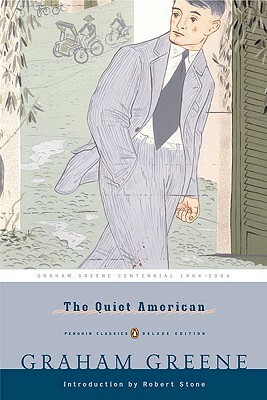
I long ago saw the movie version of The Quiet American starring Michael Caine and Brendan Frasier, but I couldn’t remember the details. I need to read more Greene, so when this book filled a hole in my A Century of Books project, I found a copy.
The narrator, Thomas Fowler, is an aging British reporter in Saigon, a cynical, world-weary man. The time setting is the early 1950s, when it was the French fighting the Communists in Vietnam. Fowler has lived a long time in Vietnam and has a young mistress named Phuong whom he cares for more than he admits.
At the beginning of the novel, he learns that an American, Alden Pyle, is dead. Then the story backtracks to his meeting with Pyle, a young naïve man who has just arrived in the country. Fowler catches on fairly quickly that Pyle has no real understanding of the country or its people but some half-baked ideas about Vietnam based on a book by an author who spent one week in the country. However, Pyle is not receptive to other ideas (until it’s too late).
Fowler invites Pyle to his home, where he meets Phuong. Very quickly, Pyle decides that he is in love with Phuong and tells Fowler he can make a better life for her, so he will court her but not behind Fowler’s back. He seems to have no conception that this may be painful for Fowler.
Fowler is married, so he cannot marry Phuong, but he writes a letter to his wife asking for a divorce—a request he’s fairly sure will be denied. At about the same time, he receives notice that he has been promoted and should return to London, but all he wants is to stay in Saigon with Phuong. He writes asking to stay.
He knows, though, that Phuong, although she cares for him, is probably ultimately going to be practical and take the young man who can marry her—egged on by her older sister, who has always thought Phuong could do better.
With this situation between them, Fowler begins hearing rumors about Pyle’s activities in Vietnam.
There are some suspenseful passages in this story, but what Greene does even better is get into the motivations of his characters. Of course, all the Americans in the novel are clueless oafs (except Pyle, who is clueless but not an oaf), and the women are disregarded. Phuong’s sister has more of a personality than Phuong does, and in one passage, Greene has Fowler basically say to Pyle that Phuong doesn’t think. (All she does in her own time is dance, visit her sister, and read movie magazines.)
If you can get past these caveats, this is a really good, suspenseful and psychological novel. None of the characters are particularly likable, but at some points you feel a lot of sympathy for Fowler.

 What? Me Read?
It’s been a long time since I read The End of The Affair, but I remember liking it. He sure likes writing about love triangles!
That’s true. I read that, too, but I don’t remember it very well.
I’m glad you enjoyed this one. I loved it— I thought it was one of his best. He really doesn’t give many of his female characters much of a personality, though. I wasn’t really aware of that when I read him in my youth but I’ve noticed it much more since I’ve been re-reading him recently. He’s better with older women, I think.
I think I notice how women are portrayed a lot more now that I’m older. Some male authors just aren’t good at depicting women. Maybe they never even thought about it.
I wonder if they were assuming that their readership would be male for this kind of book (since obviously women would only be reading romances 😉 ) so didn’t bother too much about developing the female characters.
Ha! That might be the case. The Japanese have made that kind of mistake before. I used to be a technical writer, and a story was told years ago that a Japanese software manual was burned on the docks in San Francisco (maybe this is an exaggeration), because they thought it would be more interesting to put the software instructions inside a story line. So, they had the secretary (female) who was using the software having an affair with her boss and sitting on his lap and stuff. It did not go over well in the States.
Hahaha, great story! Thank goodness even men attempt to make their female characters a bit more rounded these days, though I still get tired of why every woman has to be beautiful to be interesting.
Yes, we’re more likely to see that from a male author than a female one, I hope. I remember so vividly that cliche they used to use in movies and TV–an obviously gorgeous actress with her hair in a bun and glasses and the hero is paying her no attention. Then she takes the glasses off. Or in the case of a Stanley Ellin book I read years ago, the hero, a tennis coach, pays no attention to the gawky woman he is coaching. Then she inherits some money, dyes her hair, and gets some good clothing. Whammo! What a joke.
Haha, yes, the secretary with glasses was such a cliché! I think women authors are nearly as guilty of it as men, though, especially in crime fiction. The heroine always has flowing blonde or auburn hair, and is frequently fighting off admirers, all under the pretence of feminism – trying to be taken seriously despite her looks – when in reality it’s just a continuation of the idea that women must be beautiful or they may as well cease to exist! You get occasional non-beautiful heroines, but they always tend to be old – like Vera or Miss Marple!
Yes, I think that is sometimes true. However, Jess Kidd has a first book out for what I think is a series, and her heroine is a middle-aged ex-nun!