
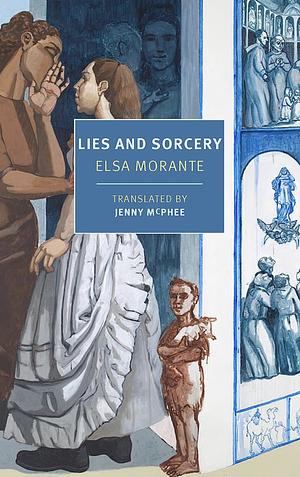
This book was the last one I read for my A Century of Books project. At nearly 800 pages in small type and a fairly bizarre plot, it was quite a slog for me, but I was determined to finish it, especially because I hadn’t finished several others.
The novel is set in Sicily and narrated by Elisa, a young woman who is looking back over the history of her family to try to understand some complicated and intertwined relationships. She is an intrusive narrator, popping in frequently to make observations, and she implies in the beginning that she’s been mentally ill and is not altogether to be trusted. But I didn’t experience a big reveal that labels her as unreliable. Notes in the Introduction indicate that the novel is fairly autobiographical.
Elisa begins with her maternal grandparents. Her grandmother, Cesira, is a schoolteacher who marries Teodor Massia because he looks like a gentleman and acts like a gentleman so he must have money. Unfortunately for her, the Massia family throws him off because he has married a schoolteacher. Worse, he is a wastrel who blows away any money they have, so their daughter Anna grows up in poverty but with an inflated sense of self-worth as the daughter of the upper class.
On the other side of the family, Alessandra, the servant of a peasant, is happy to marry her elderly employer Damiano De Salvi, because for her it is a big step up. Unfortunately, they are not blessed with a child, that is, until she is dazzled by Nicola Monaco, a land agent who seems to her to be a great gentleman. When she has his child, she raises Francesco to think of himself as a person of great potential. The De Salvis spend every penny sending him to school and are repaid by his being ashamed of them.
For her part, Anna Massia (Elisa’s mother) spots her cousin, Eduardo Massia di Carullo, when she is five years old. Her mother points out this wealthy branch of the family, and Anna is struck by how handsome he is, like a prince. When they meet, more than 10 years later, he is struck by how beautiful she is, and she is instantly enamored. Unfortunately, Eduardo, although charming, is not a nice person, and he spends most of his time tormenting her and making her prove she loves him. They are engaged, but his family doesn’t know about it.
Eduardo, for some reason, befriends Francesco, who is a student in town dressed in shabby clothes, but he has adorned himself with some flashy but cheap ornaments and is introducing himself as a baron. It is through Eduardo that Anna and Francesco meet at a time when Eduardo is tiring of Anna. Francesco has no idea of their actual relationship and in fact never has. Then Eduardo disappears.
Anna doesn’t know that the Massia di Carullo family has been paying her mother a small amount of money every month since her father died. When Eduardo discovers this, just before he is ready to break with Anna, he tells his mother to double the amount. But this makes Anna find out about it, and she in her pride goes to his mother and says they don’t want her money. Then she and her mother are destitute, her mother ill and still having to teach, while she, indolent and untrained for anything, lies around the house all day. Francesco having fallen in love with her, she marries him even though he revolts her.
Our narrator describes all this in great detail, along with her parents’ marriage. Her mother is not at all maternal and often is quite nasty to her, but of course that makes the little girl idolize her more and follow her lead in disdaining her father.
The novel begins to turn into absolute weirdness about 10 years after the marriage when Anna learns that Eduardo died some time before of tuberculosis. Eduardo’s mother, who worshipped her son, has retreated from that reality and believes Eduardo is traveling around writing letters to Anna. Dona Concetta asks Anna to bring her the letters, which Anna begins writing.
Even though I have told a lot, by now, I’m not kidding, we are at about page 350 with plenty more to go as the entire family descends into madness.
Morante is a terrific writer, but she really takes her time. At one point early on, she is showing how Eduardo taunts Anna and she provides not one lengthy example but several. And these are sickening conversations.
The Introduction to my NYRB edition states that the theme of the novel is the inability to get out of poverty. That is certainly there, but I think a more important theme, aside from that of the perceived importance of class, is unrequited love. Nearly every character in the book loves someone who either doesn’t love them back or even actively despises them. And these people are tempestuous! And as for sorcery? Is there really a ghost of Eduardo or are these people driving themselves freaking insane?
Although the novel handles human emotions and behavior insightfully, and I sometimes sympathized with Elisa and occasionally with Francesco, most of the characters are more or less terrible, especially in their treatment of others.
I received this book from the publishers in exchange for a free and fair review.

 What? Me Read?
Congratulations on finishing your Century of Books project! That’s an achievement!
Thanks!
Hurrah! You’re finished! And what a stonker to finish on – 800 pages of increasing insanity! I’m surprised you got out of it sane… 😉
That was only one of several books I had to read at the end that were all 500+ pages. I still have a few reviews to post.
This sounds intriguing, but I’m not sure if it’s something I would want to read, particularly at nearly 800 pages long! Well done for finishing it – and finishing your Century of Books.
Thanks!
congratulations for making your way through this as well as finishing the challenge!
Thanks!