
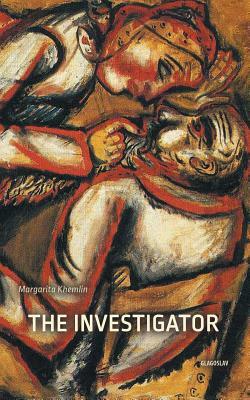
Contemporary writer Margarita Khemlin has set this story in 1950s Soviet Ukraine, when reverberations from World War II were still going on.
Police Captain Mikhael Ivanovich Tsupkoy unusually gets the case of the murder of a Jewish woman, Lilia Vorobeichik, who has been stabbed with a knife. The situation is unusual because the protocol for a serious crime is to call in a criminal investigator. However, Tsupkoy is able to wrap the case up immediately because Lilia’s boyfriend, Roman Nikoleyeivich Moiseenko, confesses immediately. When he commits suicide in jail, the case is closed.
Later, Tsupkoy catches a glimpse of someone who he thinks is the dead woman. He returns to her house to find her twin sister, Eva, living there. She and another woman are making matzo, which apparently was illegal at the time, but they claim it’s for feeding the chickens. When he does a recheck the next day, he meets a dressmaker, Polina Lvovna Laevskaya. Tsupkoy becomes interested in what’s going on and seems to be still investigating the case.
Because his friend, Jewish veteran Evsey Gutin, knows everyone in the Jewish community in town, Tsupkoy goes to visit him and his wife Belka to ask Evsey about a name he’s come across. Shortly thereafter, when Tsupkoy is on vacation, he learns that Evsey committed suicide.
I found Tsupkoy’s investigation to be confusing, because he keeps returning to the same large group of people to eke out one more fact. In retrospect, it’s hard to reconstruct the order of things. One important point, though, is that after Polina Laevskaya makes allegations that the investigation into Lilia’s death was perfunctory, she begins spreading rumors designed to ruin Tsupkoy’s reputation. People who previously trusted him begin to avoid him.
This novel seemed rather messy structurally. For one thing, I would have loved to see a list of characters like used to be included at the beginning of many Russian novels, because there are lots of them, and they are referred to inconsistently, sometimes by last name, sometimes by first, but more often by a nickname, and hardly ever by their patronymics, as used to be the case. Also, the later investigation, admittedly not official, seems haphazard. Fairly early on, I had an idea who the murderer might be, and although I doubted myself and didn’t come up with an alternative, I was right.

There often seemed to be something going on in the conversation that was unspoken and that I didn’t understand. Maybe that was because of the times and location. Certainly, there is a lot of tension between the Communist ideals and the realities of the Jewish comrades, as what Tsupkov calls Jewish nationalism (which just refers to their traditions, apparently) is illegal. Ethnic groups are supposed to assimilate—and this fact is important to the plot.
Finally, the motive only comes out in the last few pages, and it’s ambiguous and seems weak. If it had been developed a little more, it might have been stronger, but that may have been difficult to do without revealing the killer.

 What? Me Read?
Interesting setting but I don’t think I’d want to struggle through it, especially not with all those names – my pet hate when it comes to Russian literature.
You’re not kidding.