
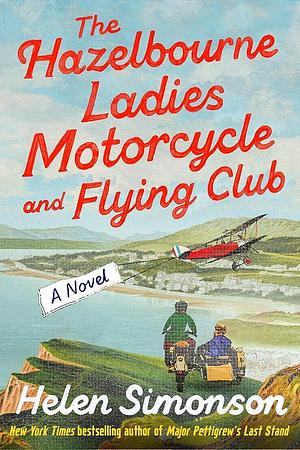
Constance Haverhill has an uncertain future post-World War I. She and her mother helped out her mother’s school friend, Lady Mercer, for years, and she took them in after the death of Constance’s father, a farmer. However, now that her mother has died, Lady Mercer has made it clear there is no place for her. She is giving her the summer as a companion to her mother, Mrs. Fog, who is recovering from serious illness at a seaside resort. A problem is that, with the end of the war, young men are returning to the work force, so young women are losing their jobs.
In the lobby of the hotel, Constance encounters Poppy Wirral, who runs her own business transporting people around the seaside town in the sidecars of motorcycles. She has ridden there to meet her mother, Lady Wirral, for lunch, but she has forgotten to bring proper dress. Constance ends up lending her a skirt, and Poppy invites her to lunch with her mother and brother, Harris, an ex-RAF pilot who lost a leg in the war.
It’s obvious from the beginning where the relationship between Constance and Harris will go, although there are impediments. Most of the novel is about the remaining effects of the war, particularly upon women and disabled soldiers. Harris, for example, tries to get work as a flight instructor and failing that, a promised job in his late father’s bank, but everyone just assumes he can take up the job of running his estate. But the estate needs money. Poppy has been employing only women motorcyclists in her transport business, but then she is told that a new law by the labor board will require her to employ only men. Constance, although she ran the Mercer estate during the war, faces sex discrimination and worse when she tries to find a job as an accountant or bookkeeper.
Of course, the problem with all this is the predictable romantic finish. It’s all very well to write a book protesting the problems of women trying to make a living, but that message is undercut somewhat when the heroine’s problems are all going to be solved by marriage. (I don’t think this is going to be a surprise for anyone, so I didn’t warn about spoilers.) I commented on this same thought in a recent review of a contemporary novel from the same period.
Another theme is snobbishness and racism, as embodied by Lady Mercer and her daughter’s fiancé, an American named Percival Allerton. It was actually hard for me to imagine that a man in the diplomatic services would behave the way he does. Part of this theme involves Mrs. Fog’s reunion with old school friends, Mathilde de Champney and her brother Simon. Mrs. Fog’s family has repeatedly separated her from them, as they are of mixed blood.
Another thread in this theme concerns Mr. Pendra, an Indian representative of one of the states of India, whom Constance and the Wirrals befriend.
My final criticism hints around at a spoiler. Harris’s and Constance’s insipient romance is disturbed by the intervention of a spiteful character. However, this problem is resolved in about two pages, and then (spoiler, really!) Constance gets to run into his arms for that blissful finish. Only if it was me, after what happened, he’d have a lot more ‘splainin’ to do.

 What? Me Read?
I enjoyed this, but I understand your criticisms of it!
So far, it seems like none of her books have been quite as good as the first one.
Yep, marriage always seems to be the solution to all women’s problems! Except when the book is about what a miserable life she leads after she’s married… 😉
No kidding! 😉 And I have no problem with that except when the book is making this kind of a point.
I liked this more than you I think!
I’m sure lots of people did!