
Today is another review for the Literary Wives blogging club, in which we discuss the depiction of wives in fiction. If you have read the book, please participate by leaving comments on any of our blogs.
Be sure to read the reviews and comments of the other wives!
- Becky of Aidanvale
- Kate of booksaremyfavoriteandbest
- Naomi of Consumed By Ink
- Rebecca of Bookish Beck
We’re also welcoming a new member to our club, although she just joined, so she may not be reviewing today’s book. Our new member is Marianne of Let’s Read! You can see her bio on my Literary Wives page (link above).
My Review
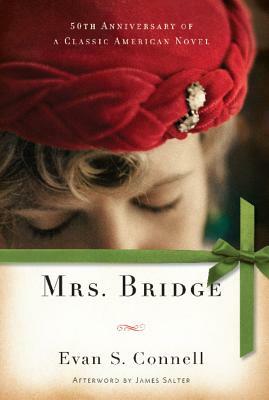
For its time, Mrs. Bridge was an unusual novel, especially in its structure. It is narrated in short chunks or chapters, 117 of them and most no longer than a page. Most of them document seemingly trivial incidents, but all together, they create a detailed picture of the characters and their relationships. Nothing much seems to happen except the conduct of a certain kind of life.
Mrs. Bridge marries and moves to Kansas City. Her husband is determined to provide well for his family, and the result is that he is always working, hardly ever at home. He is successful. Soon, Mrs. Bridge is a society matron with three children, a woman very conventional and concerned with appearances and “proper” behavior, not one to face ugliness. She has servants and not much to do.
Two of her three children react against her overconcern with propriety and perhaps her lack of a sense of humor. She constantly picks on her son Doug for basically being a boy—being unconcerned with his appearance and not very worried about any of her corrections. Her oldest daughter, Ruth, just goes her own way.
Mrs. Bridge has occasionally had intentions to read more or learn Spanish or take painting lessons—improve herself—but aside from buying the tools, nothing much comes of this. Eventually she faces middle age and an empty nest and wonders what has happened to her life.
I grew up 20 to 30 years later than this novel, but I remember this same kind of life for suburban matrons, even with housework and children and no servants—the lack of mental stimulation and a feeling of lack of purpose. I found this novel sad but interesting.
What does this book say about wives or about the experience of being a wife?
Most of the information about Mrs. Bridge’s marriage is implied, since we see so little of Mr. Bridge. He is definitely in charge of the family. Mrs. Bridge does everything he tells her to, including placing her vote. Yet she seems to feel that her role is to correct the children constantly over minor things—many of which would never bother Mr. Bridge. He often seems stern, yet he seems to have a better relationship with the children than she does, and we have indications that he cares about her, only his way to show it is to buy her things. A few times she shows a sexual longing that he doesn’t seem to return. Not much affection is shown, but I believe it is felt. Whether it’s stronger than that as time goes on is not clear. Basically, the two have defined roles and they keep to them without much questioning.
Really, you have to feel sorry for Mrs. Bridge, who seems to feel vaguely that she is leading a sterile life, but it’s what everyone else of that social stratum is doing, too.

 What? Me Read?
I agree – the novel was sad but interesting. I was glad for Mrs. Bridge when she was shown affection, but those moments were so few, they felt like pulling teeth. Mr. Bridge may have been in charge, but I can’t imagine that he was very happy, either. I would love to read a story in which a couple from that era break free of the mold. Have we read a book like that yet?
No, I don’t think I have! Well, maybe The Home-Maker! I’m trying to think when that was set. I think about the same time, maybe earlier.
Oh yes, that was a good one! It’s maybe set a bit earlier, though.
In the 20s. Not that much earlier, and really unusual for the time, I would guess.
I think fathers quite often got the credit for being the more fun parent because they left most of the discipline to the wife and weren’t around a lot of the time. I know I was always thrilled when my dad played with me, but just took my mum for granted. Poor wives!
Well, that could certainly be true, although our mother didn’t like games, and our dad did. But yes, the wives get the short end of the stick.
Only a handful of our reads have had comic elements; most are sad and frustrating because of the constraints on women in other times and places — or now, still. This was very powerful. I’m glad we read it.
So am I. We didn’t put Mr. Bridge on our list, but I wonder if we should. Well, I think several of us are going to read it, so maybe that suffices.
We can at least swap e-mails about what we thought 🙂
Funny fact: I just looked up one of our reads for later in the year, Family Family by Laurie Frankel, and saw that the main character is also named India! (But it sounds like she’s a single mother, so I don’t know if there is a central marriage to talk about. Then again, if she refuses marriage, that’s a comment in itself.)
A book serendipity!