
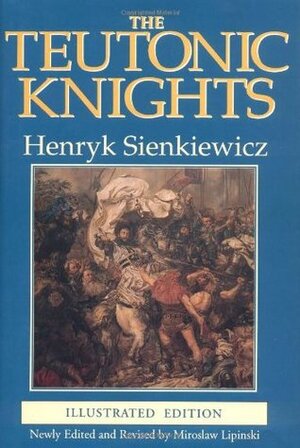
I don’t really remember what led me to read With Fire and Sword years ago. It is the first book of a trilogy by Henryk Sienkiewicz, a writer of historical fiction and Nobel Prize winner who was publishing around the turn of the 20th century. While I was reading that book, a friend who was born of Polish parents in England just after World War II told me that Sienkiewicz’s books were the books of her childhood, although they are certainly meant also for adults.
I found With Fire and Sword to be exciting and interesting and went on to read the whole trilogy, although my blog just has the review I wrote for Nancy Pearl‘s blog about the first book. And then just recently I came across a used copy of Sienkiewicz’s The Teutonic Knights, which he considered to be his best book.
You might think that a book entitled The Teutonic Knights would have them as heroes, but you would be wrong. In fact, although Sienkiewicz’s portrayal is more nuanced, many of them are quite dastardly.
The novel is set 150 years before With Fire and Sword, beginning in 1399. The two main characters, the knight Macko of Bodaniec and his young nephew and squire Zbyszko are returning from war in Lithuania against the Teutonic knights. The knights were invited into the Baltic area many years before to keep the Prussians in line, but since then they have expanded to an order with incredible power and have been making incursions on the neighboring areas of Poland and Lithuania, using as an excuse conversion to Christianity. The only problem with this is that Poland is already Christian and Lithuania has been converted as a result of the marriage of the Lithuanian King Jagiello with the Polish Queen Regnant Jadwiga. Teutonic knights who are beginning to see a loss of their purpose have been refusing to convert their neighbors, preferring to enslave them and take their property.
Macko and Zbyszko have stopped at an inn when likewise the entourage of Duchess Anna Danuto stops for a rest on the way to the royal birth of King Jagiello and Queen Jadwiga’s first child. In her train is a beautiful young girl, still a child at 12, Janusia, the daughter of Count Jurand of Spychow, a hated enemy of the Teutonic knights, who killed her mother. Young Zbyszko is so taken with her that he makes her a knightly vow to present her with three peacock feathers that Teutonic knights wear in their helmets, which means he has to fight them.
Macko and Zbyszko are invited to accompany the duchess, and as they approach Cracow, Zbyszko sees a knight wearing peacock feathers. Thinking God has answered his prayer to meet his vow, he dashes at the knight and is only stopped when a Polish knight breaks his lance, because the man is Kuno Lichtenstein, an envoy to the king. Attacking an envoy is punishable by death.
So, Zbyszko is imprisoned while various important people try to get him off, pleading his extreme youth and impetuosity. But Lichtenstein insists on his punishment, and King Jagiello feels he has no other option.
On the day of the execution, an old custom is invoked. Janusia throws her veil over Zbyszko and claims him as hers. This saves his life and engages them to be married.
Macko and Zbyszko finally make it home to Bogdaniec, which was destroyed before they left and their entire family killed. Zbyszko is only returning temporarily, intending to go meet his vow, while Macko has now enough spoils from war to begin returning the estate to prosperity. But now we meet Jagienka, the neighboring damsel, who is healthy and beautiful and can use a crossbow or kill a bear with the best of them. She was Zbyszko’s childhood friend, and now she falls in love with him. This made me very curious about what would happen, as Zbyszko is also attracted to her.
And I’m not going to say much more except that this novel, although 780 pages long, rattles along at a pretty good clip and features kidnappings, knightly deeds, dastardly acts, fights unto death, and climaxes with an enormous, exciting battle. In amongst the action, Sienkiewicz shows a great deal of knowledge about Medieval history, dress, and customs.
This is another page turner, and I have already put another book by Sienkiewicz on my next Classics Club List.
P. S. Sienkiewicz is most well-known for Quo Vadis, his novel about Christianity in Ancient Rome. This is just my opinion, but I think his Polish novels are a lot better.

 What? Me Read?