Review 1763: Jack

Jack tells more fully the story of Jack Boughton, whose tale was first alluded to in Robinson’s Gilead and whose fate was more fully explored in Home, which takes place chronologically after Jack. Jack is the hapless ne’er-do-well prodigal son in Home, but Jack explores his relationship with Della Miles, a romance with a young black woman that is forbidden in 1950’s Missouri.

Jack is living in St. Louis at the beginning of the novel, just barely hanging on to the fringes of society. He is drunk part of the time and owes money that he can’t repay. He is fresh out of jail and living in a cheerless rooming house.

He has already met Della at the beginning of the novel and has fallen instantly in love with her, but he is minutely aware of himself and his unsuitability. She is a young woman, educated, a schoolteacher, and she is black. It’s against the law for him to consort with her, and just being seen with him will ruin her reputation. For his part, he’s an older man, an ex-con, a bum.

Della gets accidentally locked in a cemetery one night where he sometimes sleeps. So, the first part of the novel is a long conversation at night.

Robinson is finely tuned to the condition of the human heart, as becomes obvious as we watch Jack, overly sensitive to every nuance of a situation. True to his upbringing by a devout Presbyterian minister, Jack frequently engages in theological discussions odd for an atheist. We watch Jack try to defeat his feelings for the sake of his beloved and fear that any small disappointment will send him on a downward spiral, for he is so fragile.

Robinson is a wonderful writer with a deep understanding of human nature. Although these Gilead books can be difficult, they are rewarding.

Gilead

Home

Lila

Review 1762: The Christmas Wish

Last year, I saw pictures from The Christmas Wish on TV and thought they were so beautiful that I bought a copy of the book. This little children’s story is illustrated with photos, some of which have been doctored to create the effects. This book is written by Lori Evert, and the photography is by Per Breiehagen.

Anja is a little girl who wants to be Santa’s helper for Christmas. So, after doing her chores and helping out a neighbor, she puts on her skis and heads north. On the way, she is helped by a cardinal, a draft horse, a musk ox, a polar bear, and a reindeer, each giving way to the next as she goes farther north.

The little girl is dressed in a traditional Norwegian outfit, and the photos are just wonderful. The story is simple but sweet. This is a book that could be passed down as a family heirloom.

Snow

Premlata and the Festival of Lights

Red Knit Cap Girl

Reading Thirkell’s Barsetshire Series in Order: #7 The Brandons + #6 Pomfret Towers Wrap-Up

It’s time for the wrap-up of Pomfret Towers and to introduce the next book. I hope everyone enjoyed reading Pomfret Towers. The following people either posted their reviews or made comments. Thanks for your participation:

  • Penelope Gough
  • Historical Fiction Is Fiction
  • Yvonne of A Darn Good Read

The next book, The Brandons, is one I read long ago but before I began blogging. I am looking forward to rereading it as I can’t remember it at all. I will be posting my review on Friday, December 31. I hope some of you will join me in reading it.

And here is our little badge.

Review 1761: #ThirkellBar! Pomfret Towers

Cover for Pomfret Towers

It’s time to talk about the sixth book in Angela Thirkell’s Barsetshire series, Pomfret Towers. Who read it and what did you think?

This novel is another one that I reviewed several years ago, so I will not repeat the plot synopsis and review but simply supply a link to the original review.

What struck me this time around was how sweet a story this is, with Thirkell creating characters we like tremendously but not forgetting a couple we can dislike. Yet, she’s subtle about all of this and shows a little sympathy for one of the most irritating characters.

Little Alice, so young and shy, is both a sympathetic character and one who provides some good-natured comedy. For example, her reaction to being invited to Pomfret Towers for the weekend—a terrifying prospect—is to hope the house burns down overnight before she has to go. She is silly and adolescent in her attachment to the odious Julian Rivers and very brave when she finally sees through him.

On the other side is Mrs. Rivers, so full of herself as a Writer of popular novels that sound dreadful, so managing in a house where she is not the hostess, and so irritating in her attempts to throw together her daughter Phoebe and the mild-mannered Gillie Foster, the heir to the earldom. But when she is humiliated by her son at the end of the novel, Thirkell deftly makes us feel sorry for her (but not for Julian).

I liked practically everyone in this novel, even Lord Pomfret, known for his rudeness. Another charming novel by Thirkell.

Summer Half

August Folly

The Demon in the House

Review 1760: The Turning Tide

I’ve started to feel as though Catriona McPherson’s approach to a mystery is to throw clues at you until you’re impossibly confused. That’s probably why I prefer her cozy thrillers. Still, I like her characters Dandy Gilver and Alec Osborne, so I keep reading.

Dandy’s daughter-in-law has given birth to twins when Dandy and Alec finally decide to respond to a third letter asking for help. One reason they decide to come is they have just heard of the death of a family friend, Peter Haslett, that seems to be connected with the case. The Reverend Hogg has asked them to find out what is wrong with Vesper, the Cramond Ferry girl, who appears to have gone mad and now blames herself for Peter’s drowning.

When they arrive in Cramond, they are confused by a meeting with three people who seem to have different agendas, Reverend Hogg, Miss Speir, who runs an uncomfortable inn, and Miss Lumley, who owns a local pub. They also hear different versions of Peter’s death. Most say he fell off the ferry and drowned, but one person says he came off the path and had his head crushed in the mill race.

He supposedly was visiting some friends, agricultural students doing an experiment with potatoes, but when Dandy and Alex meet them, the students make nothing of the fact that they have planted the potatoes upside down. When Dandy and Alec meet Vesper, she certainly seems mad, half naked and babbling about Mercury and snakes. But soon, Vesper too is dead.

I think I defy anyone to figure out McPherson’s crime novels. Still, they’re fun to read.

Dandy Gilver and a Spot of Toil and Trouble

Dandy Gilver and the Unpleasantness in the Ballroom

The Reek of Red Herrings

Review 1759: White Tears

You may think you know what’s going on in White Tears, but you don’t. Kunzru provides a few clues to that effect, but it’s easy to glide right over them.

Seth is a nerdy outcast in college when he meets Carter Wallace, a good-looking, popular rich kid. The two bond over sound and music. Seth has been immersing himself in techno when Carter introduces him to the gritty sounds of old-time Black country soul on vinyl and even older 45s.

After college, the two form a recording company, with Carter as the face and Seth doing the creative work and sound engineering. They are beginning to become famous for an old-fashioned sound, produced entirely by analog instruments. But Seth notices Carter losing focus and becoming more engaged with collecting.

One day, Seth is indulging his hobby of walking around New York recording noises when he catches someone singing part of a blues song, “Believe I buy me a graveyard of my own.” He plays it for Carter, who becomes obsessed with it. Carter uses the fragments from Seth’s recording to make what sounds like an old-time record, complete with cracking noises. Then he mocks up a picture of a 45, invents a singer, Charlie Shaw, and advertises the fake record on a collectors’ website.

What starts out as a seemingly harmless prank has serious consequences. Soon, apparently meeting a collector who wants to buy the fake record, Carter is severely beaten and left in a coma. Seth finds out his company and their apartment are both owned by the family corporation, and he is immediately dispossessed, the family claiming he is just a hanger-on. But Seth and Carter’s sister Leonie want to know what happened to Carter.

This novel is dark and unexpected. At first, I wasn’t so interested in the story about Carter and his fanboy Seth, neither of whom are that likable, but eventually I got sucked in. Again, it’s a novel I wouldn’t have chosen for myself, but I read it for my James Tait Black project.

Utopia Avenue

Telegraph Avenue

Mortal Love


Review 1758: Too Good To Be True

In looking for more to read by Ann Cleeves, I wasn’t aware that I had ordered something between a short story and a novella, packaged under the name of Quick Reads. This little volume cost almost as much as a regular paperback and took about a half hour to read.

At the request of his ex-wife Sarah, Jimmy Perez travels to the border town of Stonebridge. Here a young teacher, Anna Blackwell, has been found dead, an apparent suicide. Sarah is concerned because the village rumor mill is alleging that her husband Tom was having an affair with Anna. Sarah hasn’t helped the situation by heading a drive to remove her from her position.

When Jimmy investigates the crime scene, he finds some evidence to indicate that Anna may have been murdered. Also, a mysterious stranger seems to be following him.

I am not really a fan of mystery short stories, because I enjoy all the things that the short story in that genre has little time for, character development, atmosphere, and so on. As it turns out, the motive for this murder seems unbelievably flimsy. I don’t think I’ll be purchasing any more of these Quick Reads.

White Nights

Wild Fire

Thin Air

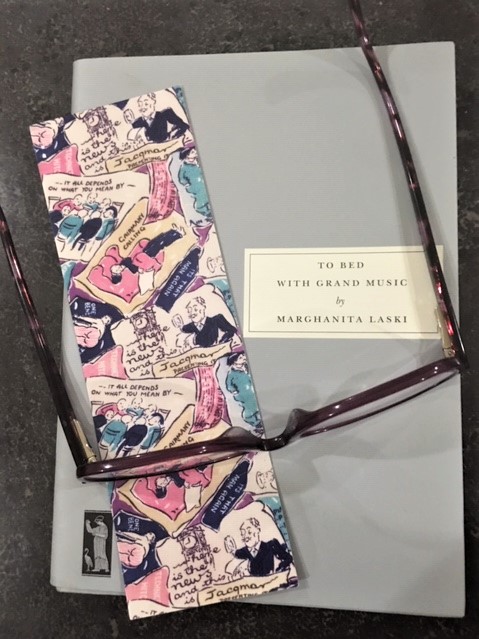
Review 1757: To Bed with Grand Music

To Bed with Grand Music opens with Deborah Robertson in bed with her husband Graham swearing perfect fidelity before his deployment to Cairo during World War II. Graham more honestly doesn’t promise that but says he won’t sleep with anyone that matters. At first, Deborah contents herself at home, but when, in her boredom, she begins snapping at her little son, Timmy, her mother suggests she get a job.

Her mother is thinking about a job nearby in Winchester, but Deborah makes arrangements to visit a friend in London, Madeleine, and see about a job there. Intending to go home on the evening train, she ends up getting drunk and spending the night with a man.

Shocked at herself, Deborah is determined to stay home, but she has a talent for convincing herself that what she wants to do is right, so it’s not too long before she turns down a job in Winchester only to take a lower-paying one in London. From there, she begins a career of connecting with men of increasingly higher rank.

Deborah is definitely an antihero. She starts out selfish and nervous and becomes deceitful, amoral, and avaricious as she goes on. Her faint motherly instincts become almost nonexistent. This is an insightful, sardonic character study of a particular type of woman.

The Victorian Chaise-Longue

A Fugue in Time

Vanity Fair

Review 1756: The Cold Millions

Best of Ten!

Sixteen-year-old Rye Dolan and his older brother Gig are wanderers through the Northwest, among thousands of other men looking for work when they can get it, in 1909. Indeed, the town of Spokane is teeming with them. It is a thriving town that has grown rapidly, and at first glance it seems to consist only of fabulously wealthy mine owners and the destitute.

The mine owners only accept workers through corrupt employment agents. Men pay a dollar, a day’s pay, for a referral for a job they may not get, and most of the money gets kicked back up the chain to the employer. Gig is a member of the IWW, or Wobblies, who are trying to recruit members to their union during a Free Speech Day that protests against the employment agents, the poor pay and working conditions, and the corrupt Spokane police department.

Rye isn’t so sure he believes in the union, but on Free Speech Day when the police begin beating and arresting the protesters, he is inspired to jump on a soapbox next to Gig and sing the union songs. So, he and Gig are arrested and thrown into jail along with 500 other men, into packed cells and brutal conditions.

Rye, because of his age, gets out of jail early with the help of a lawyer and Elizabeth Gurley Flynn, a crusading 19-year-old union firebrand (an actual historical figure). However, Rye sort of unwittingly makes a deal with Lem Brand, a mine owner, to give him information in exchange for getting Gig out of jail.

This novel vividly depicts the kinds of conditions that made unions evolve in the first place and the fight the unions had to stay in existence. Does that sound unexciting? Well, this novel has an appealing center around the two brothers, features a historical figure we should know more about, and is full of intrigue, action, and skullduggery. It is harrowing at times, alternating narrators among several characters who don’t always end up alive at the end of their narratives. I was enraptured.

Beautiful Ruins

The Paragon Hotel

The Long Take