Review 1592: The Night Watchman

There is always something that keeps my attention in Louise Erdrich’s books, although often they are very sad. In 1953, the United States Congress announced a program of “emancipation” of more than 100 First Nations tribes that was expressed as a program to put indigenous people on an equal footing with other Americans but was actually a way to yet again abrogate treaties and take land. Louise Erdrich’s grandfather helped save the Turtle Mountain Chippewa from this fate all while working full-time as a night watchman. The Night Watchman is Erdrich’s novel about this event.

Thomas Wazhashk, a member of the tribal council, receives a copy of the bill and figures out its intent from its bland, bureaucratic language. He gets the council to collect signatures on a petition and begins collecting information to support the tribe’s stance that its members are too poor to care for themselves so local authorities will have to take on the burden if the federal government doesn’t, this obviously a ploy to get support from state and local authorities to oppose the bill. While he works, he is visited by an owl and the ghost of an old friend who died as a boy after being imprisoned in the basement of a state boarding school.

As usual with Erdrich, aside from the main plot, the novel is full of interesting characters and subplots. Pixie Paranteau takes time off from work to try to find her sister Vera, who has vanished in Minneapolis after leaving to marry her boyfriend. On the train, she encounters Wood Mountain, a young boxer on his way to a fight, but when the fight is cancelled, he decides to make sure Pixie is all right.

Millie Cloud is the woman whom Thomas asks to share the results of the survey on the living conditions of the tribe that she wrote for her doctoral dissertation. She is socially awkward and dresses in geometric patterns.

This novels felt more hopeful than some of Erdrich’s even though it also contained scenes of brutality. My attention was engrossed by it.
Related Posts

LaRose

The Round House

There There

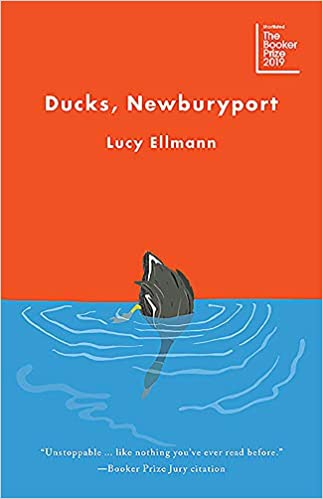
Review 1591: Ducks, Newburyport

The unnamed narrator of Ducks, Newburyport is a 40-something Ohio housewife who works from home making pies and cinnamon rolls for restaurants. She is a survivor of cancer, and she and her husband Leo are both working very hard to pay off her medical bills. She has four children, a sulky teenager, Stacy, from her first marriage and three young children from her second.

Ducks, Newburyport consists mostly of her mental ramblings as she goes about her day, a timid woman who rarely speaks her mind and is obsessed by her failures as a parent and daughter and by violent incidents in the news. The book almost completely consists of one 1,000-page sentence, if you can call a bunch of phrases beginning with “the fact that” or sometimes just lists of words a sentence. Periodically, this monologue is broken by a few paragraphs about a female cougar and her cubs.

Ducks, Newburyport breaks just about every rule connected with literature. It breaks the Strunk and White rule about not using “the fact that” about 50 times per page. It uses no traditional sentence structure or paragraphing except in the lion sections. It breaks notions of narrative. (It’s not stream-of-consciousness.) And it has a plot, sort of, but not in the traditional sense. I’m not sure if the novel is an elaborate joke or just Ellman thumbing her nose at the rules and winning awards while she does it. Lots of people have compared it to Ulysses, but Ulysses is more poetic. The narrative style alone may drive you nuts.

I noticed that Ellman gets a few things wrong. Some are to do with the age of her character, who makes lots of cultural references, many of which are too old for her. Certainly, the narrator is interested in old movies and songs, but the mistakes I’m talking about have more to do with Ellman being closer to my age than her narrator’s. She talks about everyone having their tonsils out when she was young, but that’s a 50’s or early 60’s thing rather than an 80’s. And similarly, she says just about every woman in America is on hormone replacement therapy, but that wasn’t even being prescribed as much when I was hitting menopause, and I’m older than Ellman. Some of her verbal habits, like calling underwear me-oh-mys just seem ridiculous and old-fashioned. Of course, this last could be characterization.

I also thought Ellman has been living in the U. K. too long to get an American housewife quite right. Just a small example is her repeated references to Bath Oliver biscuits. I doubt if many Americans know what those are, even if they’ve eaten them. I had to look them up, and I have eaten them. In general, as well, Americans don’t eat beans on toast, a phrase that she repeats excessively. Of course, again, that could just be a phrase that’s lodged in her head.

These are small things that you’d think her editor would have caught, if editors even edit anymore.

Did I like it? As soon as I got a feel for what the novel would be like, I assumed I wouldn’t finish it and kept waiting to decide to stop reading. But I found it oddly hypnotic, and I finished it. I found the narrator annoying as well as unreliable. She says she doesn’t remember things, but 80% of the novel is her memories. She also says she doesn’t remember her dreams and then relates them to the tune of several a page sometimes—another rule broken—which I found irritating, because I don’t like reading about dreams in fiction.

Would I read it again? No way. Does it deserve two (at least) prestigious literary awards? I have no idea.

Related Posts

4321

Milkman

The Lesser Bohemians

Review 1590: The Burning of Bridget Cleary

In 1895, a rural Irish woman, a milliner, was burnt to death by her husband and relatives. Their explanation was that the ailing woman had been taken away by the fairies and that they had burnt a changeling trying to get it to say it was not Bridget Cleary.

Historian Angela Bourke examines this crime in detail, not only the events as reported by the witnesses and the trial but the meaning of it. She interprets fairy legends and their place in rural Irish society, and she also explains the meaning of comments and actions the night of the crime and the night preceding it in terms of these legends. She looks at the crime from a feminist point of view as well.

I found this book interesting, although at times I felt Bourke got carried away with her interpretations. Most of the time the writing style and her analysis are interesting, but the book is occasionally a little dry.

Related Posts

The Good People

Religion and the Decline of Magic

The Witches: Salem, 1692

Review 1589: My Husband Simon

According to Simon Thomas’s Afterword for My Husband Simon, the publicity for it posed the heroine’s dilemma as wife vs. mistress. And that’s just typical, isn’t it? When the real choice was marriage vs. not just a writing career but the ability to be a good writer.

Simon’s Afterword discusses the class element of the novel, which comes out in nuances an American reader wouldn’t necessarily pick up on, at least not all of them. (For example, I didn’t get the distinction between Pardon? and Why? until I read the Afterword, although I understood there was something wrong with Pardon?)

Nevertheless, it’s clear from the beginning that Nevis Falconer, a young writer with one very good book out, and the man she chooses to marry, Simon Quinn, are singularly poorly suited. Nevis enjoys sophisticated, witty people who know about books and culture. Simon is actually proud of his ignorance and prefers the country and physical activity. The attraction is physical, and the two consummate it almost the day they meet. Then they immediately get married.

Four years later, there’s trouble in paradise. The couple alternates arguments with love making for a highly volatile relationship. But the worst thing is, Nevis hasn’t written anything good the whole time. And Simon and his family make insulting remarks about her career. He speaks of her doing nothing all day and is continually on at her about the state of the house.

This novel, published in 1931, takes a very serious look at the dilemma of working women of the time, especially those in the arts, a dilemma that still exists in many ways. Although I couldn’t really understand Nevis’s attraction to Simon—to me, he belittled her too much—the ways of sexual attraction are enigmatic.

Panter-Downes is a lovely writer, and I enjoyed this novel very much.

Disclosure: I received a copy of this book from the publisher in exchange for a free and fair review.

Related Posts

One Fine Day

The Home-Maker

The Blazing World

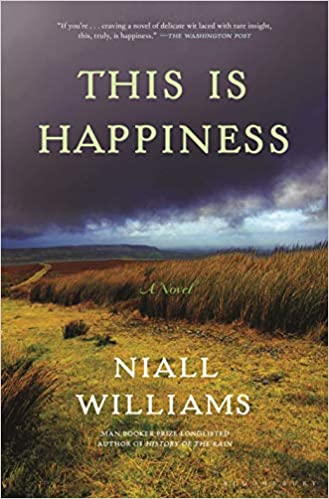
Review 1588: This Is Happiness

My first introduction to Niall Williams was his wonderful novel History of the Rain. That was so good that I confess to having found Four Letters of Love slightly disappointing, just because it wasn’t as good. This Is Happiness, however, is a gem of a novel.

As an old man, Noe Crowe recollects the summer when he was 17. He has been banished to the small village of Faha in West Clare County, because he left seminary school. While living with his grandparents, Ganga and Doady, he’s supposed to find his way back to God.

First, it stops raining, in a village where it always rains. Then Christie arrives to help install the electricity. Christie, we sense, is a charismatic individual with lots of stories to tell. He has come with a mission, and it’s not electricity. He has heard Annie Moonie lives in Faha, and he wants to apologize to her for leaving her at the altar 50 years before.

In the meantime, Noe, in a village studded with eccentric characters, finds he has fallen in love with Sophie Troy, the doctor’s youngest daughter, or is he in love with Sophie and Charlie Troy, or is it with Sophie, Charlie, and Ronnie, all three of the doctor’s daughters?

The novel starts out funny and charming and it just gets better. Hoorah for another fine book by Niall Williams.

Related Posts

History of the Rain

Four Letters of Love

Nightingale Wood

Review 1587: Captain Paul

Quite a few years ago now, I bought the collected works of several 19th century writers in ebook form from Delphi Classics and resolved to read them all, starting from the earliest works. I didn’t get very far—read one or two novels by each—before life got in the way of my project and I forgot it. But recently, I thought I would occasionally interject one of those novels into my regular reading, and the first one is Captain Paul by Alexandre Dumas, his second novel.

Now, this novel is quiet peculiar, for Dumas was inspired for it by James Fennimore Cooper’s The Pilot, which is about John Paul Jones. I haven’t read The Pilot, but it seems that Dumas has taken some liberties with Jones’s life if not with Cooper’s book. In particular, while naming his character Paul Jones, as Cooper apparently does in his book, and using some actual episodes from John Paul Jones’s life, he makes him a Frenchman (he was, of course, Scottish-American), and he gives him an entirely fictional but romantic lineage as the illegitimate son of a French count (although JPJ was born on an estate, the son of a gardener, so maybe Dumas was making some sort of assertion about his birth).

In the novel, Captain Paul, unaccountably donning two disguises in the first few pages, takes onboard his ship a prisoner of France that he is supposed to deliver to the prison island of Cayenne. The crew is not supposed to speak to the prisoner, but his conduct during a battle with an English ship leads Captain Paul to ask for the story of the prisoner, Hector de Lusignan.

Six months later, Captain Paul visits Count Emmanuel d’Auray, who originally delivered Lusignan to the ship, to tell him he knows he imprisoned Lusignan unlawfully. Lusignan’s crime was to fall in love, without fortune, with d’Auray’s sister, Marguerite, and have a child with her. While d’Auray got rid of Lusignan, his mother, the Marchioness, removed Marguerite’s child. Now, they are trying to force her to marry a fop who has promised d’Auray a commission. Captain Paul announces his intention to get Lusignan a pardon and remove Marguerite’s child from wherever it is hidden. But when he learns Marguerite still loves Lusignan, he decides to help the lovers.

There are more secrets to come, including Captain Paul’s own identity.

This is a short, fast-moving novel once you get over your bemusement about poor John Paul Jones. It is entertaining, but after all the action is over, Dumas couldn’t resist adding an Epilogue, which tells us how everyone ended up and also contains more of Jones’s real (maybe) exploits. The Epilogue, therefore, is about as long as two or three of the chapters, and everything bogs down tremendously. This is the addition of an inexperienced writer, and we all know he improved.

By the way, I believe that the figure depicted on the cover above (which is not the edition I read) is actually supposed to be Alexandre Dumas’s father, who was a famous general.

Related Posts

La Reine Margot

The Black Tulip

Acté

Review 1586: Literary Wives! The Age of Innocence

Cover for The Age of Innocence

Today is another review for the Literary Wives blogging club, in which we discuss the depiction of wives in fiction. If you have read the book, please participate by leaving comments on any of our blogs.

Be sure to read the reviews and comments of the other wives!

Cynthia of I Love Days
Eva of Paperback Princess
Lynn of Smoke and Mirrors
Naomi of Consumed By Ink

* * *

I reviewed this novel, one of my favorites, back in 2015, and I find I still agree with my original review. So, I will not re-review it, but instead am providing the link to the original review. Then I will go on to consider our usual question for this club.

What does this book say about wives or about the experience of being a wife?

“Ah, no, he did not want May to have that kind of innocence, the innocence that seals the mind against imagination and the heart against experience!” So thinks Newland Archer in contemplating May Welland, his fiancée. But of course, that’s the kind of innocence May has, as he is too slow to discover, just as he is too slow to discover he is actually in love with May’s cousin, the Countess Olenska. Newland has fastened on May’s shining purity, so that even as he hopes never to live a life of sameness, to teach May to appreciate the arts and travel, he hasn’t seemed to notice the sameness that the Wellands pursue as they cater to their hypochondriacal patriarch, spending the late winters in St. Augustine and the summers in Newport, carefully following the dictates of society.

In this novel, we don’t so much see what it’s like to be Newland’s wife as to be May’s husband. On their honeymoon, after May has dismissed the tutor Newland wishes to invite for dinner as “common,” with her limited, provincial thinking, Newland “perceived with a flash of chilling insight that in future many problems would be thus negatively solved for him, but . . . he took refuge in the comforting platitude that the first six months were always the most difficult in marriage. ‘After that I suppose we shall have pretty nearly finished rubbing off each other’s angles,’ he reflected; but the worst of it was that May’s pressure was already bearing on the very angles whose sharpness he most wanted to keep.”

Two years into the marriage, he makes plans to take flight with Ellen Olenska, thinking he can talk her into it when she is resolved not to betray her family. Wharton has just explained that Newland has given up reading poetry in the evenings because May “had begun to hazard her own [opinions], with results destructive to his enjoyment of the works commented upon.” In that scene, where he finds himself literally stifling, “As she sat thus, the lamplight full on her clear brow, he said to himself with a secret dismay that he would always know the thoughts behind it, that never, in all the years to come, would she surprise him by an unexpected mood, by a new idea, a weakness, a cruelty or an emotion.”

The other important marriage in this novel is only hinted at, but it underlies all of the action. That is Ellen’s marriage to Count Olenski. We are told the man is a brute, that he is a womanizer. When the Count’s secretary comes to make Ellen an offer to return to her husband, he tells Newland he has seen a change in her—that she must not go back.

Literary Wives logo

Ellen herself is reticent about her marriage, and I am actually not sure what Olenski’s brutishness is supposed to consist of, but I think we are to understand that she has found, despite its faults, New York society possesses a fineness and honesty that is not present in her former milieu. She wants to become a better person, so she will not go back and she does not wish to betray May and the rest of the family despite her love for Newland. And May, despite her false assumption that the two are having an affair, finds the best way to thwart Newland’s plans.

Related Posts

Madame de Treymes

The Master

Middlemarch

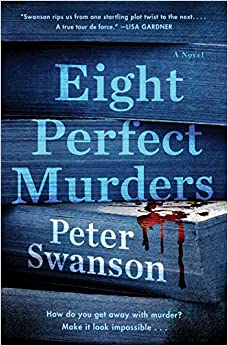
Review 1585: Eight Perfect Murders

I had a hard time rating this high-concept mystery on Goodreads, because there were things I liked about it and things I didn’t like. Overall, however, I felt it was a fast-paced novel with a love for books, especially old-fashioned crime novels.

Malcolm Kershaw has a visit from the FBI at the beginning of the novel. He is part owner of a mystery and crime bookstore in Boston. Years ago, when he first went to work there, he wrote a blog post named “Eight Perfect Murders” in which he listed eight mystery novels with near-perfect murders. Agent Mulvey has figured out that someone is using the list to re-create not the murders but the spirit of the murders. Moreover, one of the victims is someone Malcolm knew, an annoying woman who used to frequent his bookstore before she moved away. Agent Mulvey wants Malcolm to help figure out if any other deaths are related to his list.

Right away, I knew Malcolm wasn’t a trustworthy narrator, and almost immediately I guessed there would be some connection to the death of his wife, Claire. The novel takes lots of twists and turns, but I expected some of them. Still, it clipped right along, was well written, and was full of references to fiction I loved.

Why did I have trouble rating it? First, it got bogged down in the explanations at the end. The murderer explains things, and then Malcolm explains what he’s been holding back, and it’s a lot. Finally, I don’t know that I like so much these high-concept twisty-turny novels that are so popular lately, possibly because they have too many twists to be believable. They remind me of the old mysteries that are only concerned about the difficult puzzle, only with better characterization.

Then again, the book is strongly atmospheric, set in a frozen, stormy Boston, and I liked most of it. There are almost no clues about the identity of the murderer but lots of clues about Malcolm’s own secrets.

I see that Goodreads has this novel labeled Malcolm Kershaw #1. I hope that’s a mistake. I’m just saying that because of the ending. Now I bet you’re mystified. (Note: I am posting this review from my notes about six months after I read the book, and I can remember almost nothing about it. That doesn’t happen very often, so I doubt that this book is going to become a classic mystery.)

Related Posts

The Seven Deaths of Evelyn Hardcastle

Eileen

The Bone Garden

Review 1584: Milly Darrell

When Mary Crofton attends a charmless school to learn to be a governess, she is befriended by an heiress, Milly Darrell. Milly is a beautiful and good-natured girl whose life becomes complicated when her widowed father remarries.

Augusta Darrell doesn’t like Milly, but the situation changes for the worse with the reappearance in the area of a neighbor, Angus Egerton. Before he returns, the girls hear the story of his falling out with his mother after he fell in love with a girl of low birth. When his mother prevented the marriage, he swore never to return while his mother was alive and was said to have lived dissolutely. His mother dead, he returns to try to repair his dilapidated estate.

It is easy to guess that Mrs. Darrell has something to do with this story but not so easy to see how that will affect the plot. This thickens when Milly and Angus fall in love with each other.

This novella is a typical sensation work of its time. It is short and fun to read. For some reason, though, the publisher has chosen to add an alternate ending which, while not materially different from the original, is a travesty of purple prose—an indication of a lack of discrimination on their part.

Related Posts

Aurora Floyd

The Mystery of Mrs. Blencarrow

Diana Tempest