Review 1414: Lilac Girls

I would like to say to some writers, If you are going to use multiple narrators (please don’t), they must have their own voices. If they don’t sound like different people, this technique doesn’t work. Unfortunately, either Martha Hall Kelly doesn’t know this or can’t do it. I’m not talking about expressed concerns or interests here but actual tone and mode of expression.

Lilac Girls reminds me very much of Salt to the Sea. If you remember my review of that book, you know that’s not a good thing. There’s the World War II setting, the alternating chapters with different narrators, one of whom is the evil Nazi. There is also the unconvincing narrative change, the poor characterization, and the mediocre writing.

Caroline Ferriday is a New York socialite who works for the French Consulate and is involved in charities to help French children. In summer of 1939, there are already lots of refugees fleeing from France. We guess she’s going to become involved in that; however, the first hundred pages of the novel concern her growing relationship with Paul Rodierre, an actor whose wife is trapped in France. Not very interesting, since Hall doesn’t get us to care about Caroline or Paul.

Kasia Kuzmerick is a Polish teenager living in Lublin. When the Nazi attack, she witnesses their planes firing on camps of refugees. Later on, she begins running errands for the resistance.

Herta Oberhauser is a young doctor who has bought the Nazi vision despite having difficulty getting a job because women are expected to be wives and mothers. She finally gets a job working at Ravensbrück, a concentration camp for women.

Not only did I think the characterization was poor, I felt the behavior of characters was at times unlikely. For example, Kasia is old enough to understand that her mother is being forced to have an affair with a Nazi, yet she makes a dangerous public scene with her about it. Herta is an ambitious doctor who cannot find a job because she is a woman, yet she buys the ideals of the Nazi party that is keeping her down.

I admit I did not finish this novel, which was taking a long time to get anywhere (another problem with such frequent switches in narration). I read about a quarter of the book then decided to quit wasting my time. The story of Ravensbrück is important, but this writer is not up to the task.
Related Posts

Salt to the Sea

All the Light We Cannot See

The Nightingale

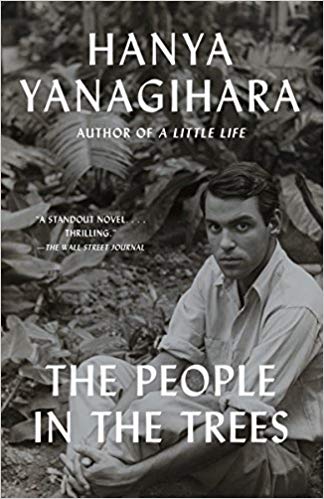
Review 1413: The People in the Trees

Best of Ten!
When everyone was reading The People in the Trees a few years ago, I didn’t think it sounded like something I’d be interested in. Then I finally read Yanagihara’s fabulous A Little Life. That made me pick up this book when I saw it again.

The novel begins with documents written by Ronald Kubodera, a coworker and acolyte of Dr. Norton Perina, a renowned scientist who won the Nobel Prize and now has been imprisoned for child molesting. Kubodera convinces Perina to write his memoir, telling his side of the story.

Just out of medical school, Perina is wondering what to do with himself. He has no intention of becoming a medical doctor, and his graduate school lab work he finds boring. He has managed to offend his laboratory boss, so he is surprised when the man recommends him for a position accompanying Paul Tallent, an anthropologist, to a remote Micronesian island.

Perina’s prize-winning work is based on what he observes on that island. Tallent takes him to the U’Ivu U’ivu Islands, an archipelago of three islands. One of them, Ivu’ ivu, is forbidden, but there are rumors of a strange animal-like people on that island. Tallent hopes to discover an unknown tribe.

The first people they discover are in a state of extreme senility, some almost totally dehumanized. When they find the village, these other people are much like other U’Ivu islanders, only there are no older people in the village.

Perina’s discovery is to figure out that the people of Ivu’ ivu can live almost eternally after eating the meat of the opa’ ivu’ eke turtle, found only on Ivu’ ivu. The downside is that something in the meat also causes increased senility. The older islanders remain physically fit but eventually lose speech and all semblance of humanity.

Perina breaks a taboo to capture an opa’ ivu’ eke turtle and smuggle it out of the country for study. He also takes with him some of the elders, whom he calls dreamers.

This novel is about the abuse of power and what it can lead to. Perina is not a sympathetic character, although he states justifications for his own actions. His view is that any scientist would have taken the turtle even though his action results in the death of a guide whom he likes. Removing the dreamers from their familiar surroundings to a lab increases their decreptitude, but Perina seems to feel no remorse or even responsibility. He is more concerned with the inevitable destruction of the lifestyle on the islands once he publishes his paper.

This is a fascinating character study of a man so driven by ambition and his own needs that he doesn’t even notice the results of his actions. Even the structure of the novel speaks to this theme of power, for Kubodera’s footnotes abound, and he cuts out an important passage from the original manuscript, included at the end of the book. Kubodera’s comment is that it shouldn’t matter. He himself is such a hero worshipper that he’s ready to excuse Perina anything. Perina attempts to tell the truth about his life, but he is so self-deluded that he becomes an untrustworthy narrator.

Yanogihara has blown me away with another terrific novel.

Related Posts

A Little Life

State of Wonder

Euphoria

Review 1412: Classics Club Spin Review! The Wise Virgins

The novel selected for me by the latest Classics Club Spin is The Wise Virgins by Leonard Woolf. This semi-autobiographical novel is partially about the courtship of Leonard and Virginia Woolf, in the characters of Harry Davis and Camilla Lawrence.

Harry and his family have just moved to the London suburb of Richstead and are shortly befriended by the Garland family, which has four unmarried daughters. Harry is disdainful of life in Richstead and of the fates of the spinster daughters, given up to good works or golf and tennis. The youngest daughter, Gwen, is naïve and gives undue weight to his discontented utterances. He amuses himself by giving her books and plays to read of Dostoevsky and Shaw.

In his art class, Harry is drawn to Camilla Lawrence, a cool beauty. When she invites him home, he finds it one of ideas and stimulating conversation. Camilla has suitors, but she is less interested in marriage than in a quest for self-fulfillment. She is repeatedly alleged to be passionless.

This novel was considered somewhat shocking in its time but was notable for examining the fates of conventional young women in Edwardian England. Harry is not a likable hero nor is Camilla very knowable. I personally did not like their glib and superior dismissal of whole classes of people. I always imagine the Bloomsbury circle snidely sniping at everyone else (and behind each other’s backs), and this novel didn’t make me rethink that idea.

This is probably taking the novel out of its time, but simply the continual reference to unmarried women by Harry as virgins irritated me to no end. He is so superior and supercilious. The introduction to the book says that “virgin” was synonymous with unmarried woman to Edwardians, but clearly for Harry there’s a sneer involved. One article I read calls Harry a truth-teller, but some of the things he says seem only designed to stir people up and make him seem more like eighteen than twenty-eight. Also uncomfortable for modern readers is the antisemitism that is accepted unquestioned by Harry and his family, who are Jewish.

Finally, there are lots of references to talking in this book, and for people who are looking for a purpose in life besides marriage and other predictable fates, they aren’t doing much actual acting. I think Woolf is pointing that out, though, by the chapter headings.

Related Posts

Mrs. Dalloway

To the Lighthouse

Flush: A Biography

Review 1411: The Crossing Places

Even though I often tire of series fiction, I still enjoy finding a promising series, and Elly Griffiths’ Ruth Galloway series is off to a good start. I selected this mystery to have a suitable review near Halloween and also for Readers Imbibing Peril.

Ruth Galloway is a forensic archaeologist who lives by the Saltmarsh near Norfolk and teaches at the nearby university. Detective Inspector Harry Nelson asks her to help him with some bones that were found on a beach near where she participated in a dig five years ago. Harry Nelson was involved in the case of the disappearance of five-year-old Lucy Downey several years ago and fears they are her bones, but Ruth finds they are from the Iron Age.

A few months later, another little girl disappears from the area. Nelson begins consulting Ruth about the case, showing her the letters he received during the first case. Now, new letters are arriving.

Around this time, friends from the dig five years ago begin to resurface. Ruth’s professor Erik travels in from Norway, and her old boyfriend, Peter, reappears.

This novel is very atmospheric, using the bleak Saltmarsh effectively as a setting. The characters also are colorful yet believable. Although I guessed the identity of the criminal fairly early, Griffiths threw in some interesting red herrings. I’ll gladly read another Ruth Galloway book.

Related Posts

The Child Garden

Quiet Neighbors

Go to My Grave

Review 1410: The Catherine Wheel

Jacob Taverner, a rich eccentric, invites some of the cousins of his extensive family to the family inn, The Catherine Wheel, for a reunion. He seems to have an ulterior motive, though, because he questions several about the stories of a hidden tunnel.

The inn has a past as a smugglers’ nest, and Detective Abbott thinks it is still so used, for drugs and stolen jewelry He asks Miss Silver to take a room at the inn to observe activities.

Jane Heron and Jeremy Taverner are among the cousins invited to the inn. It is cheaply furnished, ill kept, and creepy, and Jane’s misgivings are furthered when she recognizes Miss Silver as a detective she met before. She makes sure Miss Silver gets a room. That night, Luke White is found dead. Luke is a cousin on the wrong side of the blanket who worked as a waiter at the inn. Earlier, he was overheard telling Eily, the maid, that he was going to have her whether she wanted him or not, and if she tried to marry her sweetheart, John Higgins, one of the cousins who chose not to attend the reunion, he would murder him. Eily was discovered near the body, but so was another cousin, Florence Duke.

The dull-witted Inspector Crisp is ready to arrest John Higgins, but Miss Silver is quite certain something else is going on.

Wentworth is good at creating eccentric or likable characters, but she also telegraphs the bad guys fairly obviously, so that you know who was likely to be involved, just not why. The problem of repetition that irritated me in The Arlington Inheritance isn’t quite so pronounced in this one. Overall, the book is entertaining enough but not a great mystery.

Related Posts

The Arlington Inheritance

Mischief

Laura

Review 1409: Brookland

Prue Winship grows up the oldest daughter of a gin distiller in 18th century Brooklyn. Her father having failed to have sons, he brings her into the distillery as an apprentice when she is 14, and she learns to run it. She doesn’t expect, though, that her father’s early death will leave her and her sister Temperance in charge of it.

Despite the preoccupations of running a business, Prue has another dream—to build a bridge across the East River into New York. Many have tried to design one, but nothing has been proposed that would not obstruct water traffic for hours. Prue thinks she has an idea that would work.

This seems like it would be a book I would enjoy, but I could not get going in it. I gave it an effort, but after six days of reading, I still wasn’t into it and hadn’t reached the halfway mark. (Usually six days is enough for me to read most works of fiction, no matter how long. Often in six days I have read two or three novels.) I still had about 300 pages to read when I decided to stop. I couldn’t put my finger on my problem. The novel was well written and on an interesting subject. However, it was very slow moving and kept relating the heroine’s dreams. There is nothing more boring than a dream in fiction, I think. Finally, I dimly remember reading a book on this same subject, the distillery and the bridge, years ago, although I am fairly sure it was not this one. So, not the book for me despite its good reviews in the press.

Related Posts

Golden Hill

Seven Locks

Parrot and Olivier in America

Review 1408: Love Is Blind

Although generally speaking, I love William Boyd, I should have known better than to read a book named Love Is Blind. Even from the title, I could tell it was about a man who falls in love with a woman who is trouble, a plot that I hate. Although men love to write books upon this subject, most of the women incarcerated in the United States are there because of a man. Of course, it happens for both sexes, but a man enthralled by a lethal siren is the least of it and, for me, not interesting.

In 1894 Edinburgh, Brody Moncur is a piano tuner of significant skills. He is offered a position of assistant manager in his company’s Paris office which he takes, determined to get away from his controlling father.

In a promotional effort, Brody makes a deal with John Kilbarron, a famous pianist, to play only his company’s pianos. Soon, he has fallen in love with Lika, Kilbarron’s mistress, who is an opera singer. They begin an affair, and his life becomes a series of efforts to win her away safely from Kilbarron.

Disturbingly, we get very little sense of what Lika is like as a person. She serves pretty much as Boyd’s MacGuffin. The novel just focuses on Brody’s obsession and its consequences. It’s obvious that Lika has her secrets, and to me, it was even obvious what the major one was.

As well written as it is, I simply didn’t enjoy the theme of this book. As with Boyd’s other recent books, it takes in a sweep of history and visits many places while it meanders to its denouement.

Related Posts

Sweet Caress

Euphoria

The True Heart

Review 1407: Murder at the Vicarage – #1930Club

I decided to reread Murder at the Vicarage for the 1930 Club, but it also applies to Readers Imbibing Peril. It is the first Miss Marple book, and for much of it she seems like a minor character.

The novel is narrated by Len Clement, the vicar of St. Mary Meade. He is called away one evening by what proves to be a false call for help. He arrives home late for a meeting with Mr. Protheroe, a wealthy man who is disliked by many. In his study he finds Protheroe dead, shot in the head.

Of course, there are lots of suspects and red herrings. Mr. Hawes, the curate, is behaving oddly. Mrs. Protheroe had just decided to part from Lawrence Redding, who is in love with her. Lettice Protheroe has inconsistencies in her alibi. Rumor reports that a local poacher has a grudge. A team exploring the local barrow seems to be up to something besides archaeology.

No sooner does Inspector Slack appear on the scene when first Lawrence Redding then Anne Protheroe make confessions of guilt. Miss Marple lives next to the vicarage so has some testimony to offer about its comings and goings. And she also has some interesting ideas about who may be guilty.

Related Posts

4:50 from Paddington

At Bertram’s Hotel

A Caribbean Mystery

Review 1406: Strong Poison – #1930Club

There are those who feel that Dorothy L. Sayers ruined her Lord Peter Wimsey series with the introduction of the character Harriet Vane. I am on the fence about this. On the one hand, I don’t really enjoy Peter’s sappiness as he courts and marries Harriet. On the other hand, I like Gaudy Night, the mystery that Harriet solves herself.

I also enjoyed Strong Poison, the novel in which Harriet is introduced. Harriet, a mystery writer, is accused of poisoning her ex-lover, Philip Boyes, with arsenic. In 1930, when the book was published, no one quite understands why Harriet broke off with Philip. Philip convinced her, against her principles, to live with him without marriage, stating that he did not believe in it. Then he turned around and asked her to marry him, which Harriet views as his having tried her out. Her resulting anger seems to be the police’s motive. Lord Peter doesn’t believe it for a moment. He thinks Harriet is innocent and wants to marry her himself. Luckily, there’s a hung jury, so Peter has a month to investigate.

At first, Peter can’t get anywhere, because he can find no motive. Yet he is struck by the precautions Philip’s host at dinner took when Philip was taken ill to preserve the food. Peter is even more struck by the precautions he took not to be left alone with Philip or give him medicine when he was ill. But this host, Mr. Urquhart, Boyes’s cousin, had no opportunity to administer the poison, and Harriet did. Moreover, Harriet purchased arsenic as research for her book.

About halfway through, this mystery becomes more a puzzle about motive and opportunity than the identity of the killer. It skillfully unwinds, however, and does not cheat by hiding information from the reader.

I reread this novel for the 1930 Club and Readers Imbibing Peril, and was glad I did. I had forgotten the witty dialogue and the deft characterization.

Related Posts

Busman’s Honeymoon

Whose Body?

Unnatural Death