
 This week’s Best Book is The Rathbones by Janice Clark! Also recommended is Giants in the Earth by O. E. Rölvaag.
Author: whatmeread
Day 620: Literary Wives! The Shoemaker’s Wife
 Today is another meeting of Literary Wives, where a group of bloggers get together and review a book about being a wife. If you have read this month’s book and would like to participate, leave comments on any of our blogs. Be sure to read the reviews and comments of the other wives!
- Ariel of One Little Library
- Carolyn of Rosemary and Reading Glasses
- Emily of The Bookshelf of Emily J.
- Lynn of Smoke and Mirrors
- Naomi of Consumed By Ink
One thing I can say about The Shoemaker’s Wife. It provoked discussion in our household. After reading the novel’s first two paragraphs to my husband, I asked, “Does this qualify as purple prose?” and he answered, “It’s at least very mauve.” In any case, the novel is packed with labored metaphors, some of which leave us readers with very odd mental images—for example, a comparison of the Alps to silver daggers.
The novel is based on the story of Trigiani’s grandparents, a couple who met as teenagers in the Italian Alps and then were separated by circumstances for years. I haven’t read any of Trigiani’s other books, but along with many other writers these days, she doesn’t seem to understand in this novel that making things happen to her characters doesn’t automatically make readers care what happens to them. Her characters have traits, but they don’t have any emotional depth, so we don’t care about them.
A specific example of this comes early in the book, when the girl Enza’s little sister dies. Abstractly, the death of a child is sad, but since we barely know Enza and we just met Stella a few paragraphs before she died, we don’t feel much about it. If we had a sense of the child or the older sister, we would care more.
I was unable to finish this book, so I can’t answer the usual Literary Wives questions about it. Realizing I was not enjoying it at all, I decided to read a quarter of it and if I still felt like I was wasting my time, to stop. It is a very long book, so I read about 120 pages, and Ciro and Enza had just met by then, with Ciro banished to America immediately after. When I quit reading, Ciro was on the ship to New York. So, no answers to questions about how wives are depicted in this book, not even about the main character’s mothers. Ciro’s mother abandons her sons at a convent at the beginning of the book because she can’t support them and is never seen again, and Enza’s mother is a vaguely drawn figure who simply works hard.
All novels aren’t character driven, but for me there has to be something that makes a novel interesting besides the plot. Sometimes it’s the voice of a compelling character, sometimes a puzzle, sometimes a fascination with the subject or world view being described, but it has to be something.
 While I’m writing this, I’m thinking of examples, about how Agatha Christie could create a distinct character in a few sentences, not a nuanced one, but a distinct one nevertheless. I’m thinking how in The Secret Garden we immediately recognize Mary as an unlikable child, but we can see how the fear of waking to find everyone gone from her home in India has made her more demanding, and we sympathize. I’m thinking of how hard I cried when Beth died in Little Women. And I’m thinking how fascinated I was by 18th century Japan in The Thousand Autumns of Jacob De Zoet.
Read along with us in February, when we will be reading and commenting on The Last Wife of Henry VIII by Caroly Erickson.
Day 619: The Long Way Home
 After the traumatic ending to How the Light Gets In, Inspector Armande Gamache and his wife Reine-Marie have retired comfortably to the lovely village of Three Pines. Gamache feels none of the restlessness experienced by retired cops in other crime series, so he is not really pleased when Clara Morrow comes to him, reluctantly, with a problem.
Clara’s difficulties with her husband Peter have been growing throughout the series. The two are both artists, and their relationship was fine as long as he was the more acclaimed. But of late, Clara has gained a reputation that has surpassed Peter’s, and he has been jealous and unsupportive.
A year ago Clara asked him to leave. But she made a date with him to come back in exactly a year to see where their relationship lay. That date has come and gone, and Clara has no idea where he is. She wants Gamache to find him.
Gamache finds it easy enough to trace Peter’s movements to Paris and Venice and then, oddly, Scotland through his credit card use. They find he returned to Toronto a few months ago and then disappeared.
With Clara leading, Gamache, his son-in-law Jean-Guy, and Clara’s friend Myrna set off to find Peter, eventually ending up in a remote village at the mouth of the St. Lawrence. In their quest, they encounter a tale of madness and revenge.
This novel makes an interesting start to a new life for the series. I’m not sure how successfully it will continue, as there have been more murders per capita in Three Pines than just about anywhere. But perhaps basing the series in this small village rather than continually returning there to deal with crimes will work better, because the crimes can take place elsewhere and readers can still visit this peaceful village. I have already enjoyed some of the other novels that were set elsewhere in Canada, usually in gorgeous or interesting locations.
Day 618: Giants in the Earth
 I don’t usually read introductions until after I read a book, but I began to read the one for Giants in the Earth because I was curious about the book’s origins. I had always assumed it was an American book because it is about settlers in the Dakota territory. But in fact it was originally written in Norwegian and published in Norway in 1925 and 1926 and then translated to English in 1927, for Rölvaag came to the States in 1896 as a young man of 20.
The reason I mention the introduction by Lincoln Colcord, who translated the book with Rölvaag, is that it gives away a key plot point of the novel in the second paragraph. I couldn’t believe this, as it certainly affected how I read the novel, and it is especially egregious in that the event referred to does not happen until the very end of the book. If part of your enjoyment of a novel comes from not knowing what to expect, as mine does, do not read the introduction.
Per Hansa and his family have lost their way crossing the featureless prairies at the start of the novel. They had been travelling out with a group of Norwegians and Norwegian-Americans, but Per Hansa had difficulties with his wagon and the others went on ahead, even his best friend Hans Olsa. Then Per Hansa’s little group got lost in the fog for awhile, and now Per Hansa is afraid he might have missed the others and gone past them.
Per Hansa is an ebullient, sociable, hard-working man, and when he and his family finally arrive at the group of homesteads by Spring Creek, he is delighted with the land Hans Olsa has already marked out for him. He finds the prairie beautiful and is confident that he is going to make a wonderful life there for his family.
His wife Beret feels otherwise, and it is around her reaction that much of the novel centers. She is appalled by the prairie, this vast expanse that has not a single tree to hide behind. She soon begins to view the land as if it is some sort of godless and primitive monster, while Per Hansa sees only that it is rich and fertile.
The novel is set in the 1870’s and early 80’s and details the hardships of life so far away from any amenities. The men have to travel days for firewood in one direction and for supplies in another. Still, more immigrants keep arriving until there is a little settlement by the creek.
This is a fascinating novel about the Norwegian contribution to the settlement of the country. It is a realistic novel, not romanticized, with no big feats of heroism or villainy, just details of the life these people have chosen and its effects on them.
Day 617: Charles Dickens
 Reading this biography of Charles Dickens was very interesting to me after reading The Invisible Woman, about Dickens’ long illicit affair with Nelly Ternan. I have read biographies of Dickens before, but these two were the first I read that were forthright about some of Dickens’ inconsistencies and hypocrisies.
Renowned British actor Simon Callow puts a different spin on this book by examining Dickens’ love of and relationship to the theatre and his audience. Dickens adored the theatre and made quite a few forays into amateur theatrical productions, some of them quite large in scope, before settling on dramatic readings of his novels that were hugely successful.
It was of course during one of these productions, performances of a play he wrote with Wilkie Collins, where Dickens met Ellen Ternan, the young actress who became the focus of his mid-life crisis, which eventually ruined his marriage. She was brought in to replace Dickens’ daughter when a public performance made it improper for a young lady to appear.
This book is written in vivid and humorous style. It is entertaining and provides a view of Dickens’ career from the point of view of a theatrical background. Callow has himself played Charles Dickens more than once, most notably in a one-man performance, and is the author of nine books on theatre.
P. S. This book is sometimes titled Charles Dickens and the Great Theatre of the World.
Day 616: The Rathbones
Best Book of the Week!
The Rathbones is a strange and wonderful novel, part gothic mystery, part magical realism, about a whaling family in the 18th and 19th centuries. Mercy Rathbone is a girl, the last of a mysterious family. She lives in a massive house only partially built that used to house dozens of people. Now only her aloof mother lives there with her and her cousin Mordecai—who stays in the attic and acts as her tutor—and a few servants.
Mercy has vague memories of a brother that her mother and cousin tell her never existed. She has not seen her father for more than ten years, although packages from him occasionally arrive. She is curious about the family portraits in a gallery, all with the names removed. She knows the names of her mother and father but has no idea who her grandparents were, or how they related to Moses, the patriarch of the family.
One night Mercy is attracted by the sound of a boy singing and ventures into a part of the house where she is not allowed, the widow’s walk where her mother goes every night. There she witnesses her mother being embraced by a strange man, and that man chases her through the house. She finds refuge with Mordecai, and the two decide to go to sea to find her father. They flee in a little dory, pursued by the strange man.
So begins a wonderous adventure, where they encounter an island occupied only by old ladies; an island of rich, eccentric cousins with a massive collection of furniture and art; an island of birds occupied by a woman who only speaks bird language. At each stop Mercy learns more about the odd and sometimes grotesque history of her family, many of whom have a magical affinity for the sea.
I do not usually enjoy magical realism, but with this novel I loved never knowing where the story would go. It is an odd one, certainly, and probably not for everyone, but it is imaginative and unusual.
Best Book of the Week!
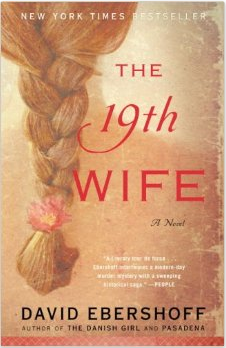 This week’s Best Book is The 19th Wife by David Ebershoff!
Day 615: The Rural Life
 The Rural Life is a collection of essays, more like musings by Verlyn Klinkenborg, a writer of the editorial board for the New York Times. Most of the essays were previously published in the Times and are related to his rural life, whether through his family history on an Iowa farm, his own farm in upstate New York, his father’s ranch in the Sierras, or travels to various western states.
I thought this would be an interesting and perhaps informative book, as I plan to be leading the rural life within a couple of years. Certainly many of Klinkenborg’s essays struck a chord with me. I liked best the pieces that do not go far from nature, whether he is discussing the care of bees, the lushness of his farm in the summer, or the beauty of a snow fall. Occasionally, he gets a little more philosophical than I am interested in.
The book is beautifully written. It occasionally confused me because it is ordered in chapters by month, and in the summer months he seems to be hopping back and forth between his farm and Wyoming. It wasn’t until a paragraph at the end that I discovered the book combines essays written over several years.
Day 614: The Bridge of San Luis Rey
 The Bridge of San Luis Rey is a moral fable that explores whether there is a purpose in life beyond that of a person’s own will. This theme is not one that interests me, nor do I usually enjoy fables, but I did enjoy Wilder’s rich characterizations in this short novel.
The novel begins in 1714 in Peru, when the bridge of San Luis Rey collapses, killing five people. A monk, Brother Juniper, believes that this event may be his opportunity for scientific proof of the will of God. So, for six years he collects information about the lives of each victim.
What follows is a chapter about each of the lives of the victims, in all their humanness and contradictions. The Marquesa de Montemayor is an ugly, rich old woman who is despised by many for her eccentricity. She obsessively loves her daughter, who has moved to Spain to get away from her, and she writes her rambling but marvelous letters that only her son-in-law reads. With her dies her young maid Pepita.
Esteban is a twin whose brother Manuel recently died. Esteban and Manuel were inseparable until Manuel fell in love with the actress Perichole, who used him to write her love letters. Ever since Manuel’s death, Esteban has been inconsolable.
Uncle Pio was a wanderer who eventually settled down to mentor Perichole, whom he raised from a young barroom singer to become a great actress. But Perichole begins to have ambitions beyond the theatre and eventually throws off Uncle Pio. Uncle Pio has devoted himself only to her, though, and promises to educate her son Jaime.
This novel is beautifully written and touching in its acceptance of the foibles of humanity.
Day 613: Brave New World
 It has been many years since I first read Brave New World, and I didn’t remember very much at all of this acid dystopian novel. It takes a bitter, satiric look into the future from 1931, and like the best of futuristic novels, is somewhat prophetic.
Bernard Marx is an unusual misfit in a society structured around the contentment of its people, or contentment as is rigidly defined there. Family units no longer exist. Society is strictly tiered. Everyone is artificially born, and the lower castes are cloned in multiples. Each caste is conditioned chemically and psychologically from before birth to be content with its lot, the mental and physical abilities of the lower castes chemically limited.
Everything is designed around productivity and consumption. People spend their leisure hours in pursuit of pleasure and get their daily dose of the drug soma. The arts are obsolete, supplanted by a very limited science.
At first it seems as though the discontented Bernard will be the hero of this novel, but there actually is none. He likes Lenina Crowne but is afraid to approach her for fear of being rejected. Lenina is a bit attracted to Bernard and is getting flak from her friends for being too exclusive of late, for there is no concept of faithfulness in this society: “everyone belongs to everyone.” So, she agrees to go with Bernard on a trip to New Mexico to view the savages—remnants of society, apparently American natives, who have not been civilized and live within a barbed wire reservation.
Lenina is too conventional a girl to enjoy this trip, horrified by the dirt and squalor of life that is not antiseptic. But Bernard, who has heard his boss’s story of a lost girlfriend in New Mexico years ago, is intrigued to find this woman, Linda, and her son John, actually born of his parent. John is an outcast of his culture, because he is the son of a woman considered a whore for behavior her own culture believes is normal. He has educated himself from Shakespeare’s complete works. Bernard gets permission to bring Linda and John back to London, setting in train unforeseen consequences.
Huxley apparently firmly believed that future societies would be controlled by drugs and psychological conditioning. It is his interest in cloning and the power of propaganda that strikes more modern readers. I’m willing to bet he paid attention to the then-current theories of eugenics that were particularly popular in England and Germany. His choice of Henry Ford as a godlike image for that society is telling not only for Ford’s invention of the assembly lines, clearly a model for Huxley’s vision of the Central London Hatchery and Conditioning Centre, but also for Ford’s own interest in eugenics.
I couldn’t help comparing Huxley’s vision of sexual freedom with that of Heinlein in Stranger in a Strange Land, a book I really hated. There are other similarities too, John the Savage almost standing in for Heinlein’s alien-born Messiah, only finally shunning what he views as an immoral society rather than trying to start a religion. I think Huxley’s ideas are much more insightful, though.
That being said, I enjoyed this re-read only moderately. I appreciate Huxley’s deadpan humor, but a late section of the book, where Mustafa Mond explains his choices in life, is a bit too much like a sort of reverse didacticism, by which I mean that Huxley is not trying to make us agree with him, but trying to show us what is wrong with Mond’s ideas (or maybe I’m wrong—I believe Huxley thought that such controls over society were inevitable). In any case, any kind of didacticism in a novel is a good thing to avoid. Still, reading this novel after such a long time was an interesting experience.

