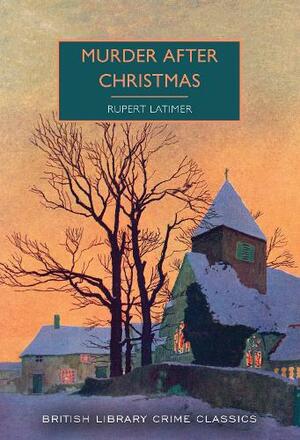
Review 2519: Murder after Christmas

There’s nothing like a nice, cozy mystery to read at Christmas time. This one is so cozy, in fact, that you don’t want any of the characters to be murderers. And what better day to post the review of a book called Murder after Christmas than New Year’s Eve?

When Rhoda Redpath invites her eccentric, elderly, very wealthy stepfather to spend Christmas, none of the Redpaths expect him to come. After all, he has never come before. Uncle Willie is nearly 90 and has lived a rambunctious life, so there are lots of people who want to meet him. Thus, when he agrees to come, the Redpaths decide to throw a real blowout, a Christmas Tree on Boxing Day, and invite everyone.

Once he arrives, his behavior is a bit odd. He eats a lot, stuffing down loads of mince pies and chocolates even though it is wartime. He gets the order of his wives mixed up, and all the Christmas packages disappear. He also starts writing his memoirs, so they have to hire a secretary.

During the party, he is hardly to be seen except when he appears dressed as Santa to pass out the packages. Frank Redpath, the host, also appears as Santa, but having been upstaged by Uncle Willie, his appearance is a bust. Then the next morning, Uncle Willie is found frozen stiff out by the snowman, still in his Santa suit. Was it a natural death or did someone murder him? When everyone learns that his wife died on Christmas day, the timing becomes very important.

Uncle Willie is found to have laudanum in his system. Nevertheless, the coroner’s hearing finds the cause of death accidental, assuming the batty old man took an overdose. Inspector Culley isn’t quite sure, so when Frank and Rhoda Redpath ask him to stay and figure out what really happened, he agrees.

Inspector Culley’s clue collection involves lots of mince pies—sewn into a chair cushion, eaten before Christmas, eaten after Christmas, packages hung from the ceiling, chocolates hidden in the snowman, and a turkey in the wardrobe—among other things. The whole thing is ridiculous and hard to keep track of, so I just went along for the ride.

Lots of fun, this one. I’ll never look at mince pies the same again.

Related Posts

The Iron Clew

Who Killed Father Christmas?

Silent Nights

Review 2518: Dean Street December! The Fledgling

Here’s another book for Dean Street December!

I have read two memoirs by Frances Faviell, but The Fledgling is the third of her three novels and the first of her novels I’ve read. For me, It wasn’t as successful as her memoirs.

One reason is the main character. He is not very appealing. I’ll explain why later.

Neil Collins is serving his compulsory military service in 1950s England. This service was apparently controversial because the country was not at war.

Neil is a fragile, small young man who gets so nervous when ordered around or bullied—which he frequently is—that he gets stupid and can’t remember how to do things. He has already gone AWOL twice and has promised his grandmother he won’t do it again.

Everyone in his unit picks on him. He thinks he has one friend, Mike, but when Mike bullies him to desert, planning to follow him and use Neil’s contacts to get to Ireland, he realizes Mike has just been using him. So Mike bullies him more until he goes. Sexual abuse is implied.

Neil shows up in his grandmother’s rooms hoping to get his twin Nonnie’s husband, Charlie, to take him to Southampton before the arrival of Mike, who was supposed to leave the next day. However, his grandmother wants to turn him in, like she did last time, and Charlie doesn’t want to help him. To make matters worse, the walls of the rooms are very thin and people keep dropping by and trying to come in. Meanwhile, unbeknownst to the family, Mike is across the street all day watching the house.

I found Neil unlikable not so much because of what he is doing but how he acts. He is like the most timid heroine in a Gothic novel. He gasps loudly when he’s hiding, he keeps raising his voice despite many warnings about the nosy neighbors. He actually falls through the door when he is eavesdropping on his grandmother and her social worker. Basically, he’s an idiot with no control over himself. He acts more like a five-year-old than a twenty-year-old.

Of course, the book is about how he gets some stuffing to brace him up, but some of the book’s values are very dated. For example, Nonnie is supposed to tolerate Charlie’s infidelity because he’s jealous of her connection with her twin. And Neil has to get in a physical fight to gain some confidence. I also didn’t really find any of the characters to be that likable.

Related Posts

A Chelsea Concerto

The Dancing Bear

The World My Wilderness

Review 2517: Dead Ernest

I very much enjoyed the Tilton books I have read so far, especially for a certain wacky energy, so when I saw that Dead Ernest filled a hole in my Century of Books project, I looked for a copy. At first, this novel was almost too frenetic for me, but either it calmed down a bit or I got used to it.

Leonidas Witherall, Tilton’s amateur sleuth, is trying to finish one of his Lieutenant Haseltine adventure novels before his publisher goes crazy, so he has asked not to be disturbed. However, telegrams keep arriving that he doesn’t look at, people keep coming to the door, and his housekeeper, Mrs. Mullet, keeps trying to tell him things he refuses to listen to. Of course, we know he should at least be opening the telegrams and listening to Mrs. Mullet.

After Leonidas sends her home, two young men show up with a truck and try to deliver a freezer. Leonidas thinks they have the wrong address and sends them next door where new neighbors are moving in. The two men come back and say the neighbors don’t want it either, but Leonidas sends them away again after they tell him that a man fixing a tire beside the road paid them to deliver it. Later, he finds the freezer shoved into his kitchen. Inside is a leg of lamb, some haddock, and a body. Leonidas is horrified to recognize it.

Leonidas recently picked up some new offices and duties. One of them involves Meredith Academy, which was taken over by the Navy during the war. Now that the war is over, the Navy has handed it back without warning. This would normally not affect Leonidas, but he was willed the school by a friend and has decided to act as head at least for the meantime. He recognizes the body as that of Ernest Finger, whom he hired as French instructor the day before.

As soon as he discovers the body, the doorbell rings. It’s a girl dressed in violet who says she was sent for his birthday. And she is determined to stay for the time she was hired even when he tells her it is not his birthday. People keep coming over, and it’s all he can do to keep his nosy neighbor, Mrs. Havershaw, from opening the freezer. Once he gets rid of all of them except Terry, the girl, he tells her what’s going on and they decide to join forces.

As Leonidas keeps getting pulled into social engagements he’s forgotten about, he continues to investigate, ruling suspects out and gaining and losing partners as he goes. This novel is funny and entertaining, and the case is ridiculous. The perfect light reading.

Related Posts

The Iron Clew

Beginning with a Bash

The Mayor’s Wife

A Century of Books! How Am I Doing? December Report

In January, I foolishly decided to join Simon Thomas’s Century of Book Challenge, even though I knew that reading 100 books, one for each year in a century, from 1925-2024, would be tough because last year I only read 169. So, how am I doing?

Here are the holes in my project with the books listed for this month below. If you want to see the details, see my Century of Books page.

  • 1925-1934: complete!
  • 1935-1944: entry needed for 1939
  • 1945-1954: entries needed for 1948 and 1950
  • 1955-1964: entries needed for 1955 and 1960
  • 1965-1974: entry needed for 1973
  • 1975-1984: entries needed for 1979, 1981, 1982, and 1983
  • 1985-1994: entries needed for 1986, 1990, 1991, 1993, and 1994
  • 1995–2004: entries needed for all years except 1998, 1999, and 2004
  • 2005-2014: entries needed for 2005, 2006, and 2007
  • 2015-2024: complete!

Since November 27, I read the following books. As we’re closing in on the end of the year, I decided to mark the ones that fill one of my holes in bold from now on. I was trying to fit in novellas for Novellas in November and some nonfiction in November, so I did poorly on this project in November. This month I tried to read mostly books for this project, but I read fewer books because of the holidays.

  • Elizabeth and Essex by Lytton Strachey from 1928
  • The Scapegoat by Daphne Du Maurier from 1957
  • Levels of the Game by John McPhee from 1969
  • A Morbid Taste for Bones by Ellis Peters from 1977
  • Cousin Rosamund by Rebecca West from 1985
  • A Girl Is a Half-Formed Thing by Eimear McBride from 2013
  • The New Life by Tom Crewe from 2023
  • The Winter Spirits by various authors from 2023

Review 2516: The Fountain Overflows

Rebecca West based The Fountain Overflows on her chaotic family life when she was a girl. I understand it is the first of an unfinished trilogy. If so, I’m interested in reading all of it.

Rose Aubrey is a daughter of an unusual couple. Her father Piers is a writer and editor whom many consider a genius, but he is a gambler who continually impoverishes his family. He has a pattern of collecting followers or benefactors who at first seem to worship him, but eventually they break with him, usually after lending him money. However, his family adores him. Her mother is a gifted pianist, formerly a famous concert performer, who is teaching Rose and her sister Mary with the expectation that they will become concert pianists, too. Their oldest sister, Cordelia, has no talent for music but doesn’t know it. She takes up the violin. Their younger brother Richard Quin is adored by all, a toddler at the beginning of the novel.

The novel covers about ten years of the family’s life. There is plenty of incident, from Mrs. Aubrey’s struggles to keep the family financially afloat to the girls’ struggles at school because they’re considered peculiar but also because they hate wasting time at school when they could be playing piano. Cordelia finds a mentor in one of her schoolteachers who encourages her in the idea that she is talented, which Mrs. Aubrey and the other girls deplore. Rose and Mary meet poltergeist activity at a friend’s house, and the family gets involved in a murder case. Also of importance is the girls’ cousin Rosamund.

It’s difficult to summarize this novel, but this family is so interesting, brilliant, chaotic, well-intended, and right behaving. I found the novel delightful.

Related Posts

Little Women

Apricot Sky

The Pursuit of Love

Review 2515: Dean Street December! The Late Mrs. Prioleau

Here’s another one for Dean Street December!

Because of the war, Susan Prioleau never meets her mother-in-law before she dies. Mrs. Prioleau seems to have kept an unhappy home, with children who left it as soon as they could, excepting Austin, her oldest son. She adored him but convinced him he is an invalid with a bad heart, which his doctor says is not true. He is immensely fat and makes his heart an excuse for doing nothing.

Susan hears stories about Mrs. Prioleau that don’t agree. She was adored by her servants of long ago, but she has written people cruel, vindictive letters. Both her daughters say she never gave them any attention, although the oldest, Nonnie, remembers a time when things were different. Her daughter Melissa disliked her, and she was estranged from her sister, Catherine, for years.

As Susan gets to know the family and helps Austin clear the house (although he won’t let her remove much), she begins to learn more about her mother-in-law’s life. Eventually, she learns about events that turned her from a selfish but warm-hearted girl to a spiteful old woman.

It’s a pity Monica Tindall only wrote one novel, because this is a good one. Although some of its secrets are easy to guess, the journey was absorbing.

Related Posts

Expiation

Which Way?

The Awakening

Review 2514: Germinal

My copy of Germinal seems to be a special edition, released in 1942 by Nonesuch Press, and perhaps part of a book club, because inside its cover is a little insert that says it is part of a series called the Ten Great French Romances. Now, I’m not so sure of the other books, although some of them don’t strike me as Romances (not even using the original definition), but poor Zola would be rolling over in his grave. Why? Because he was basically the founder of a new kind of literary movement for his time that rejected Romanticism. It was called Naturalism and is supposed to be based in science and logic and takes an impersonal stance, observing but not commenting. It also takes determinism as one of its tenets—that is, a character’s fate is determined at the get-go.

One little personal comment before my review—I received this novel as a Christmas present from my brother after unthinkingly commenting that I had never read any Zola. After I started reading it, I realized there was a reason for that.

The novel begins and ends with Étienne Lantier. He is an engine-man who has lost his job after a dispute with the foreman, and he has been traveling north looking for work. He is starving and doesn’t expect to find any.

It’s 1866, and the revolution 70 years before has helped the middle class but not the poor. Étienne travels from place to place but finds nothing.

He meets an old man nicknamed Bonnemort whose family, the Maheus, has worked for the Montsou Mining Company for generations. He ends up hanging around one of the Montsou pits, the Voreau, and so is on hand when Maheu, Bonnemort’s son, learns that his best putter has died. (I never figured out what a putter is, but now I see it’s someone who brings empty containers up to the surface and brings filled ones down to the bottom.) Étienne has just walked off, but Maheu sends his daughter Catherine after him to fetch him back and gives him a job. (Yes, women worked in the mines, too.)

Étienne is a little better educated than the miners and has been writing to a representative of Workers International. Soon, he is talking about half-understood principles of socialism and unionism to the mine workers. The Maheus, whom he takes a bed with, are barely able to feed themselves on the wages of Maheu, Catherine, Bonnemore, and Zacharie, and in fact Zacharie is being prevented from marrying because his family needs his wages. Then the unexpected demand for repayment of a debt begins a period of starvation.

Although the novel is about an actual 1866 mining strike, a strong subplot is about Étienne’s relationship with Catherine. He at first takes her for a boy, she is so young, but because a man named Chaval is pursuing her, Étienne assumes she is loose, as most of the mining women are, so they start off badly. (Modern audiences may be upset, as I was, when they find that Catherine doesn’t enter puberty until long after she is involved in a sexual relationship with Chaval.)

After a period of hardship for all the miners, the company decides on a new policy of timbering that will essentially cut the miners’ wages. Étienne becomes their leader when the miners begin negotiations to avoid a strike.

This novel is unremittingly grim. Zola digs you right in to every detail of the miners’ lives and then includes a couple of passages that contrast this with what the middle class mine managers and owners are doing. For example, the village has just emerged from a period of starvation when Zola describes a several-course dinner party at the home of Hennebeau, the mine manager. Later, when the miners are destroying the mines, Hennebeau is too wrapped up in the discovery that his wife is unfaithful to pay much attention.

Although this novel is considered a very important work in French literature, naturalism is not for me. It is too brutal.

Related Posts

Manga Classics Les Misérables

Little

The Black Count: Glory, Revolution, Betrayal, and the Real Count of Monte Cristo

Review 2513: Classics Club Spin Result! Hero and Leander: Not!

I made a mistake when I put Hero and Leander on my Classics Club list. I wanted to add a play by Marlowe, and I picked it out from a list of his works without realizing it was a long poem. Why I didn’t pick one of his plays from a volume of four that I already had, I don’t know. What I know is that long poems and I don’t get along, especially ones laden with classical illusions.

But I tried. Leander, a beautiful virginal youth, sees Hero, a nymph who has vowed to Venus to keep her virginity. They fall in love. He woos her but she is reluctant. She finally gives in. He leaves but decides to marry her.

The poem is divided into six “sestiads.” I got about halfway through the fourth one—about halfway through the poem—when I realized I had stopped knowing what was going on. I tried several times but Marlowe just seemed to be babbling on about various deities. I finally stopped.

Reading this made me remember a college paper I wrote about whether Shakespeare really wrote Shakespeare. The assumption made by people who thought he didn’t was the classist idea that he wasn’t educated enough to have such a vocabulary, but this idea reflected a lack of knowledge of Elizabethan society. He was the son of the mayor of Stratford, which didn’t put him in the first ranks of society but made his family provincial but important. True, he had no university education, but he was clearly an autodidact who was fascinated with words. And he was educated enough to be a tutor when young to a prominent family. There are contemporary references to him, and he suffered some flak for not having been at Eton or Oxford.

But just reading the various contenders’ work (of which Marlowe was one despite having died well before the end of Shakespeare’s career) told me that there was no resemblance between his style and others’. His was much more sophisticated and flowing. It’s that iambic pentameter and that word play. And all I have to say is, Roland Emmerich may know a lot about film, but he knows nothing about literature.

My apologies if I made any mistakes. This is all from my memory.

Related Posts

Edward II

Antony and Cleopatra

King Lear

Review 2512: Dean Street December! The Dancing Bear

The rate I’m knocking out books for my A Century of Books project has been slow lately because first I was reading books for Novellas in November (some of which also qualified for ACoB), and I also wanted to read at least a few books for Dean Street December. And I don’t know what I was thinking, but I also put several books for my other projects on my library reserve list, and they have arrived. I must be crazy! Anyway, I read The Dancing Bear for Dean Street.

Although The Dancing Bear is set in time after Faviell’s A Chelsea Concerto, it is actually her first memoir. It covers her time in post-World War II Berlin, where her husband was part of the Occupation. The people in the city are freezing and starving, and even their occupiers are on strict rations of many commodities.

Much of the book is about Faviell’s relationship with the Altmann family. She is being driven in her car when she spots Frau Altmann, an older lady of fragile build, trying to move a heavy cart of furnishings through the streets. Faviell’s German driver thinks it’s hilarious when she falls, but Faviell stops to help her and shames him into helping, too. Despite the dictum not to give rides to Germans, she takes Frau Altmann home in her car.

There, she gets to know Herr and Frau Altmann, two gentle and dignified older people, their daughters Ursula and Lilli, and their sulky son Fritz, a former member of a Nazi youth group against his parents’ wishes. Ursula is the only bread-winner, making money by fraternizing with the British and American soldiers. Lilli, extremely frail, is a ballet dancer.

Aside from descriptions of the living conditions and the changing situation between the Soviet and the other occupiers, much of the story is about Faviell’s relationship with the Altmann’s and with her regular driver, Stampie, who trades on the black market to keep some German families alive.

This is a fascinating account of how some people meet and overcome difficult situations and some don’t. I also wasn’t aware of the conditions in Berlin (although I had heard of the Berlin Flyover) and all the manipulation the Soviets did to try to claim the entire city from their other allies.

Related Posts

A Chelsea Concerto

In the Garden of Beasts: Love, Terror, and an American Family in Hitler’s Berlin

The Oppermanns

Review 2511: Tropical Issue

Tropical Issue is the sixth of Dorothy Dunnett’s Johnson Johnson novels, published in 1980 as Dolly and the Bird of Paradise. Somehow I accidentally am rereading these books completely out of order. (In this case, I typed in “Dunnett Johnson Johnson books in order” and then assumed that the search page, which showed me the covers, was showing me them in order. My mistake, obviously.)

Rita Geddes, a punk Scottish makeup artist, first meets the famous portrait painter Johnson Johnson when her friend Ferdy Braithwaite, a well-known photographer, borrows Johnson’s flat for a photo shoot of political journalist Natalie Sheridan and asks Rita to do the makeup. Johnson has been reported as the only survivor of a plane crash, so when Ferdy deserts her there after the photo shoot, having dismissed Johnson’s exhausted housekeeper, Rita ends up having to take care of him for a couple of days and develops a dislike of him.

Natalie offers Rita a provisional job on Madeira, where she gets to see her friend Kim-Jim again. Kim-Jim is getting ready to retire, and he has set things up so that Rita will most likely be offered his position as full-time makeup artist for Natalie. However, on her way from the airport, Rita is assaulted by a man who seems to believe that she and Kim-Jim are plotting against Natalie.

Rita figures out that her attacker is Roger van Diemen, a banana industry executive, who is supposed to be leaving the island for rehab. When she goes to the airport to make sure he gets on the plane, she meets Johnson Johnson again. Next, she, Fergy, and Kim-Jim take a sledge ride down a steep hill, a tourist offering, but the sledge has been tampered with, and they are almost killed. Finally, a death makes Rita determined to find out what’s happening.

This novel is fast-paced and includes murder, spying, piracy, a hurricane, and even an encounter with a volcano after all of the characters end up in St. Lucia. It has a complicated plot and witty dialogue as Rita tries to figure out what’s going on. And Rita has her own secrets.

Related Posts

Ibiza Surprise

The Game of Kings

Queen’s Play