
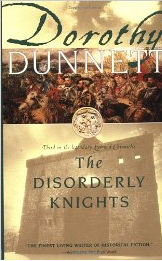
 This week’s Best Book is The Disorderly Knights by Dorothy Dunnett!
Author: whatmeread
Day 255: Anderby Wold
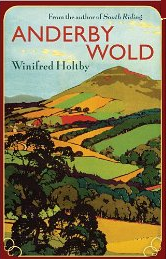 Mary Robson is a young married woman who has been working for years to save her family farm, Anderby Wold. She even married John, her much older husband, whose hard work has kept it going these past years. She is a managing woman who thinks it is her duty to oversee the welfare of the village, making herself disliked by many. Because of her preoccupations, she seems much older than she actually is.
One day she encounters David Rossiter, a young radical journalist who disagrees with everything Mary believes in. David is trying to get farm workers interested in unionizing, and Mary becomes unsuitably obsessed with the younger man. The schoolmaster, Coast, becomes involved in the unionization issue expressly to make trouble for Mary, whom he detests.
Anderby Wold is an interesting slice of Yorkshire life in the 1920’s. It reflects the issues of the times, when farmers were facing increased demand for workers’ rights. Another of Winifred Holtby’s consistent themes that appears here is getting on with life after the death of a loved one. This novel is Holtby’s first, and its realistic depictions of village life of the times reflect her background as a journalist.
Day 254: Vulture Peak
 Burdett’s Bangkok series is dark, but Vulture Peak is much more twisted than the others. Detective Sonchai Jitpleecheep of the Royal Thai Police is ordered by his powerful superior, Colonel Vikom, to investigate a triple murder in a luxurious villa on Vulture Peak, a steep hill above the seaside town of Phuket.
Sonchai realizes that this investigation is linked to Vikom’s stated intention of wiping out trafficking in body parts, part of his campaign for governor of Bangkok. But Sonchai is puzzled by two things: he has never heard before that Thailand is a center of trafficking for body parts and he doesn’t understand why Vikom wants to be governor. Still, it is certainly true that the three bodies have been harvested of every possible organ, including their faces.
Sonchai believes the murders are connected to a trip he took at Colonel Vikom’s command a few weeks before, during which he was posing as an organ merchant. He was dispatched to Dubai to meet Lily and Polly Yip, a pair of Chinese twins who are rich, spoiled, and very odd–and engaged in organ trafficking.
Soon Sonchai is enmeshed in a complicated case that involves trips to Hong Kong and Shanghai, possible involvement of Colonel Vikom’s biggest rival General Zinna, a wandering lunatic with a badly disfigured face who is raping women in Bangkok, and a schizophrenic Chinese cop.
As usual, the pace is fast, the atmosphere is edgy, the characters are interesting, and the insight into Thai and Buddhist culture fascinating.
Day 253: The Darkest Road
 I guess it’s about time for me to finish The Fionavar Tapestry series by reviewing the last book. I have avoided doing this because my notes mostly consist of comments about who I was sad about (Finn, Tabor, and Diarmuid) and who I didn’t care about (Jennifer, Darien, Dave, Paul, Kevin).
The end of the novel is, of course, an epic battle. I would actually like to read a fantasy novel that doesn’t end with an epic battle. But the crux of the matter lies with the god-child Darien, who has to decide whether he is good like his mother Jennifer or evil like his father Rakoth. Unfortunately, because Kay chose the route of having Jennifer be Queen Guinevere reincarnate, she isn’t allowed to develop as a character but is treated more as a symbol. As I stated before in my review of The Wandering Fire, I think the whole Guinevere/King Arthur/Lancelot plot is completely unnecessary.
My other significant comments are that the pace is very slow and I feel the final book, although affecting, perhaps tied up all the loose ends too neatly. I would like to close, unusually, by quoting a review from Publisher’s Weekly, because it is true and made me laugh. “The exceptionally detailed background of this fantasy would be more impressive if it didn’t suffocate a book already burdened with static narrative and turgid, poetic prose that all too fittingly captures the adolescent posturing of its transplanted college student protagonists.” You might remember my comments about the juvenile characters in my review of The Summer Tree.
The Fionavar Tapestry is a well-known work by Guy Gavriel Kay, but really, if you want to try reading him, you can do much better. Pretty cover, though.
Day 252: The Demon of Dakar
 A theme of this mystery novel is how crime affects the lives of innocent people. Manuel Alavez’s two younger brothers were lured from rural Oaxaca with the promise of money made by a fat man and a tall thin man from Sweden. Manuel turned down the offer and continued his hard labor on the family farm. His brother Angel was killed in Germany, and Patricio was arrested at the Swedish border carrying drugs he thought were important letters. Now, Manuel has traveled to Sweden to visit Patricio in prison and collect the money that was promised to him even if he failed.
Slobadan Andersson is the fat man, the owner of a restaurant named Dakar in Uppsala. He and his partner Armas, the tall man, also import and sell drugs. But Armas soon goes missing.
Eva Willman is the single mother of two teenage sons. She has been unemployed for a long time, ever since the post office laid her off, but she has heard that there is a waitress position open at Dakar. Shortly after she starts work, feeling a new sense of self-worth, she learns her oldest son Patrik was reported at the scene of the stabbing of a local drug dealer.
Johnny Kvarnheder is a chef who has just left his old life behind to start work at Dakar.
These characters and others are affected by the activities of the drug smugglers and sellers who are trying to open up the drug market in Uppsala. Ann Lindell and a host of her colleagues from several agencies end up trying to find out who murdered Armas, who stabbed the drug seller, and who is responsible for selling drugs to teenagers. At the same time, Ann still misses her ex-lover Edvard and tries to cope with the serious illness of her mentor.
This novel is more of an interesting police procedural than a mystery, since readers know who murdered Armas but don’t understand how all the pieces fit together. The fates of the Mexican men were especially compelling. One caveat is that there were far too many police officers to keep track of, which may be realistic but somewhat impedes the story.
Special Post! Best Book of the Week!
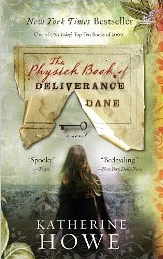 I completely forgot to post my Best Book announcement at the end of the week! This week’s Best Book (actually, last week’s) is The Physick Book of Deliverance Dane by Katherine Howe.
Day 251: The Disorderly Knights
Best Book of the Week!
The Disorderly Knights is the third novel in Dorothy Dunnett’s rousing Lymond Chronicles series. I previously reviewed the first two novels, The Game of Kings and Queen’s Play.
Upon his return to Scotland from his adventures in France, Francis Crawford of Lymond establishes a small fighting force of independent knights and begins training them. As their reputation spreads, the band begins to attract more knights, and he hears that they are to be joined by a renowned fighter, Sir Graham Reid Mallett, Knight Grand Cross of the Order of St. John. Many of the men who know Reid Mallet consider him almost a living saint. In disposition and talents he seems to be a perfect foil for Lymond, but they clash, and some of Lymond’s men begin to turn against him. As usual, Lymond’s behavior appears to put him in the wrong, and Reid Mallett seems to want to usurp the fighting force.
This conflict eventually leads to Malta, where Lymond arrives just before the Ottoman Turks attack. During the siege, Lymond becomes involved in the political maneuvering and feuds among the various national factions of the declining Order of St. John. He also hears that Oonagh O’Dwyer, the beautiful Irish rebel he encountered in Queen’s Play, is captive in another city on the island. After the siege, he follows her to North Africa in an attempt to free her.
It is difficult to write more about this novel because of spoilers, but also because the plot becomes increasingly complex from this point on, with threads that are not all explained until the sixth book. Suffice it to say that, although this is a slow-starting series, if you get this far, you will be hooked. The novel is suspenseful and exciting, and Lymond makes a complicated and compelling main character, almost an anti-hero at times. These books were written in the 1960’s and 1970’s, and I think the only series to compare with them might be George R.R. Martin’s Song of Fire and Ice or Dunnett’s own House of Niccolo series.
Day 250: The Last Detective
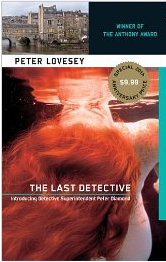 My husband and I have been enjoying reruns of the older British TV series The Last Detective on Netflix, so I picked up this book. Unfortunately, I spent the first part of the novel bemoaning its lack of resemblance to the series. Since it has a strong message of lack of trust in “new” police methods and technology instead of reliance on the police’s judgment and intuition, I also couldn’t help thinking of recent cases such as that of Michael Morton, who spent 25 years in prison for murdering his wife based on very little but a scenario invented by the police and was last year found by DNA evidence to be innocent. However, since one of Lovesey’s hero’s traits is a dogged pursuit of the investigation rather than a rush to judgment, I got over that.
The body of a woman is discovered nude in a lake near Bath. Although the police aren’t certain of the cause of death, her clothes and possessions don’t turn up anywhere, and the pathologist believes she has been asphixiated. After some time, the body is identified as that of Geraldine Snoo, a soap opera star who had been written out of the plot months before.
One obvious suspect is Gregory Jackman, Gerry’s husband and a professor of English at the local college. Detective Superintendant Peter Diamond leads the investigation, which eventually seems to point toward another suspect, Dana Didrickson, a divorcee who seems to be in love with Jackman. The mystery also involves the whereabouts of letters purportedly written by Jane Austen.
My biggest problem with the novel is one of approach. It contains two long sections narrated first by Jackman and then Didrickson that are supposedly their statements to the police, an approach very similar to that used in older detective novels like The Moonstone. The Moonstone, though, had the excuse that its statements were written ones requested by the investigator to separately verify everyone’s statements of the crime. In the context of a more modern novel, I found them completely unlikely, written as they are like prose, containing too much detail, and with few questions interjected by the police.
Once the novel gets past these sections it improves a lot, though, and becomes lively and entertaining, including a chase through the Roman baths.
Day 249: The Physick Book of Deliverance Dane
Best Book of the Week!
Connie Goodwin has just passed her orals in history at Harvard and is one thesis away from her doctorate when her advisor, Manning Chilton, challenges her to find an undiscovered primary source on which to base some subject about Colonial America. She is almost immediately side-tracked in her research by a request from her mother to sort out her grandmother’s long-abandoned house in Marblehead and sell it to pay off back taxes.
Connie finds a very old, filthy house with a gate so overgrown with vines that it’s hard to find the house. Almost immediately she has a few odd glimpses, as if she can vividly picture her grandparents and other people in the house.
While sorting through the objects and papers in the house, she finds evidence of a woman named Deliverance Dane, who was found guilty of witchcraft in the Salem trials and left behind a “recipe” book, possibly of spells. Chilton immediately begins putting pressure on Connie to find the book, as it could provide the first evidence that people were actually practicing witchcraft at that time in Massachusetts. As Connie searches for the book, she makes some astonishing discoveries about her family and herself.
Back in the 17th century, Deliverance Dane, a wise woman or healer, is called to attend a child she cannot save. When the child dies, her father accuses Deliverance of satanism.
Some small things at the beginning of the novel irritated me. In laying the foundation of some basic history, I think Howe condescends to the reader a bit too much. For example, she finds occasion to tell us what a familiar is. Although many people may assume that all familiars are cats and find out differently from this novel, I would be surprised if people didn’t know what they were, if only from remembering their grade school lessons about the Salem witch trials. But perhaps I’m wrong.
There are also a couple of instances where Connie takes awhile to figure out something that she, as a graduate history student, should already know. For example, she doesn’t immediately know that “receipt” is another word for “recipe,” and then she has to explain this term to her professor, supposedly an expert in Colonial America. I am no historian or even generally interested in this period of history, but I knew immediately what the word meant. She does the same thing with figuring out that “Deliverance Dane,” mysterious words on a piece of paper, is someone’s name, as if in all her studies of the period she never encountered such an unusual name.
It is also very easy to see where the novel is going and who will turn out to be a villain. However, I still found it interesting enough to regard it as a strong first novel, especially if you enjoy the mixture of historical fiction and the supernatural. The characters are believable, and both story lines kept my attention. The historical portion seems solidly researched.
And I won’t mention the tomatoes, because it’s just too picky.
Day 248: A Long Finish
 Aurelio Zen’s assignment in A Long Finish reflects the corruption in the Italian police force and government that is always being pointed out in these books. Zen is assigned to go to Alba not by his superiors but by a famous movie producer. The producer wants him to investigate the murder of Aldo Vincenzo, a noted winemaker–more importantly, to free Vincenzo’s son Manlio so he can get the grape harvest in and oversee the production of the wine. Vincenzo was found stabbed in his own vineyards with his genitals removed. The producer is a wine connoisseur who wants to make sure this year’s vintage isn’t wasted.
Zen finds himself in a dreamy, unfocused state, having nightmares because of several successive personal losses. Unfortunately, I’ve read the Aurelio Zen novels in an entirely random order, so I was confused about the sequence of the events in his personal life. Zen also has a severe cold, and someone is leaving him anonymous phone messages.
The first scene in the book, however, was of the murder, so the readers know that just before his death, Vincenzo encountered a trespassing truffle hunter. But which person was it? The truth may lie 40 years in the past, as indicated by the method of Vincenzo’s death, with echoes of partisan fighting during World War II, or maybe that is just a ruse.
I may be tiring a little of Aurelio Zen. I couldn’t put my finger on anything definite, but throughout this novel I got the impression that Dibdin is just trifling with his readers.

