
 I have been remiss in posting my Best Book for last week. It is The Candlemass Road by George MacDonald Fraser.
Author: whatmeread
Day 231: I Am Half-Sick of Shadows
 Another comic mystery starring the eleven-year-old sleuth Flavia de Luce, I Am Half-Sick of Shadows is the usual fun, even though the clues don’t add up until after the murderer is revealed.
Flavia’s father has rented out the house for Christmas to a film company in an effort to save the estate, since the family is so badly in debt. On Christmas Eve, the lead actors, Phyllis Wyvern and Desmond Duncan, perform a small benefit concert for the village of Bishop’s Lacey, after which everyone is snowed in by a blizzard. During the night, Wyvern is murdered, strangled to death with a length of film. This situation leaves the entire film crew and population of the village as potential suspects.
Although Flavia doesn’t know who the killer is, she becomes trapped on the roof where she has gone to shoot off fireworks and perform a scientific experiment. She has devised a super-sticky bird lime and has spread it all over the roof in an effort to capture Father Christmas, if he exists. Unfortunately, the murderer finds some reason to suspect that Flavia might be on his or her trail.
Day 230: The Candlemass Road
Best book of the Week!
At first The Candlemass Road seems like it will be a romantic adventure story similar to Lorna Doone, but George MacDonald Fraser was an expert on the border counties of England and Scotland and far too cynical for that, so it is an adventure certainly, but not a romance.
Lady Margaret Dacre has not been home to Askerton Hall in Cumberland since she was four years old, but now her grandfather Lord Ralph Dacre has been murdered and rumor has it that Lady Margaret has been sent away from court by Elizabeth I herself. At the beginning of the novel, all of the hall’s servants, including the narrator Frey Luis Guevara, a Catholic priest, are frantically preparing for her arrival.
Young and beautiful, she arrives in a temper. She has been accosted on the road by George Bell, one of her tenants, who has come to complain that he has received no help from her bailiff about the dreaded Nixon clan, who has demanded blackmail. None of Lord Dacre’s tenants have had to pay blackmail because he protected them, but after his death, his men at arms all departed.
When Lady Margaret asks Land Sergeant Carleton for protection for her people, he says the problem lays outside of his purview–he has merely come to pick up a prisoner. Incensed, Lady Margaret refuses to give him the prisoner, who was caught stealing bread and cheese from the kitchen.
The thief is a broken man–that is, one who has no master or clan–named Archie Noble the Waitabout. Lady Margaret is about to let him go free when she finds he got his horse from a famous villain, who tried to murder him in his camp. Already angered by Archie’s impudence, Lady Margaret declares him a murderer and threatens to hang him unless he goes by himself to aid the Bells, whose blackmailers return that night.
The short novel is beautifully written with dialog in a northern dialect that is still understandable, with Elizabethan expressions thrown in. The novel is an exciting yet chilling and occasionally humorous picture of the time and place.
Day 229: Death Without Company
 Lucius Connally, the ex-sheriff of Absaroka County and Walt Longmire’s old boss, asks Walt to look into the death of an old Basque woman named Mari in an assisted-living home. Before he even finds out she was poisoned, Walt discovers she used to be Lucius’s wife. Her brute of a second husband, who left the family in the 50’s, does not respond to phone calls.
In investigating the crime, Walt is brought into the life of the Basque sheepherders. He finds himself chasing a mysterious large man and rescues the old woman’s granddaughter after she is attacked in her own bakery.
With a backdrop of the stunning Wyoming vistas and the usual recurring characters, the Longmire series continues to be entertaining.
Day 228: The Night Circus
 It is the mid-19th century. Prospero the Enchanter raises his daughter Celia Bowen as if she were an apprentice magician, only it is not magic she is working. Continuing an ancient disagreement, Prospero challenges the man in the gray suit to a competition–his daughter against any opponent. So, the man in the gray suit takes a young boy out of an orphanage.
Both children grow up training for this elusive competition, and when they are adults, the man in the gray suit collaborates in creating the Night Circus and sends his protégé Marco to work for its designer. Soon Celia is employed by the circus as an illusionist, and Celia and Marco take up the competition with no understanding of its rules. Celia doesn’t even know who her opponent is.
The Night Circus is a marvelous place, all white and black and gray, constantly growing and changing. It becomes the venue for and creation of the competition.
The Night Circus has been extremely popular, and it seemed like it was right down my alley. However, although it is entertaining enough and is certainly based on an original idea, at some point my interest began flagging.
I think one major problem of the novel is that we are constantly told how wonderful the circus is, but Erin Morgenstern fails to describe it in a compelling way. Descriptions are vague instead of specific enough for readers to imagine a scene. In two or three consecutive pages, for example, I just happened to notice that Morgenstern used the word “elaborate” five or six times with no attempt to describe each object beyond that word. The details she does divulge don’t sound as if they would be that interesting, and frankly, a black, white, and gray circus seems to be the invention of a person more concerned with style than enchantment. An important part of a circus is the vibrancy of color. I felt no sense of wonder, was never surprised or beguiled, and I was occasionally confused, especially concerning the “wonderful coalescence” described in one scene. What does that mean? Although the competition turns out to be about life and death, I also never felt any sense of danger.
Another problem for me is the fable-like quality of the novel, which treats the characters more emblematically than as real people. You feel some sympathy for Celia and Marco, but you don’t know what they are like. Overall, I found the novel mildly disappointing.
Day 227: At Bertram’s Hotel
 Miss Marple’s nieces and nephews don’t have much luck sending her off for a rest. At her niece’s expense, she is spending a week at Bertram’s Hotel, a place she remembers from her childhood. Although at first the hotel seems exactly the same as it was when she was young, Edwardian in appearance and yet offering every comfort despite the intercession of the war, Miss Marple can’t help feeling something isn’t right.
Another guest at the hotel is the dashing Bess Sedgwick, who has lived a life of excitement and glamor. By coincidence, her daughter Elvira, whom she deserted at the age of two, also is staying there. Soon Miss Marple has spotted them meeting separately with the notorious race car driver Ladislaus Malinkowski.
Befuddled Canon Pennyfeather goes to the airport to fly to his conference in Switzerland on the wrong day. Returning unexpectedly to his room at Bertram’s, he opens the door to find–something–but is knocked out and disappears.
In the meantime Chief Inspector Davy is investigating a huge crime network responsible for a series of robberies. In two of the incidents a witness claimed to see a reputable citizen who was actually somewhere far away from the crime at the time, but both of these men were staying at Bertram’s Hotel.
And soon there is a murder to solve. As with much of Agatha Christie’s work, the plot is overcomplicated and somewhat silly. Still, At Bertram’s Hotel is a lot of fun.
Day 226: I Curse the River of Time
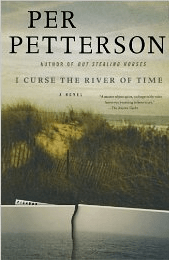 I Curse the River of Time is a sad book about Arvid Jansen, a man trying to cross a divide between himself and his dying mother. At the same time his marriage is failing and the Berlin Wall is coming down. Things are coming to an end in his life.
Jansen remembers decisions he made, particularly the one to leave university and join the Communist party. As the wall falls, he considers his loss of faith in the party.
In contemplating his failing marriage, he also remembers his courtship of a young girl, although it is not clear whether he is thinking about his wife. He goes to his mother’s home country of Denmark, to a beach house where his family spent the summers, and recalls his childhood bond with his mother.
The novel is moody and inconclusive, and for some reason I kept expecting it to become sinister, although it did not. Even though the novel is focused around his attempts to reconcile with his mother (although that is perhaps not the correct word since there has not been a falling out–she is simply cold and unresponsive to him), it seems to me that Jansen thinks about her too much, is too obsessed with her.
The writing is excellent, spare but full of details. However, the entire feel of the novel is tenuous. There does not seem to be much to fasten onto.
Special Post! Best Book of the Week!
 This week’s Best Book is The Hare with Amber Eyes: A Hidden Inheritance by Edmund de Waal.
Day 225: The Devil All the Time
 Truly gritty noir seems to come out of rural settings these days instead of the city. Such is the case with The Devil All the Time by Donald Ray Pollock.
Arvin Russell is having a tough childhood in the backwoods town of Meade in southern Ohio. His mother is dying of cancer, and his grief-crazed father Willard has set up a “praying log” where he sacrifices animals and makes Arvin pray for hours on end. When his mother dies, his father commits suicide by hanging himself at the praying log.
Back in Willard Russell’s home town of Coal Creek, Virginia, Brother Roy Laferty is a preacher who eats bugs for the glory of God and travels around with his crippled friend Theodore, a gay pedophile. Roy marries Helen, the woman Willard’s mother wanted him to marry, but later, egged on by Theodore, he murders her. The two start off on a spree of serial killing.
As Arvin grows up in Coal Creek with his grandmother, another couple from Meade haunts the highways of the midwest. Carl and Sandy Henderson pick up hitchhiking men. Carl has Sandy seduce them so that he can murder them and take photographs of Sandy with their bodies.
Lee Bodecker, the policeman who accompanied Arvin back to his father’s body when he was a boy, is now the corrupt sheriff of Meade, Ohio. He knows his sister Sandy is a prostitute but is unaware of her more sinister activities with Carl.
Now grown, Arvin has spent his high school years protecting his unattractive, devout cousin Leonora from the taunts of his school fellows. The town is excited because of the arrival of the new preacher, Preston Teagardin, a nephew of the dedicated Reverend Sykes. But Teagardin is not quite as dedicated as his uncle, and he also has an eye for the young girls. He decides that a naive, religious girl might be a good place to start.
The fates of all these people are soon to converge in a way that won’t be pretty. The flavor of the grotesque and perverse echoes of Flannery O’Connor and other Southern Gothic writers. With hardly a redeeming character to be found, we have to wonder if Pollock is simply revelling in his ability to produce such depravity.
Day 224: The Happy Foreigner
 The Happy Foreigner by Enid Bagnold is interesting as a record of conditions in France right after World War I. In fact, at the time of its publication (1920), it was lauded for its journalistic qualities. The book is almost certainly quasi-autobiographical, although it was published as fiction.
Fanny is a British girl who volunteers to drive for the French army right after the war. In many places the villages are completely destroyed, and very little food is available. The driving is difficult and hazardous. Fanny and the other girls live in a shack with paper-thin walls, a leaky roof, and mud on the floor, and sleep on stretchers supported by sawhorses. From there, she is transferred closer to Germany, where she lives more comfortably in a town with more gaeity. It is ironic that the Germans seem to be in better shape economically and their towns less ravaged after the war than the French.
As well as a true depiction of the time and place, the novel is about the entrance of women into areas of work that had previously belonged solely to men. When Fanny first enters the dining room of an underground fortress in Verdun, her second posting, all talk ceases, as most of the men have not seen a woman in years. Later when she is assigned to drive for a Russian Colonel, she must address his doubts about her capabilities before he will let her drive.
Fanny meets a French officer, Julien, and they fall in love, but their relationship is one of the oddest things in this unusual, almost telegraphically written book. They are both so leery of each other that their dealings with each other are very tenuous.
I was a little disappointed that Bagnold chose to anchor this tale around a romance, no matter how odd, as it seemed a hackneyed idea, but I suppose that given the circumstances of just a few women among a huge number of men, that was an inevitable choice.

